Water Sort Puzzle
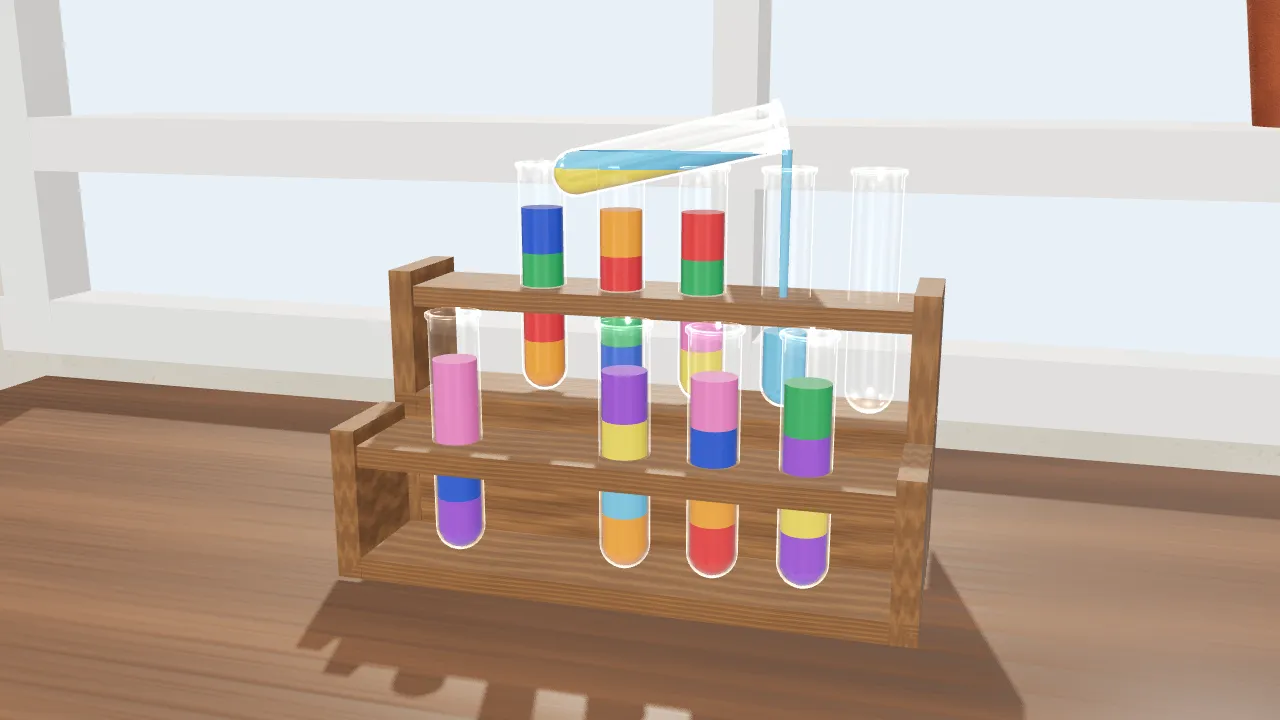
Pour coloured water between glass tubes until each holds one colour.
On Amazon.in. As an Amazon Associate I earn from qualifying purchases.
How to play
- Tap a tube to lift it, then tap another tube to pour. The top colour runs across, as many matching layers as will fit.
- You can only pour onto the same colour or into an empty tube. A tube filled with four layers of one colour is finished and gets a cork.
- Stuck? The wooden tokens on the table help: Undo (five times a level), Restart, and + Tube for one extra empty tube each level.
- When every tube holds a single colour, tap Next level for more colours. Tap Today for the daily puzzle, the same for everyone on the same day.
Challenges
- Solve a level: every tube holds a single colour
- Solve a level with five or more colours without using Undo
- Solve today’s daily puzzle
Try this
- Before you pour, look for a colour that is already on top of two tubes. Bringing those together frees a tube and often opens up the whole puzzle.
- Try to keep one tube empty for as long as you can. An empty tube is the most useful thing on the table, because anything can go into it.
- Watch a tube as it pours: the water surface stays level while the glass tips, and the tube tilts further and further as it empties.
Fun facts
- Real coloured water poured onto water does not stay in a neat layer. The stirring of the pour mixes it at once, and the dye then keeps spreading by diffusion.
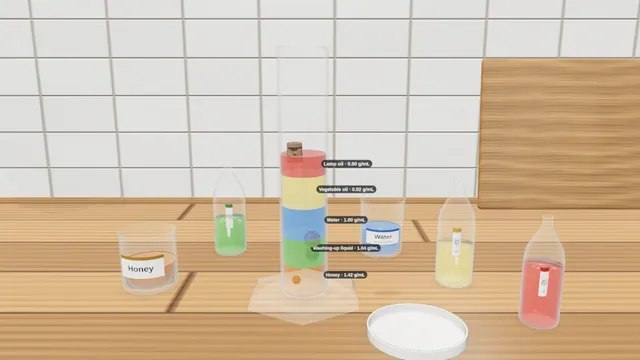
- Liquids stay in layers only when the lower one is denser, as in a density tower made with sugar or salt solutions of different strengths.
- A small dye molecule needs many hours to spread a centimetre through still water by diffusion alone, but a stir mixes it in seconds.
- Every level here is dealt at random and then checked by a computer search for a way to solve it before you see it.
Sorting liquids: diffusion, density and a puzzle you can always solve
The tubes in this puzzle behave the way we wish real liquids would: red poured onto blue stays a neat red layer, ready to be poured away again. Real coloured water does not, and the reasons are some of the most useful ideas in chemistry.
Why real colours would mix
Two portions of water dyed different colours have almost exactly the same density, so nothing holds one on top of the other. The pour itself stirs them: a falling stream carries the new water deep into the old, and the swirls mix the two within seconds. Even in perfectly still water the colours would not stay apart. Dye molecules are always being jostled by the water molecules around them and wander at random, which is called diffusion. It is slow over large distances, many hours for a centimetre, but it never stops, so a sharp boundary between two colours slowly blurs into a smooth fade.
How density keeps layers apart
Layers survive when the liquids have different densities and the densest is at the bottom. Dissolve a lot of sugar in one batch of water and less in another, and the stronger solution sinks below the weaker one. Pour gently and you can stack several colours, as in the density tower on this site. Gravity pulls the denser liquid down, so a disturbed boundary sinks back into place instead of mixing. Diffusion still works across the boundary, but slowly, so a careful tower lasts for hours.
Volume is conserved
Pouring never creates or loses water. Every pour simply moves some of the equal portions from one tube to another, so the total never changes. When a tube tips, its water stays level with the floor while the glass turns around it. The tube pours as soon as the level surface reaches the lip, which is why a nearly full tube starts pouring after a small tilt and a nearly empty one has to tip right over.
A puzzle with a guaranteed answer
Every arrangement of the tubes is a position, and every legal pour leads to another one. Solving the puzzle means finding a path through this network of positions to one where each tube holds a single colour. The game deals the colours at random, then a computer search explores the network. Only a deal with a path to the end is used, so every level and every daily puzzle can be solved.
For the curious
Diffusion spreads a dye a typical distance x ≈ √(2Dt) in time t, where D is the diffusion coefficient. For a small dye molecule in water D is about 5 × 10⁻¹⁰ m²/s, so spreading 1 cm takes t ≈ x² / (2D) ≈ 10⁵ s, roughly a day. A layer of density ρ1 rests stably on a denser one, ρ2 > ρ1, because lifting a small parcel of the denser liquid by a height h costs potential energy (ρ2 − ρ1)·g·h per unit volume. In a tube of radius r tilted by θ, the water level stays horizontal, and the tube starts to pour when the surface reaches the lowest point of the rim, at height L·cos θ − r·sin θ above the bottom, where L is the length of the tube.
Questions people ask
Would real coloured water stay in layers like this?
No. Water coloured with dye has almost the same density whatever its colour, so the pour stirs the layers together and diffusion slowly blends what is left. Layers last only when each one is denser than the one above it, as in a density tower.
Is every level solvable?
Yes. Each level is dealt at random and then checked by a computer search that looks for a sequence of legal pours ending with one colour per tube. If it finds none, the deal is thrown away and a new one is made. The extra tube and Undo are there to make it easier, not because you need them.
What is the daily puzzle?
Tap Today on the table. The puzzle is made from the date, so everyone who plays on the same day gets the same one. Solve it and the token shows that it is done for today; a new one arrives tomorrow.