Red Cabbage pH Rainbow
Pour household liquids into cabbage juice and make a pH rainbow.
How to play
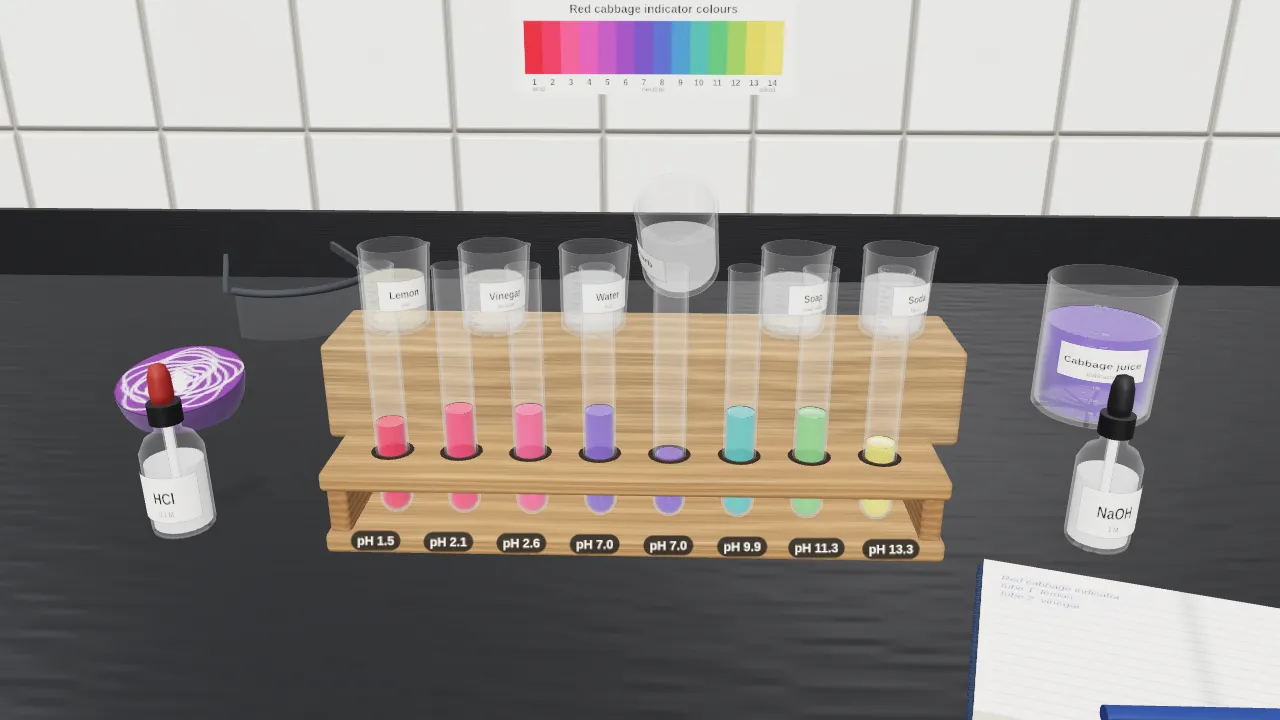
- Drag a small beaker over a test tube and keep pushing: it tips, and the liquid pours over the lip. Tip it gently for a trickle, further for a stream.
- Drag a dropper out of the acid (HCl) or alkali (NaOH) bottle and hold it over a tube to add drops.
- Tap any tube to read its pH and what has gone into it. The pH label under each tube updates as you pour.
- Try the three Challenges, or open Lab for Make the rainbow and Rinse all tubes.
Challenges
- Turn a tube of cabbage juice red with an acid
- Make five different colours along the rack
- Turn a tube red with acid, then bring it back to purple with a base
Try this
- Add vinegar to the baking-soda tube. It fizzes as carbon dioxide escapes, and the colour swings from blue back towards pink.
- Add soapy water to a water tube a few millilitres at a time. Small additions move the colour more near neutral than you might expect.
- Compare lemon juice with hydrochloric acid. Both look red, but the acid is about ten times more acidic: one pH unit is a factor of ten.
Fun facts
- The colour comes from anthocyanins, the same family of pigments that colours blueberries, red grapes and many flowers.
- Each step of one on the pH scale is a tenfold change in hydrogen-ion concentration, so pH 3 is ten times more acidic than pH 4.
- Pure water at 25 °C has a pH of 7, because it splits very slightly into equal amounts of H⁺ and OH⁻ ions.
- The pH scale was introduced in 1909 by the Danish chemist Søren Sørensen at the Carlsberg Laboratory in Copenhagen.
One pigment, a whole rainbow
Chop a red cabbage, soak it in hot water and you get a purple juice full of anthocyanins. These pigment molecules are sensitive to acid: they gain or lose hydrogen ions (H⁺), and every time they do, their shape and the way they absorb light changes. That makes cabbage juice a natural pH indicator.
In strong acid the pigment holds on to an extra hydrogen ion and looks red. As the solution becomes less acidic it turns pink, then purple around pH 5–6 and violet near neutral. In mildly alkaline solutions it loses hydrogen ions and turns blue, then blue-green. In strongly alkaline solutions the molecule’s ring opens up and it becomes yellow; green appears where blue and yellow forms are mixed.
What pH measures
pH is a measure of how many hydrogen ions are free in a solution. Acids such as lemon juice (citric acid) and vinegar (acetic acid) release them. Bases such as baking soda, washing soda and soap mop them up. Because the numbers involved are tiny and vary enormously, chemists use a logarithm: pH = −log₁₀[H⁺]. Pure water has [H⁺] = 10⁻⁷ mol/L, so its pH is 7.
Lemon juice and vinegar are weak acids: only a small fraction of their molecules give up a hydrogen ion at any moment, so lemon juice sits around pH 2 and vinegar around 2.5 rather than lower. Baking soda (sodium bicarbonate) settles near pH 8.3, and washing soda (sodium carbonate) near 11.5. Hydrochloric acid and sodium hydroxide are strong, so even fairly dilute solutions reach the ends of the scale.
Mixing, buffers and fizz
When you pour one liquid into another, the acids and bases react. Some mixtures resist change: baking soda soaks up added acid, so the colour shifts slowly at first. That resistance is called buffering. Add enough vinegar, though, and the bicarbonate turns into carbonic acid, which breaks down into water and carbon dioxide: the fizz you see.
For the curious: how the tubes are calculated
Each tube’s pH comes from a charge balance: the positive charge of H⁺ and sodium ions must equal the negative charge of OH⁻ and of every acid that has given up hydrogen ions. Each weak acid is described by its pKa values (acetic 4.76; citric 3.13, 4.76 and 6.40; carbonic 6.35 and 10.33), and the simulation searches for the [H⁺] that balances the books, using the water constant Kw = 10⁻¹⁴. Carbonic acid above its solubility escapes as bubbles. It is a simplified model: household liquids are idealised and activity corrections are ignored, but the shape of the behaviour is real.
Safety
Cabbage juice, lemon juice, vinegar and baking soda are safe kitchen chemistry. Hydrochloric acid and sodium hydroxide, and products such as drain or oven cleaner, burn skin and eyes: in this experiment they stay virtual. Please read our disclaimer before trying real experiments.
Questions people ask
Why does red cabbage juice change colour?
It contains anthocyanin pigments that gain or lose hydrogen ions depending on how acidic the solution is. Each form of the molecule absorbs different colours of light, so the juice looks red in acid, purple near neutral and blue, green or yellow in alkaline solutions.
What pH is vinegar?
Household white vinegar, about 5% acetic acid, usually has a pH of around 2.5. Acetic acid is a weak acid, so only a small fraction of its molecules release hydrogen ions at any moment.
Is red cabbage indicator safe to make at home?
Yes. It is just cabbage soaked in hot water, with an adult handling the hot water. Test it with kitchen liquids such as lemon juice, vinegar and baking soda solution, and avoid strong cleaners, which can burn skin and eyes.