Flame Test Colours
Hold metal salts in a Bunsen flame and read their spectral lines.
How to play
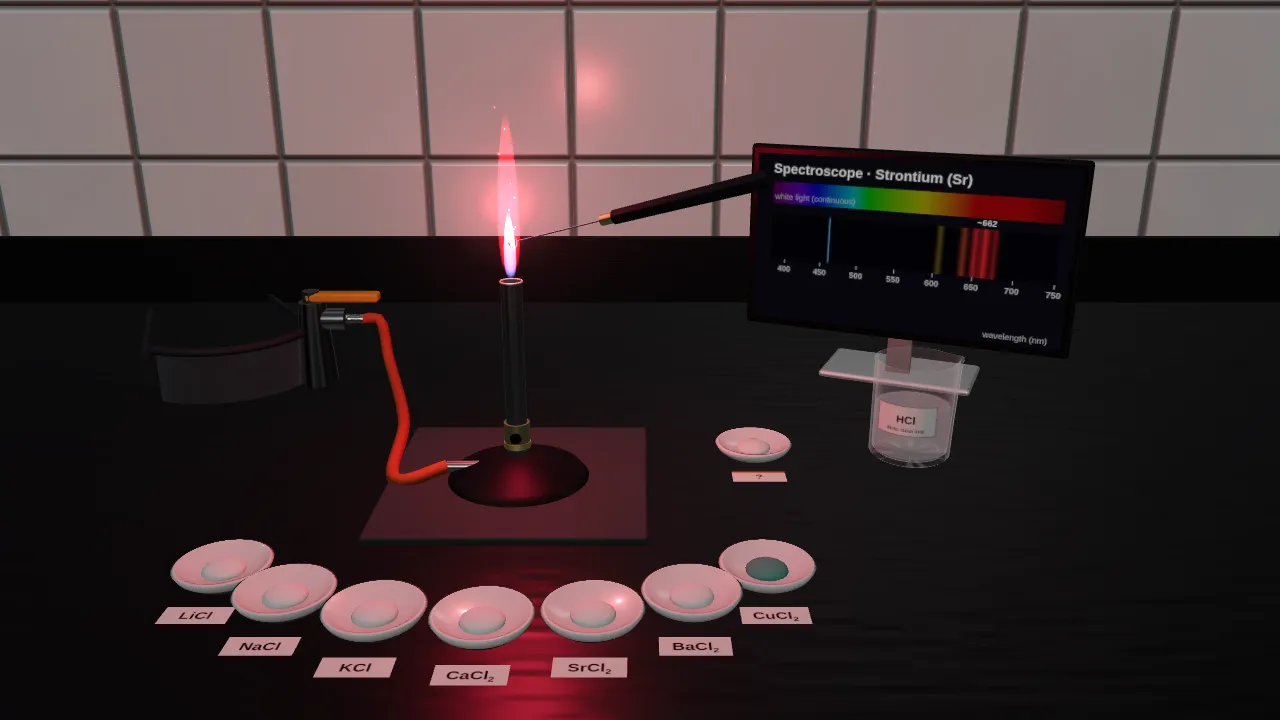
- Drag the yellow lever of the gas tap to turn the gas on: the Bunsen burner lights.
- Drag the brass collar on the burner sideways to open the air hole. Closed gives a yellow, sooty flame; open gives a roaring blue one.
- Drag the wire loop into a dish of salt, then hold it in the flame. Dip it in the acid beaker to clean it between salts.
- Read the spectroscope panel: each bright line is one exact colour of light. Try the three Challenges, or open Lab.
Challenges
- Light the burner and open the air collar for a roaring blue flame
- Compare the two reds: hold lithium and strontium in the flame
- Test the salt in the dish marked ? and name the metal
Try this
- Test sodium, then potassium. Sodium’s yellow is so bright that, in real labs, a trace of it can hide potassium’s faint lilac.
- Compare lithium and strontium. Both look red to the eye, but their spectra are completely different.
- Close the air hole. The flame turns yellow and smoky, and the spectroscope shows a continuous band instead of lines.
Fun facts
- Sodium’s yellow comes mainly from two lines very close together, at about 589.0 and 589.6 nanometres: the sodium D lines.
- Fireworks get their colours from the same metals: strontium for red, barium for green and copper for blue.
- Robert Bunsen and Gustav Kirchhoff discovered caesium (1860) and rubidium (1861) by spotting new lines in flame spectra.
- Orange sodium-vapour street lamps glow with the same D lines you see in a sodium flame test.
Every metal has a colour signature
Heat a metal salt in a hot flame and some of its electrons are knocked up into higher energy levels. They don’t stay there: within a tiny fraction of a second they drop back, and each drop releases a photon, a packet of light. The energy levels in an atom are fixed, so the drops are too, and each metal gives out only certain wavelengths. That is why lithium glows crimson, sodium yellow-orange, potassium lilac and copper blue-green.
Reading the lines
The colour your eye sees is a blend. A spectroscope separates it, spreading the light out by wavelength so each energy jump becomes a sharp bright line. Sodium shows its famous yellow pair near 589 nm. Lithium has a strong red line near 671 nm. Potassium’s strongest lines sit at the very edge of human vision, deep red near 766–770 nm and violet near 404 nm, which is why its flame looks a soft lilac. Some flame colours come partly from short-lived molecules made in the flame, such as calcium and strontium hydroxides; these give fuzzier bands rather than sharp lines.
Because every element’s pattern is unique, spectra work like fingerprints. The same idea lets astronomers read the chemistry of stars billions of kilometres away, and helium was first found in the Sun’s spectrum before anyone found it on Earth.
The Bunsen burner
With the air hole open, gas and air mix before burning, the fuel burns completely and the flame is pale blue, quiet and very hot (well over 1,000 °C). Close the hole and the gas burns short of oxygen: tiny specks of soot glow yellow, like a candle flame. Hot solids glow with a continuous spread of colours, so a luminous flame is useless for flame tests. Chemists use the blue flame.
For the curious: photon energy
A photon’s energy depends only on its wavelength: E = hc / λ, where h is Planck’s constant and c the speed of light. A handy form is E (in electronvolts) ≈ 1240 / λ (in nanometres). Sodium’s 589 nm line carries about 2.1 eV, exactly the gap between two of sodium’s energy levels. The simulation draws each metal’s main lines at their measured wavelengths, and fades the colour away exponentially as the salt evaporates from the loop.
Safety
Real flame tests use an open flame and hydrochloric acid to clean the wire. Barium and copper salts are toxic, and lithium and strontium salts are harmful if swallowed. They belong in a school or university lab with goggles and a supervising teacher. Please read our disclaimer.
Questions people ask
Why do different metals give different flame colours?
Heat lifts electrons in the metal atoms to higher energy levels. When they fall back they emit light of exact energies, and those energies are different for every element, so each metal produces its own set of colours.
Why is potassium’s flame colour hard to see?
Potassium’s strongest lines are at the edges of human vision, so its lilac is faint, and even a trace of sodium produces a yellow bright enough to swamp it. Chemists often look through blue cobalt glass, which blocks the sodium yellow.
Why does the flame turn yellow when the air hole is closed?
Without enough oxygen the gas burns incompletely and forms soot. The hot soot particles glow yellow with a continuous spectrum, like a candle flame, which would hide the line colours of a flame test.