Soda Geyser
Drop mints into a cola bottle and launch a foaming fountain.
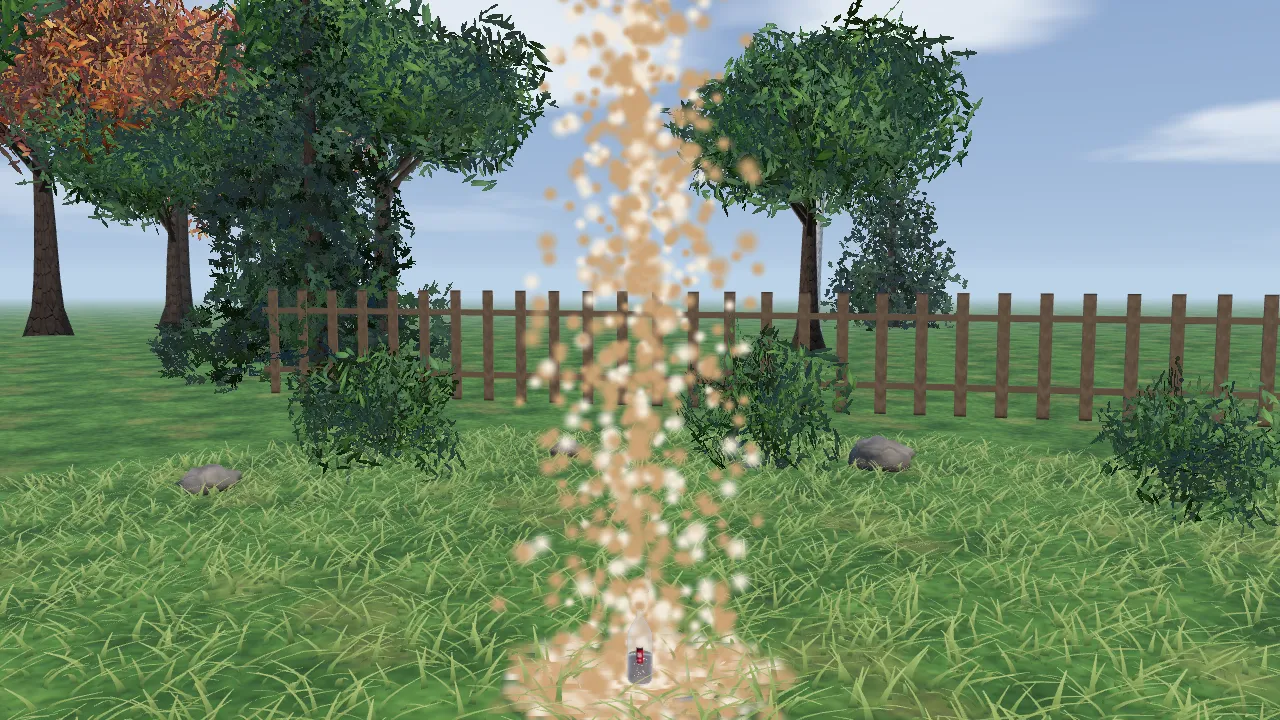
How to play
- Tap the blue pack of mints to load them into the clear tube (up to eight).
- Drag the tube over the open bottle and let go: the mints drop in and the fountain launches.
- Drag the white geyser nozzle onto the neck to narrow the jet, or drag it off again.
- Try the three Challenges, or open Lab to change the drink and its temperature. Fresh bottle sets up again.
Challenges
- Drop the mints into the cola and launch a fountain
- Make a fountain more than three metres tall
- Fit the geyser nozzle and beat your best open-bottle height
Try this
- Launch with one mint, then with eight. More mints mean more places for bubbles to start, so the gas escapes faster.
- Compare diet cola, regular cola and carbonated water at the same temperature and see which fountain goes highest.
- Try cold (4 °C) and warm (35 °C) cola. Warm drinks give up their gas more readily.
Fun facts
- Bubbles need a starting point such as a scratch, a speck of dust or a rough surface. Scientists call these nucleation sites.
- The eruption is physical rather than chemical: no new substances are made, the dissolved carbon dioxide simply escapes.
- Fizzy drinks are bottled under pressure, which forces extra carbon dioxide to dissolve in the liquid.
- Warm drinks hold less dissolved gas than cold ones, which is one reason an opened warm bottle goes flat faster.
Why a mint makes cola explode
A sealed bottle of cola holds several grams of carbon dioxide dissolved in every litre, forced in under pressure at the factory. Open the cap and the pressure drops. The drink now holds far more gas than it can keep at normal pressure: it is supersaturated. It wants to lose that gas, yet it fizzes only gently. Why?
Bubbles are hard to start
A brand-new bubble has to push the liquid apart, and at very small sizes surface tension squeezes it so hard that it simply dissolves again. Bubbles therefore grow from nucleation sites: tiny scratches, specks of dust or pockets of trapped air where a bubble can get a head start. A smooth bottle offers few sites, so the gas trickles out.
A mint is a different story. Under a microscope its surface is pitted and rough, covered in an enormous number of nucleation sites. Mints are also dense, so they sink straight to the bottom and bubbles form all the way down the bottle. Gas floods out at once, and the rising froth has only one exit: the narrow neck.
What changes the height
More mints mean more sites and a faster release. Warm drinks give up their gas more easily than cold ones. Diet cola usually gives a taller fountain than regular cola; one explanation is that its sweetener and preservative lower the surface tension, which makes bubbles easier to form. A narrower nozzle speeds the jet up further, which is why people use geyser caps.
For the curious: the model
How much gas a liquid can hold follows Henry’s law: dissolved gas is proportional to the pressure of that gas above the liquid, C = kH·p. In the open air there is almost no carbon dioxide pressing on the drink, so nearly all of it is surplus. The simulation releases it at a rate proportional to what is left, dC/dt = −k·N·C, where N is the number of mints and k depends on the drink and its temperature. The gas flow Q (litres per second, from the ideal gas law) pushes foam through the neck at speed v ≈ Q / A, and the fountain rises to about h = v² / 2g. One tuned factor accounts for the energy lost to foam and friction, so the heights are typical rather than exact.
Safety
Do it outdoors, aimed away from people, cars and windows, and wear eye protection: the jet is fast and sticky. Never put the cap back on after adding mints. Please read our disclaimer before trying the real thing.
Questions people ask
Why do mint sweets make cola erupt?
Cola is supersaturated with carbon dioxide once it is opened, but bubbles need a rough surface to start on. A mint’s pitted surface provides a huge number of these nucleation sites, so the dissolved gas escapes almost all at once and pushes the drink out of the bottle.
Does diet cola work better than regular cola?
Usually, yes. Diet cola tends to give a taller fountain. A common explanation is that its sweetener and preservative lower the surface tension, making it easier for bubbles to form.
Is the soda geyser a chemical reaction?
No. Nothing new is made. Carbon dioxide that was already dissolved in the drink comes out as gas, so it is a physical change driven by nucleation.