Iodine Clock Reaction
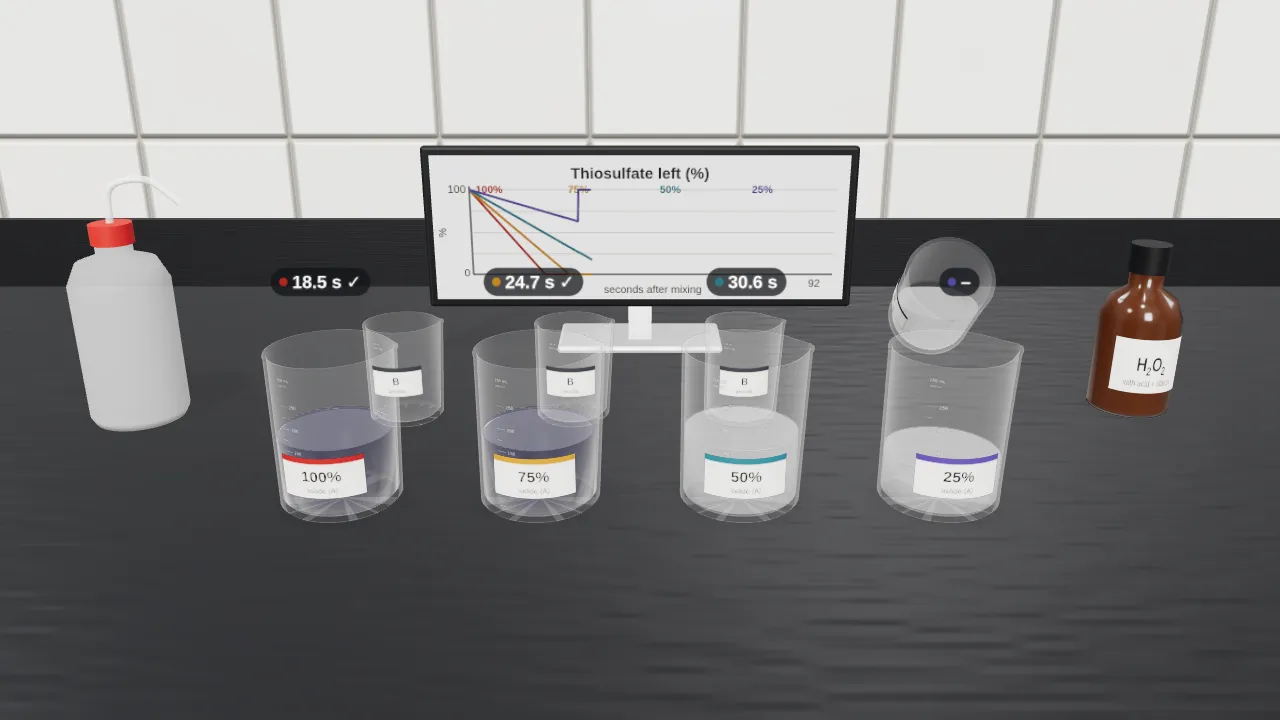
Pour solution B into four beakers and see them snap to blue-black.
How to play
- Drag a small beaker of solution B over one of the big beakers and keep pushing to tip it in. That clock starts the moment the two meet.
- Watch the timer above each beaker. Nothing seems to happen, then the mixture snaps to blue-black.
- Start the other beakers: they hold 75%, 50% and 25% as much iodide. Tap a beaker for its predicted time.
- Try the three Challenges, or open Lab to change temperature, iodide and thiosulfate.
Challenges
- Pour solution B into a beaker and wait for it to turn blue-black
- Start all four clocks and watch them switch in order
- Predict how much longer the 50% beaker takes than the 100% one
Try this
- Look at the four times. The 50% beaker takes about twice as long as the 100% one, and the 25% beaker about four times as long.
- Double the thiosulfate. Every clock takes twice as long, because there is twice as much iodine to mop up first.
- Warm the mixture from 20 °C to 30 °C. The times roughly halve: reactions speed up as molecules collide harder and more often.
Fun facts
- Starch turns deep blue-black with iodine because iodine (as triiodide and longer chains) slips inside the coil of starch’s amylose molecules.
- Clock reactions date back to the 1880s: Hans Heinrich Landolt studied the classic iodate version in 1886.
- Sodium thiosulfate was the photographer’s “hypo”, used to fix photographs by dissolving unexposed silver salts.
- Because the slow step’s rate is proportional to the iodide concentration, halving the iodide doubles the waiting time.
A reaction with a built-in timer
Two clear liquids are poured together. Nothing happens, and nothing happens, and then, in the blink of an eye, the whole beaker turns inky blue-black. The iodine clock looks like magic, but it is two reactions racing each other.
The slow reaction
Hydrogen peroxide slowly turns iodide ions into iodine:
H₂O₂ + 2I⁻ + 2H⁺ → I₂ + 2H₂O
Its speed depends on how much of each reactant is there: rate = k[H₂O₂][I⁻]. This is the reaction that keeps time.
The fast reaction
The mixture also contains a little sodium thiosulfate. Thiosulfate grabs iodine the instant it forms and turns it straight back into iodide:
I₂ + 2S₂O₃²⁻ → 2I⁻ + S₄O₆²⁻
So while thiosulfate lasts, no free iodine can build up, and the starch has nothing to react with. The thiosulfate is being used up steadily in the background, like sand running through an hourglass.
The switch
The moment the last thiosulfate is gone, iodine starts to accumulate. Starch reacts with even a trace of it, forming its famous blue-black complex, and because the iodine is now building up quickly, the colour change takes only a fraction of a second. The more iodide or peroxide you use, the faster thiosulfate is consumed and the sooner the switch comes. The more thiosulfate you add, the longer the wait.
For the curious: predicting the time
Each iodine molecule uses two thiosulfate ions, so the clock runs out when 2 × rate × time equals the starting thiosulfate concentration. That gives t ≈ [S₂O₃²⁻]₀ / (2k[H₂O₂][I⁻]). The simulation integrates both reactions step by step (the fast one treated as instant), with an effective rate constant for the acidified mixture and an Arrhenius temperature factor, k = Ae−Ea/RT, with an activation energy of about 56 kJ/mol. Students use exactly this setup to work out how a rate depends on each concentration, which chemists call the order of a reaction.
Safety
The real reaction uses hydrogen peroxide and dilute acid, which irritate skin and eyes, and iodine stains. Wear goggles and gloves and work with a teacher or another trained adult. Please read our disclaimer.
Questions people ask
Why does the iodine clock change colour so suddenly?
Iodine is made slowly the whole time, but thiosulfate turns it back into iodide straight away. Only when the thiosulfate runs out can iodine build up, and starch reacts with even a trace of it, so the colour appears all at once.
How do you change the time of an iodine clock?
Use more iodide or peroxide, or warm the mixture, to make it faster. Add more thiosulfate, or dilute the reactants, to make it slower. Halving the iodide roughly doubles the time.
What does the starch do in the iodine clock?
Starch is the indicator. Its amylose chains coil around iodine and form a deep blue-black complex, which makes even small amounts of iodine easy to see.