Elephant Toothpaste
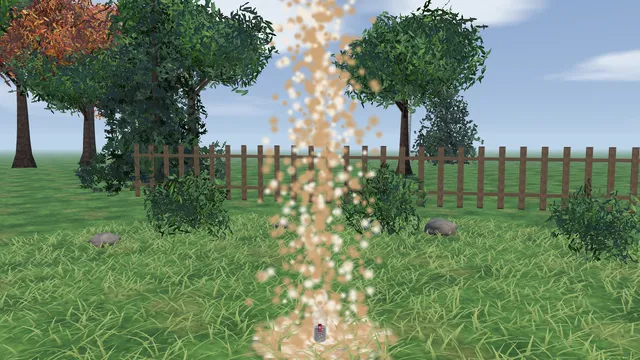
Pour a catalyst into peroxide and send a fountain of foam skyward.
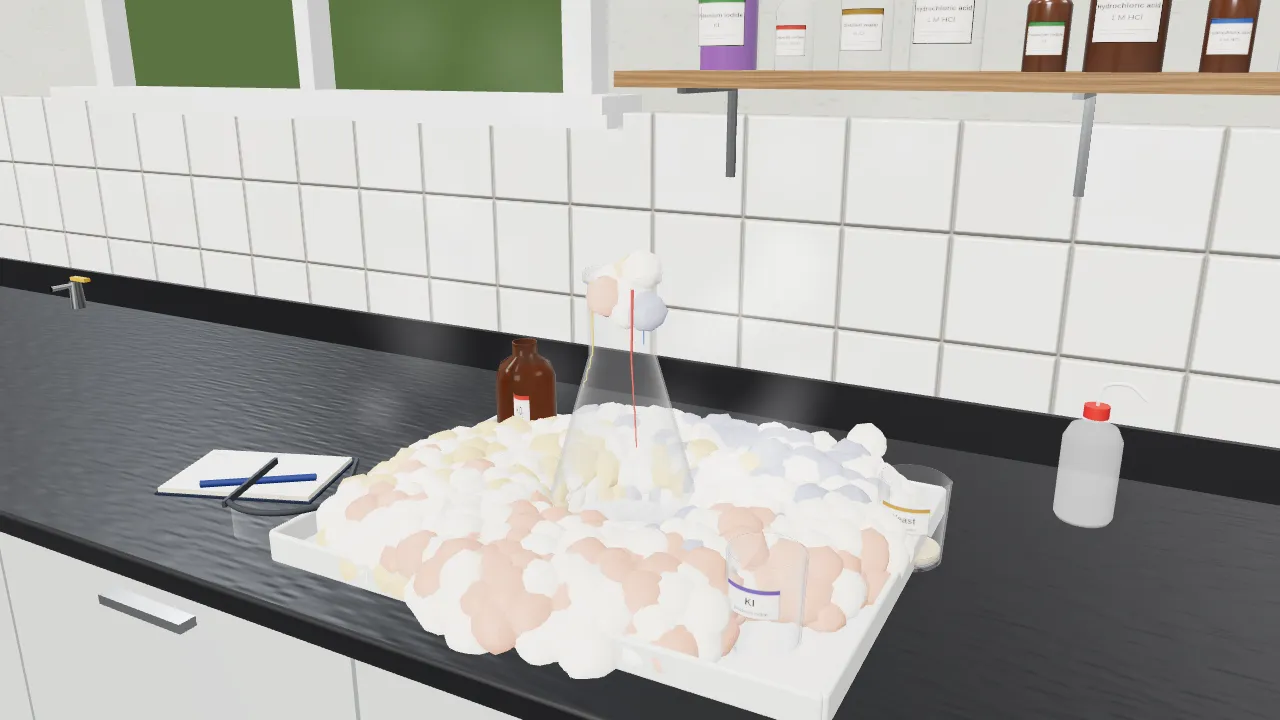
How to play
- Lift the potassium iodide (KI) or yeast beaker, hold it over the flask and tip it to pour. A whole beaker gives a fast eruption, a splash a slow one.
- Lift the brown bottle and pour more hydrogen peroxide into the flask. The catalyst is still in there, so it erupts again.
- Tap the foam to pop bubbles, or drag your finger through it to push it around.
- Try the three Challenges, or open Lab for the peroxide strength, the food colouring and a fresh flask.
Challenges
- Pour a catalyst into the flask and make the foam erupt
- Make the foam with yeast, and with potassium iodide
- Make 20 litres of oxygen in a single eruption
Try this
- Compare 3% with 30% peroxide in the Lab. The 30% bottle makes about ten times as much oxygen, so you get roughly ten times the foam.
- Watch the temperature with 30% peroxide. The reaction releases enough heat to bring the mixture to the boil, and steam drifts off the foam.
- Pour the yeast into 30% peroxide. Enzymes stop working when they get too hot, so watch what happens to the gas flow as the temperature climbs.
Fun facts
- Hydrogen peroxide is sold in brown or opaque bottles because light speeds up its breakdown into water and oxygen.
- Peroxide strength is sometimes labelled in “volumes”: 3% is about “10 volume”, meaning one litre can release about ten litres of oxygen gas.
- Catalase, the enzyme in yeast, is one of the fastest enzymes known: a single molecule can break down millions of hydrogen peroxide molecules every second.
- The catalyst isn’t used up. Iodide ions come out of the reaction unchanged, ready to break down the next peroxide molecule.
What makes the foam erupt
Hydrogen peroxide (H₂O₂) is a slightly unstable molecule. Left alone, it slowly breaks down into water and oxygen gas:
2 H₂O₂ → 2 H₂O + O₂
On a shelf that takes months or years. Add a catalyst and it happens in seconds. The dish soap in the flask traps the oxygen in countless tiny bubbles, and that foam has nowhere to go but up and out of the narrow neck. Food colouring dripped down the inside of the glass paints the stripes.
Two catalysts, one job
Potassium iodide (KI) offers the peroxide a shortcut. An iodide ion takes an oxygen atom from one peroxide molecule, becoming hypoiodite (IO⁻), then reacts with a second peroxide molecule, releasing O₂ and turning back into iodide. Because the catalyst comes out unchanged, a small amount can break down a lot of peroxide, and fresh peroxide poured onto it foams up all over again. A little iodine forms along the way, which is why foam made with iodide often has a faint yellow tinge. The more catalyst you pour in, the faster the reaction goes.
Yeast does the same job with an enzyme called catalase. Living cells make it to destroy the hydrogen peroxide produced by their own chemistry. Like most enzymes, catalase works best at moderate temperatures and stops working if it gets too hot.
How much foam, and why it gets hot
The amount of foam depends on how much peroxide there is. 100 mL of 3% solution releases about one litre of oxygen; the same volume at 30% releases about twelve. The reaction is also exothermic: it gives out about 98 kJ of heat for every mole of peroxide. The 3% version just feels warm, but the 30% version can reach boiling point, which is why its foam steams. Heat also speeds the reaction up, so a strong mixture races faster and faster.
Safety first
The spectacular version uses 30–35% hydrogen peroxide, which burns skin and eyes. It belongs in a lab, with goggles, gloves and a trained adult in charge. The classroom-safe version uses 3% pharmacy peroxide with yeast; even then, wear goggles and gloves and have an adult supervise. Please read our disclaimer before trying any real experiment.
For the curious: rate and gas volume
With iodide, the rate law is rate = k[H₂O₂][I⁻]. The iodide isn’t used up, so [I⁻] stays constant and the reaction behaves as first order in peroxide: [H₂O₂] = [H₂O₂]₀ e−k′t, with a half-life of ln 2 / k′. Oxygen behaves almost like an ideal gas, V = nRT / P, so the 0.49 mol of O₂ from 100 mL of 30% peroxide fills about 12 litres at 25 °C. This simulation uses these relationships, plus an Arrhenius factor that speeds the reaction up as the mixture warms.
Questions people ask
What is elephant toothpaste made of?
Hydrogen peroxide, a squirt of dish soap, food colouring and a catalyst, usually potassium iodide or yeast. The catalyst splits the peroxide into water and oxygen, and the soap traps the oxygen as foam.
Is elephant toothpaste safe to touch?
Foam from the concentrated version can be hot and may contain unreacted peroxide, so don’t touch it. The 3% yeast version is much milder and only warm, but it’s still best to wear gloves and goggles and to wash your hands afterwards.
Why does the foam get warm?
Breaking down hydrogen peroxide releases energy, about 98 kilojoules for every mole. That heat warms the foam, and with strong peroxide it can make the mixture boil.