Puzzle Cube
Turn the faces of a real 3×3 cube, scramble it and solve it again.
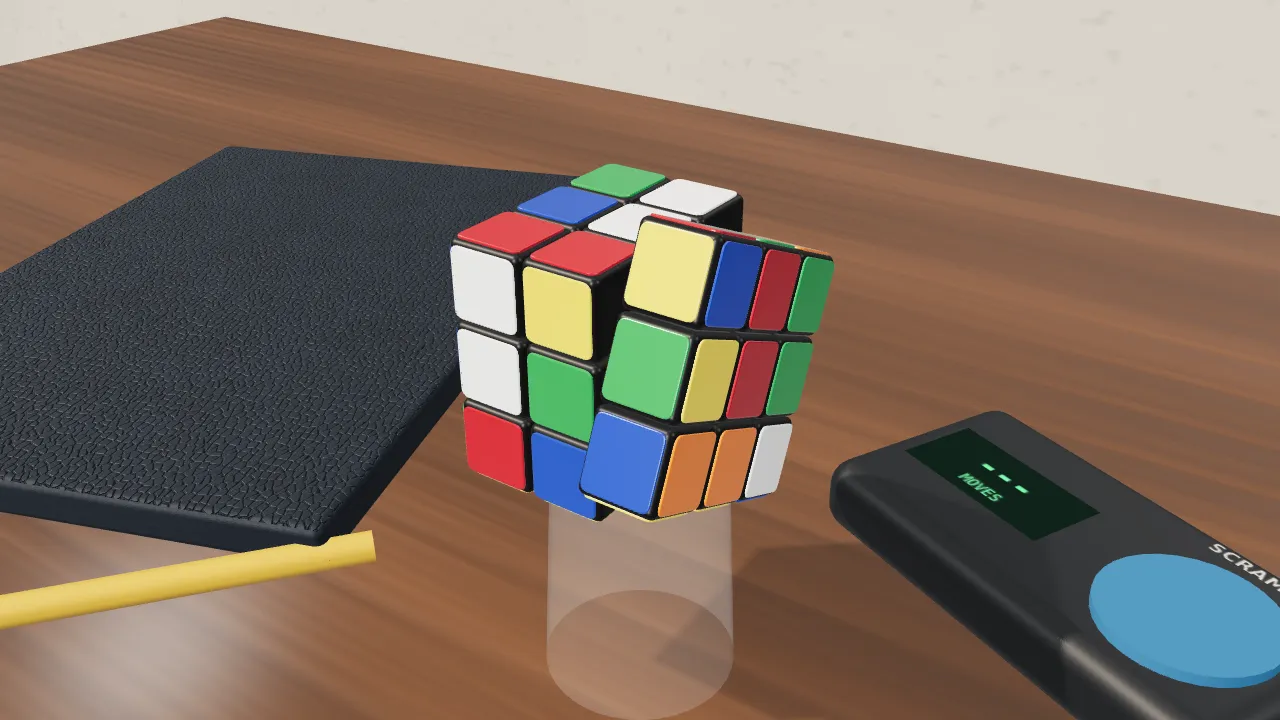
How to play
- Drag across a face to turn that layer. The stickers follow your finger and snap to the nearest quarter turn when you let go.
- Drag the empty space around the cube to look at it from every side, including underneath through the clear stand.
- Tap the blue pad on the speedcube timer to scramble the cube with 22 random turns. The timer counts your moves.
- Stuck? Open Lab and switch on hints: an arrow shows the turn that undoes your last one, all the way back to solved.
Challenges
- Make one whole face a single colour
- Solve the first layer: one face plus the matching row around it
- Solve the whole cube (hints in the Lab are allowed)
Try this
- From a solved cube, repeat the four turns R U R′ U′. After six rounds the cube is solved again.
- Repeat just R then U, over and over. It takes 105 rounds to come back to the start.
- Solve the white face first, then look at the side rows: matching each of them to its centre colour is the first layer of the beginner’s method.
Fun facts
- The best-known 3×3 cube was invented in 1974 by Ernő Rubik, a Hungarian professor of architecture and design.
- A 3×3 cube has 43,252,003,274,489,856,000 positions, about 43 quintillion.
- In 2010 a team using computer searches proved that every position can be solved in 20 face turns or fewer, a figure nicknamed God’s number.
- The centre pieces never move relative to each other when you turn the faces, so they fix which colour belongs on each side.
The mathematics in your hands
A 3×3 puzzle cube looks like 27 small cubes, but inside it is a clever mechanism: 6 centre pieces fixed to a central spindle, 12 edge pieces with two stickers each and 8 corner pieces with three. Every turn moves 4 corners and 4 edges around a face. The puzzle is to undo a scramble using only those turns.
How many positions?
The 8 corners can be arranged in 8! ways and each can be twisted 3 ways, though the twist of the last corner is fixed by the others. The 12 edges can be arranged in 12! ways and flipped 2 ways each, with the last flip again fixed. One more rule, that you can never swap just two pieces, halves the total. Multiply it all out and a cube has 43,252,003,274,489,856,000 reachable positions. Taking the cube apart and putting it back at random would give twelve times as many, and only one in twelve of those could still be solved.
Moves form a group
Mathematicians call the set of all move sequences a group: any two sequences combine into another, every sequence can be undone by doing its inverse backwards, and doing nothing counts as a move too. Repeating a sequence always brings the cube home eventually, and the number of repeats it needs is called its order. A single quarter turn has order 4. The popular trigger R U R′ U′ has order 6, R followed by U has order 105, and the longest possible order of any sequence is 1,260.
Commutators: changing a little at a time
Solvers rely on sequences of the form A B A′ B′, called commutators. If A and B overlap in only a few pieces, the commutator moves just those pieces and leaves everything else untouched. Speedcubing methods are largely clever libraries of commutators and their cousins, conjugates (A B A′), which let you apply a known trick in a different place.
For the curious
The number of positions is 8! × 37 × 12! × 211 ÷ 2. In 2010 Tomas Rokicki, Herbert Kociemba, Morley Davidson and John Dethridge showed with a large computer search that every one of them can be solved in at most 20 face turns, counting a half turn as one move. This model works the same way: every cubie has an exact position and orientation, and the orders above were checked by repeating each sequence on it. The hints use the group’s simplest property: the inverse of a sequence is its moves reversed and each one turned the other way.
Questions people ask
How many positions does a 3×3 puzzle cube have?
A standard 3×3 cube has 43,252,003,274,489,856,000 reachable positions, about 43 quintillion. Only one of them is solved.
What is God’s number?
It is the largest number of moves needed to solve the cube from any position when every move is chosen perfectly. In 2010 it was proved to be 20 face turns, counting a half turn as one move.
What does group theory have to do with the puzzle cube?
The cube’s moves form a mathematical group: sequences can be combined, every sequence has an inverse that undoes it, and repeating any sequence eventually returns the cube to where it started. Solving methods are built from group-theory tools such as commutators and conjugates.