The Five Platonic Solids
Fold plywood nets into the five Platonic solids and check Euler’s rule.
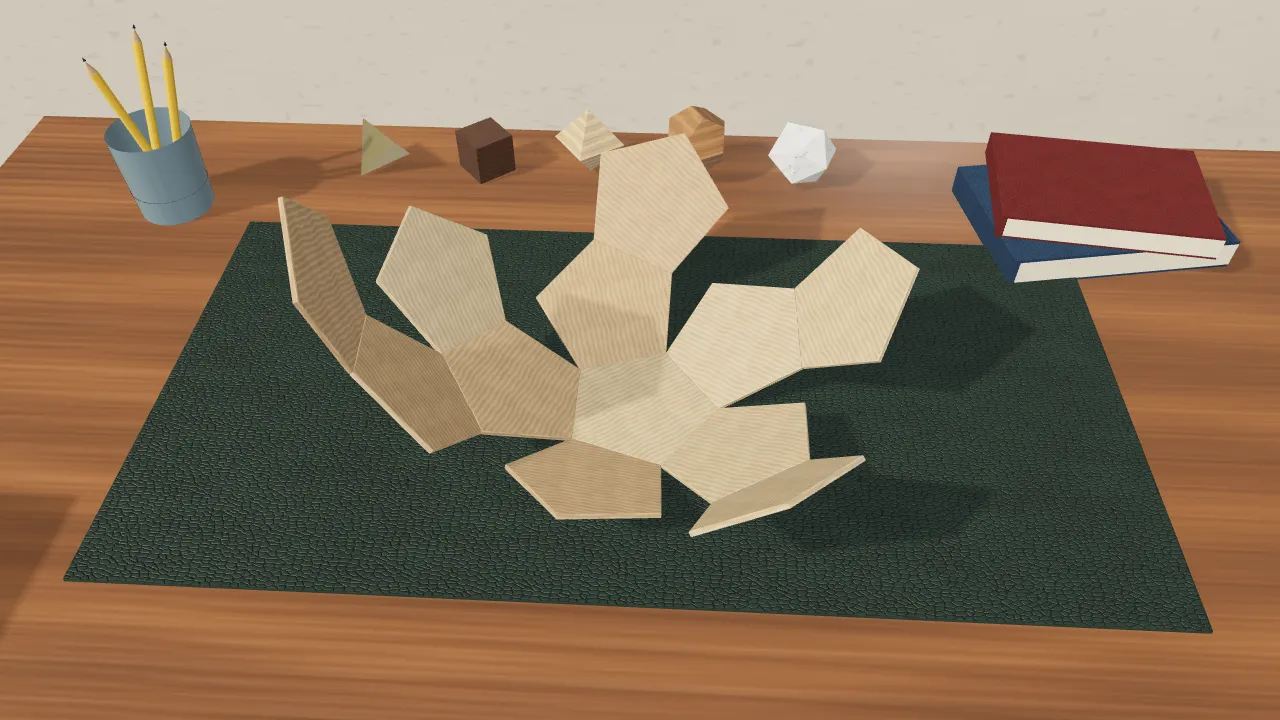
How to play
- Drag a panel to fold it up along its hinge, or tap it to fold it or lay it flat.
- Tap the base panel lying on the desk to fold the whole net up at once.
- Tap a folded-up solid to grow its dual through it in brass wire.
- Tap one of the solids at the back of the desk to get its net. The readouts count corners, edges and faces.
Challenges
- Fold a net all the way up into a closed solid
- Fold up three different Platonic solids and check that V − E + F = 2
- Find the solid whose dual is the same shape as itself
Try this
- Fold up the cube and tap it to show its dual: an octahedron, with a corner poking through every face. Then fold the octahedron and see a cube.
- Count the faces meeting at one corner and add up their angles. It is always less than 360°, which is what lets the corner fold up into a point.
- Multiply the angle gap at a corner by the number of corners for each solid. You get 720° every time.
Fun facts
- There are exactly five Platonic solids: the tetrahedron, cube, octahedron, dodecahedron and icosahedron.
- Euclid proved in the Elements that no other regular solids are possible.
- Euler’s formula V − E + F = 2 holds for every convex polyhedron, not just the Platonic ones.
- In the Timaeus, Plato linked four of the solids with the classical elements: fire, air, water and earth.
Why there are only five
A Platonic solid is as regular as a solid can be. Every face is the same regular polygon, and the same number of faces meet at every corner. There are only five: the tetrahedron (4 triangles), the cube (6 squares), the octahedron (8 triangles), the dodecahedron (12 pentagons) and the icosahedron (20 triangles).
The angle argument
Why only five? Look at a single corner. At least three faces must meet there, and their angles must add up to less than 360°, otherwise they would lie flat instead of folding into a point. Equilateral triangles have 60° corners, so three, four or five of them can meet (180°, 240° or 300°), giving the tetrahedron, octahedron and icosahedron. Six would make exactly 360° and lie flat. Squares have 90° corners: three can meet (270°), giving the cube. Regular pentagons have 108° corners: three can meet (324°), giving the dodecahedron. Three hexagons already make 360°, and larger polygons are worse. That leaves exactly five.
The missing 720°
The amount by which a corner falls short of 360° is its angle deficit. René Descartes noticed that if you add up the deficits of all the corners of a convex polyhedron, you always get 720°. For the cube it is 90° × 8; for the dodecahedron 36° × 20; for the icosahedron 60° × 12. The readouts show the sum for whichever solid you pick.
Euler’s formula
Count the corners (vertices, V), edges (E) and faces (F) of any convex polyhedron and you will always find V − E + F = 2. The cube has 8 − 12 + 6 = 2, the icosahedron 12 − 30 + 20 = 2. Leonhard Euler wrote about this relationship in the 1750s, and it became one of the founding results of topology.
Duals and nets
Put a point at the centre of every face of a cube and join the points across neighbouring faces: you get an octahedron. This partner is called the dual. The cube and octahedron are duals, as are the dodecahedron and icosahedron, while the tetrahedron is its own dual. The dual shown here is scaled so that its edges cross the solid’s edges at right angles, at their midpoints. A net is a flat pattern that folds up into the solid. Cut along enough edges to let the faces open, and they unfold around a tree of hinges. A cube has 11 different nets.
For the curious
A regular solid with p-sided faces meeting q at a corner exists only when 1/p + 1/q > 1/2. The only whole-number solutions with p, q ≥ 3 are (3,3), (4,3), (3,4), (5,3) and (3,5): the five solids. Here each net unfolds along a breadth-first tree of faces grown from the bottom face. Each face turns about its hinge edge by the exterior angle between it and its parent face, so at the end everything lies flat on the desk.
Questions people ask
Why are there only five Platonic solids?
At each corner at least three identical regular faces must meet with angles adding up to less than 360°. That only works for three, four or five triangles, three squares or three pentagons, which gives exactly five solids.
What is Euler’s formula for polyhedra?
For any convex polyhedron, the number of vertices minus the number of edges plus the number of faces equals 2. For a cube that is 8 − 12 + 6 = 2.
How many nets does a cube have?
Eleven. There are eleven different ways to lay six squares flat so that they fold up into a cube, not counting rotations and reflections of the same pattern.