Mandelbulb Fractal Flight
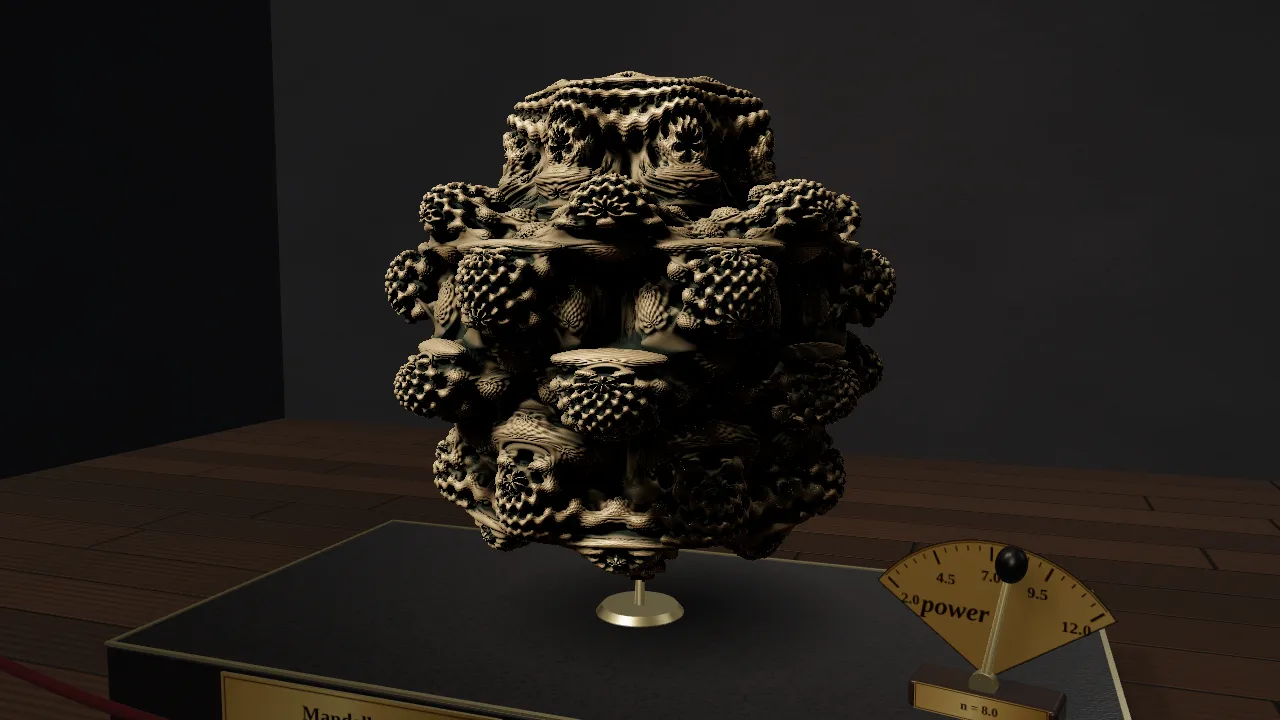
Dive into a bronze Mandelbulb, a 3D cousin of the Mandelbrot set.
How to play
- Tap the sculpture to dive towards that spot. Tap again to go deeper, or tap empty space to back out.
- While you are close, drag to look around. From the gallery view, drag to walk round the plinth.
- Pull the brass lever on the plinth to change the power n and reshape the whole sculpture.
- Open Lab for the detail level, Breathe, Fly mode and other materials.
Challenges
- Pull the lever down to power 2 and watch the rows of bulbs dissolve into swirls
- Tap the sculpture to dive in until you are 10 times closer
- Keep diving until you are 100 times closer: there are bumps on the bumps
Try this
- Pull the lever to power 2. The neat rows of bulbs dissolve into swirls: the famous bulb-on-bulb detail only appears at higher powers.
- Tap the same bulb again and again. Each dive takes you about twice as close, and new, smaller bulbs keep appearing.
- Raise the detail one step at a time in the Lab and watch new, smaller bumps grow on every bump.
Fun facts
- The power-8 Mandelbulb became widely known in 2009 through the work of Daniel White and Paul Nylander.
- There is no single “true” 3D Mandelbrot set; the Mandelbulb is one popular way of extending the idea into three dimensions.
- The shape is drawn without ever being stored: a formula estimates how far each point is from the surface, and each ray steps forward by that distance.
Squaring numbers in three dimensions
The famous Mandelbrot set lives on a flat plane of complex numbers. You pick a point c, start with z = 0, and repeat one rule: z becomes z² + c. For some points z stays small forever; for others it grows without limit. The points that stay small form the Mandelbrot set, whose edge is infinitely detailed.
What squaring does
Squaring a complex number has a beautiful geometric meaning: it squares its distance from zero and doubles its angle. Mathematicians long wondered how to do the same in three dimensions, but there is no system of three-dimensional numbers that behaves like the complex numbers. The Mandelbulb sidesteps the problem. It describes each point by its distance from the origin and two angles, like latitude and longitude, then raises the distance to the power n and multiplies both angles by n. With n = 8 this simple rule, repeated, produces the intricate shape you see.
Why the detail never ends
Points just inside and just outside the surface behave very differently when the rule is repeated, so the boundary folds and wrinkles at every scale. Each time you raise the detail setting, the program repeats the rule more times before deciding whether a point escapes, and smaller features appear. Dive towards the surface and new structure keeps unfolding beneath you.
How it is drawn
The fractal is not built from triangles. For every pixel, a ray leaves the camera, and a formula called a distance estimator tells it how far it can safely travel without passing through the surface. The ray takes that step, asks again, and repeats until it is close enough to call it a hit. This is ray marching. While you move, the picture is drawn at reduced resolution to keep it smooth; when you stop, it is redrawn sharply in strips. Phones and tablets use fewer steps and fewer repeats of the rule.
For the curious
In spherical coordinates (r, θ, φ), the Mandelbulb step is z ↦ rⁿ(sin nθ cos nφ, cos nθ, sin nθ sin nφ) + c. Alongside z the program tracks the derivative dr ↦ n·rⁿ⁻¹·dr + 1, and the distance to the surface is estimated as ½ r ln r / dr. An orbit trap, which records how close each point’s sequence comes to the origin, darkens the deep folds like the patina on old bronze. In fly mode the camera’s speed is proportional to the estimated distance, which is why you slow down near the surface.
Questions people ask
What is the Mandelbulb?
It is a three-dimensional fractal made by repeating a rule like the Mandelbrot set’s z → z² + c, but applied to points in 3D space using spherical coordinates and a higher power, usually 8.
Is the Mandelbulb a true 3D Mandelbrot set?
Not exactly. There is no three-dimensional number system that works like the complex numbers, so there is no unique 3D version. The Mandelbulb is one popular extension that captures much of the same spirit.
How is the Mandelbulb rendered?
By ray marching. For each pixel a ray steps forward by an estimate of its distance to the fractal surface until it is close enough to count as a hit, and then the surface is shaded with light and shadow.