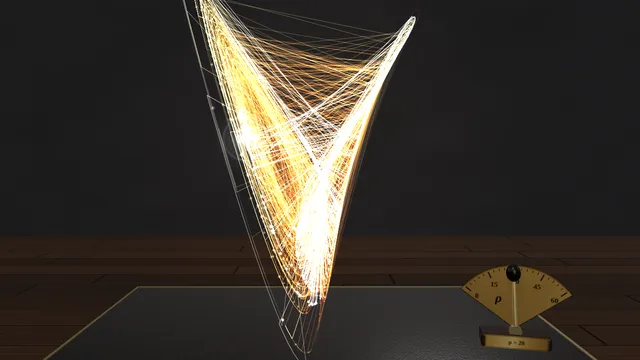
The Butterfly Effect
Start two twins a millionth apart and see how soon they part ways.
How to play
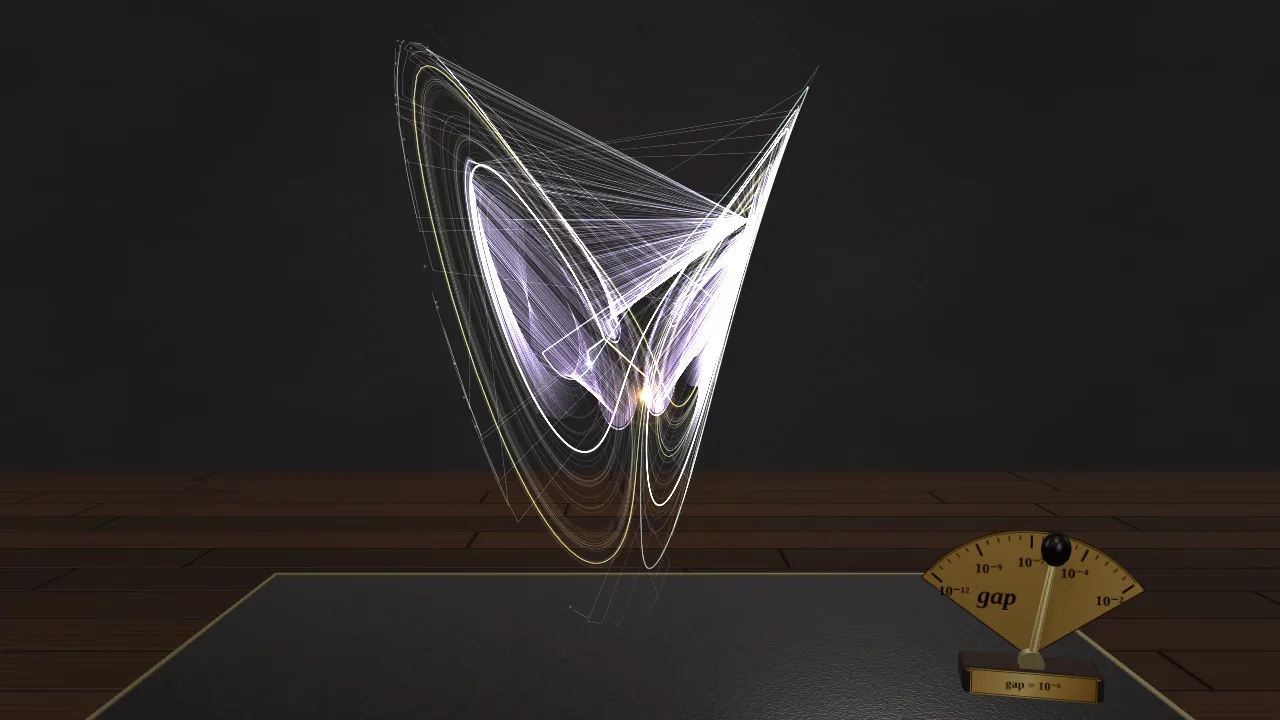
- The amber and blue twins start just 10⁻⁶ apart, with a crowd of particles in the same tiny ball. Drag them to any starting spot and let go.
- Or tap anywhere in the space around the attractor to release them there.
- Pull the brass lever on the plinth to set the starting gap, from a trillionth (10⁻¹²) to a hundredth (10⁻²). They are released again when you let go.
- Read “Gap between twins” and “Parted ways after”. Try the three Challenges, or open Lab for σ and ρ.
Challenges
- Drag the twins to a new spot, let go, and wait for them to part ways
- Set the gap lever to a billionth (10⁻⁹) and keep the twins together for 20 time units
- Open the gap to a hundredth and see the twins split in under 9 time units
Try this
- Note when the twins part ways, then pull the lever to make the starting gap a million times smaller (10⁻¹²). You gain only about 15 time units more.
- Watch the crowd: it stays a single dot for a while, then stretches into a thread and finally smears over both wings.
- Make the gap 10⁻² and the twins part almost at once.
Fun facts
- The name comes from a 1972 talk by Edward Lorenz, “Predictability: Does the Flap of a Butterfly’s Wings in Brazil Set Off a Tornado in Texas?”
- Weather forecasts lose their useful detail after about one to two weeks, partly for this reason, however good the computers become.
- Forecast centres run “ensembles” of dozens of forecasts from slightly different starting states to see how much the outcome might vary.
- Here, each factor of ten smaller in the starting error buys only about 2.5 extra time units of predictability.
Deterministic, yet unpredictable
The two highlighted particles obey the same three Lorenz equations, with no randomness anywhere. Given their starting points, their whole future is fixed. They begin a millionth of a unit apart, smaller than any measurement could detect, and for a while they move as one. Then the gap starts to grow, faster and faster, until one is on the left wing and the other on the right. This is sensitive dependence on initial conditions, better known as the butterfly effect.
Exponential growth
Near the attractor the flow keeps stretching neighbouring paths apart and folding them back. On average the gap grows like e^(λt), where λ, the largest Lyapunov exponent, is about 0.9 per time unit for the classic Lorenz values. So the gap roughly doubles every 0.77 time units and grows tenfold every 2.5. Starting from one millionth, it takes about ln(10⁶)/0.9 ≈ 15 time units to grow to the size of the attractor itself: the moment the twins “part ways”. The exact moment varies from run to run, because the stretching is stronger in some parts of the attractor than others.
Why better measurements barely help
Because the growth is exponential, shrinking the starting error helps only a little. Make the gap a million times smaller and you gain just ln(10⁶)/λ ≈ 15 time units. Try it with the slider. This is why weather forecasts have a horizon of roughly one to two weeks for detail, no matter how good our instruments and computers become.
The crowd: ensemble forecasting
The faint crowd starts inside the same tiny ball as the twins. At first it is a single point; then it stretches into a thread along the attractor and finally spreads over both wings. Weather services do exactly this: they run dozens of forecasts from slightly different starting states. When the ensemble stays tight, the forecast is confident; when it spreads, they know it is uncertain.
Chaos is not randomness
Even after the twins have separated, each still traces the same butterfly. Chaos destroys our ability to say where on the attractor a particle will be, but not the shape of the attractor itself, which is like the climate behind the weather.
For the curious
The twins and crowd are integrated with fourth-order Runge–Kutta in fixed steps of 0.004 in double precision, which carries about 16 significant digits, so even a 10⁻¹² gap is resolved. The faint skeleton line is one long trajectory of the same system. Parameters: σ = 10, ρ = 28, β = 8/3.
Questions people ask
What is the butterfly effect?
The idea that in a chaotic system a tiny change in starting conditions, like the flap of a butterfly’s wings, can grow into a completely different outcome later on.
Does the butterfly effect mean weather is random?
No. The equations are deterministic, but small uncertainties in the starting state grow exponentially, which limits how far ahead the weather can be predicted in detail.
Who discovered the butterfly effect?
The meteorologist Edward Lorenz, who noticed it in his weather simulations around 1961 and popularised the butterfly image in a 1972 talk.