Spiral Gear Art
Roll a toothed wheel round a ring with a pen and draw roses and stars.
How to play
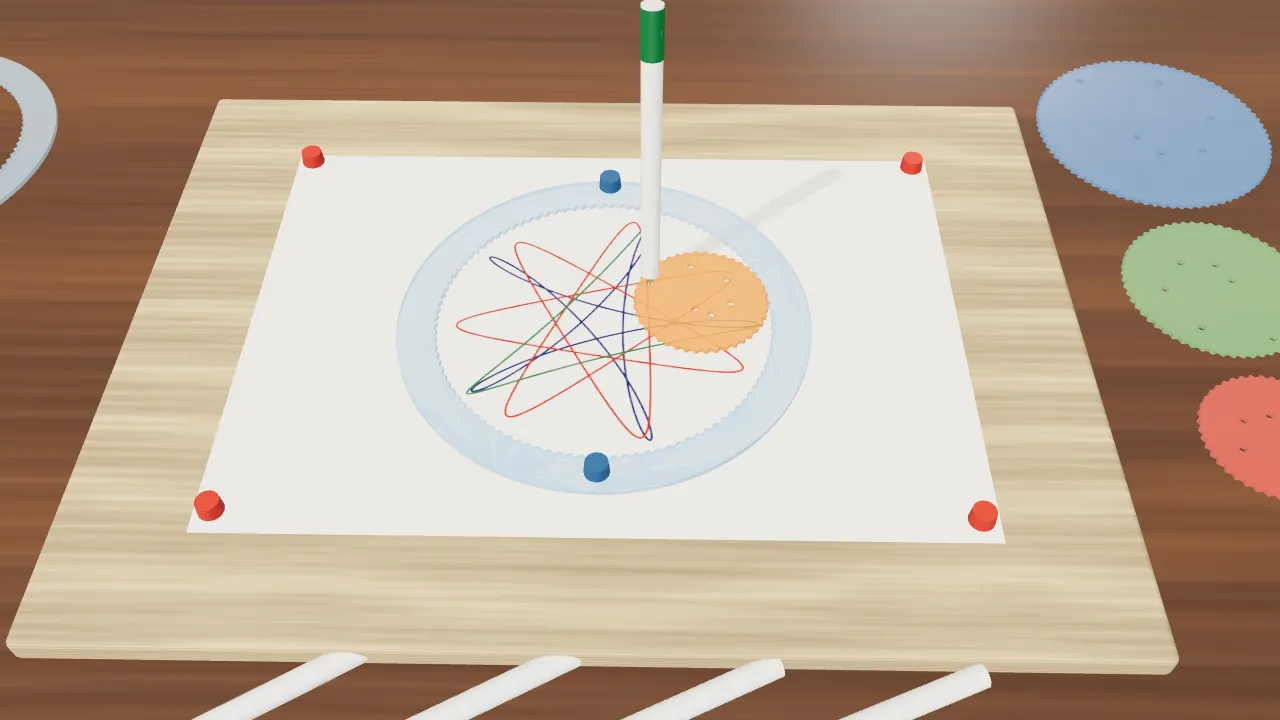
- Drag the wheel round inside the ring. Its teeth can’t slip, so the pen in its hole traces a looping curve on the paper.
- Keep going until the curve meets its own start. The readout tells you how many turns that takes.
- Tap another hole in the wheel to move the pen, tap a wheel in the tray or the spare ring to swap gears, and tap a pen to change colour.
- Tap the pad of paper for a fresh sheet. Open Lab to draw a whole curve at once.
Challenges
- Draw a closed rose with five petals
- Draw a closed seven-pointed star
- Draw closed patterns in three different colours on one sheet
Try this
- With the 105-tooth ring, try the 63, 42 and 84 wheels. All three give five lobes, because 105 and each of them share the factor 21, yet the shapes are completely different.
- Use the 52-tooth wheel. It shares no factor with 105, so the pattern needs 52 trips round the ring and 105 lobes before it closes.
- Draw the same gears with the pen in the outermost hole and then the innermost. Moving the pen in turns sharp points into soft waves.
Fun facts
- The best-known gear-drawing set, the Spirograph, was developed by the British engineer Denys Fisher in the 1960s.
- The curves it draws are hypotrochoids: the path of a point attached to a circle rolling inside another circle.
- A pattern closes after r ÷ gcd(R, r) trips round the ring and has R ÷ gcd(R, r) lobes, where R and r are the tooth counts and gcd is their greatest common divisor.
Gears, divisors and the curves they draw
A gear-drawing set turns arithmetic into art. Put a toothed wheel inside a toothed ring, push a pen through one of the wheel’s holes and roll the wheel round. Because the teeth mesh, the wheel can’t slip: every tooth that passes the ring turns the wheel by one tooth too. The pen, held off-centre, is carried round the ring while the wheel spins it the other way, and it draws a looping curve called a hypotrochoid.
Why the teeth matter
All the gears in a set have teeth of the same size, so the radius of each gear is proportional to its number of teeth. That means the whole pattern is decided by just three things: the teeth on the ring, the teeth on the wheel, and how far the pen sits from the wheel’s centre. Change the pen hole and the lobes grow sharper or softer; change the gears and the pattern changes completely.
How many petals?
Each time the wheel travels once round the ring, it passes all the ring’s teeth. The pen returns to exactly where it started only when a whole number of wheel turns lines up with a whole number of trips round the ring, which first happens after the ring and the wheel have moved by the least common multiple of their tooth counts. Divide that by each count and two simple rules appear: the curve has R ÷ gcd(R, r) lobes and closes after r ÷ gcd(R, r) trips, where gcd is the greatest common divisor. A 105-tooth ring and a 63-tooth wheel share 21, so the pattern has 5 lobes and closes after 3 trips. With a 52-tooth wheel they share nothing at all, so you need 52 trips and get 105 lobes.
Roses, stars and polygons
The size of the wheel compared with the ring decides the character of the drawing. Small wheels give spiky stars, wheels a little over half the ring give roses whose petals cross in the middle, and large wheels give rounded polygons with little loops at the corners.
For the curious
Measure angles in tooth units and let θ be how far the wheel’s centre has travelled round the ring. Rolling without slipping turns the wheel by −(R − r)θ/r, so a pen at distance d from its centre traces
x = (R − r) cos θ + d cos((R − r)θ / r) and y = (R − r) sin θ − d sin((R − r)θ / r).
The curve repeats when both θ and (R − r)θ/r are whole multiples of 2π, which first happens at θ = 2π · r / gcd(R, r). Rolling the wheel round the outside of the ring instead gives the related family of epitrochoids.
Questions people ask
What shapes do spiral drawing gears make?
They draw hypotrochoids, the curves traced by a point on a wheel rolling inside a larger ring. Depending on the gears and the pen hole they look like stars, roses or rounded polygons with loops.
How do you know how many petals a spiral gear pattern will have?
Divide the number of teeth on the ring by the greatest common divisor of the ring’s and the wheel’s tooth counts. A 105-tooth ring with a 63-tooth wheel shares 21, giving 105 ÷ 21 = 5 lobes.
Why does a spiral gear pattern take several turns to close?
The pen only returns to its starting point when whole turns of the wheel line up with whole trips round the ring. That takes the wheel’s tooth count divided by the greatest common divisor of the two counts, so a 63-tooth wheel in a 105-tooth ring needs 3 trips.