Density Tower
Pour five liquids into a tall glass and drop things into the layers.
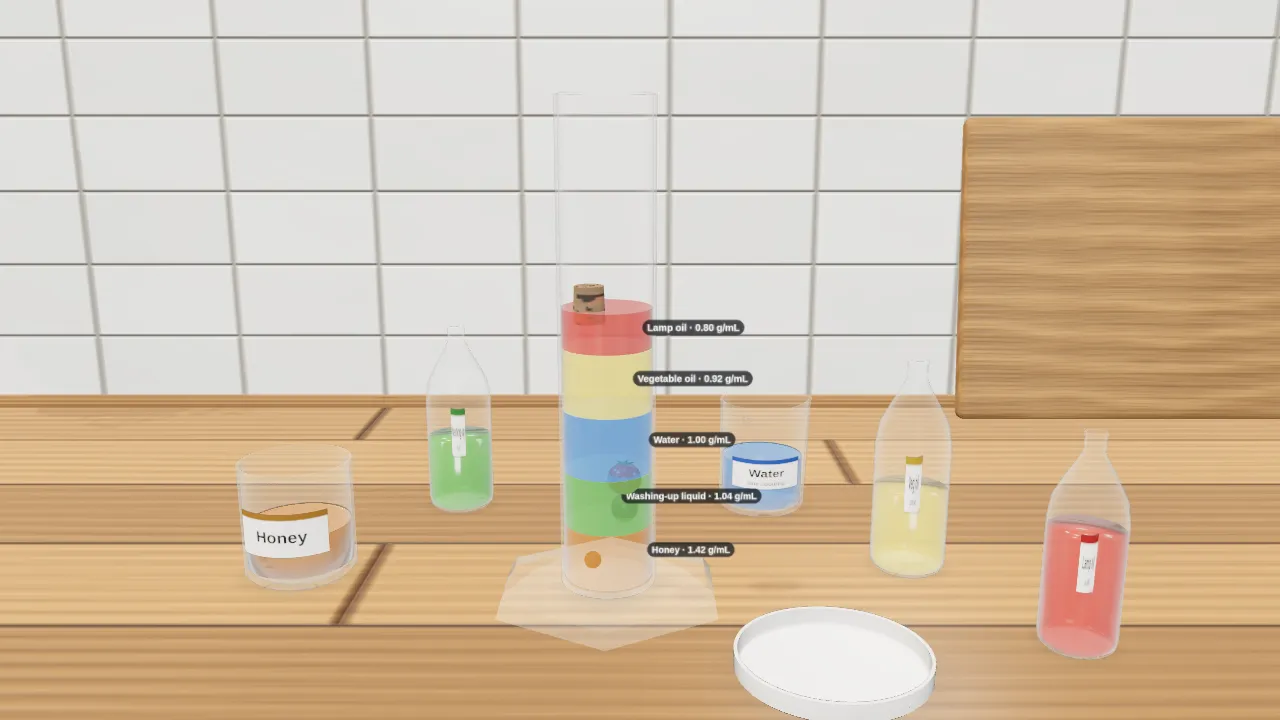
How to play
- Drag a bottle or jar over the tall glass and keep pushing: it tips and pours. Tip it gently for a thin trickle, which keeps the layers clean.
- Pour the liquids in any order. Each one sinks through anything lighter and settles on anything denser.
- Drag the grape, cherry tomato, cork or plastic bead from the saucer over the glass and let go. Drag them out again to try another tower.
- Labels beside the glass show each layer’s density. Lab can pour the whole tower for you, or empty the glass.
Challenges
- Pour four clean layers that don’t mix
- Get the grape floating in the middle of the tower
- Find what sinks right to the bottom
Try this
- Pour the honey last. It sinks through everything, slowly, and still ends up at the bottom.
- Pour water fast onto the washing-up liquid. Both are water-based, so a splashy pour blends them into a cloudy band.
- Tip lamp oil quickly onto water. However hard you pour, oil and water never mix: the layers always come back.
Fun facts
- Honey is about 1.4 times as dense as water, which is why it always ends up at the bottom.
- Archimedes’ principle: an object in a fluid is pushed up by a force equal to the weight of the fluid it displaces.
- Most vegetable oils have a density of about 0.92 g/mL, so they float on water.
- PTFE, the slippery plastic used in non-stick coatings, is more than twice as dense as water.
Heavy at the bottom, light on top
Density is how much mass is packed into each millilitre. Water has a density of about 1.00 g/mL; honey, thick with dissolved sugars, is about 1.4; washing-up liquid is a little denser than water; vegetable oil and lamp oil are lighter. Pour them into one tall glass and gravity sorts them: the densest sinks to the bottom and the lightest rises to the top.
Why some layers mix and others don’t
Whether two liquids stay apart depends on more than density. Honey, washing-up liquid and water are all water-based, so in principle they blend into each other. They form layers only because their densities differ enough and a gentle pour doesn’t stir them; splash one into another and they mix into a cloudy band. Oil and water are a different story: water molecules attract each other far more strongly than they attract oil, so the two separate however they are shaken. The two oils, on the other hand, mix freely with each other, so it takes a careful trickle to keep them apart. That is why patient pouring, down the side of the glass or over the back of a spoon, matters so much.
Floating somewhere in the middle
Drop an object in and it is pushed up by a force equal to the weight of the liquid it displaces: Archimedes’ principle. If the object is less dense than the liquid around it, that push wins and it rises; if it is denser, it sinks. In a layered tower it sinks through everything lighter than itself and stops on the first layer that is denser, resting at the boundary with part of it in each. A cork floats on top of everything. A grape, a little denser than water, sinks through the water and the soap but rests on the honey. A PTFE bead, more than twice as dense as water, goes all the way down.
Slow going through honey
How fast something falls depends on viscosity, a liquid’s resistance to flowing. Honey is thousands of times more viscous than water, so even a heavy bead creeps through it. For small, slow objects the drag is described by Stokes’ law, and the bead settles to a steady speed at which drag balances its weight minus the buoyant push.
Safety
Lamp oil (paraffin) is harmful if swallowed and can cause serious lung damage if it is breathed in, so keep it away from children and flames and never store it in a drinks bottle. Use it only with an adult in charge, and please read our disclaimer.
For the curious
Density ρ = m ÷ V. The buoyant force is F = ρliquid Vdisplaced g, summed over each layer the object straddles; it floats where that equals its weight, ρobject V g. A small sphere of radius r sinking slowly through a liquid of viscosity μ reaches the terminal speed v = 2(ρobject − ρliquid)g r² ÷ 9μ (Stokes’ law).
Questions people ask
Why do the liquids in a density tower form layers?
Each liquid has a different density. The densest sinks to the bottom and the lightest floats to the top, and as long as you pour gently the layers don’t stir into each other. Oil and water layers stay apart even when shaken, because they don’t mix at all.
Why does a grape float in the middle?
A grape is a little denser than water and washing-up liquid but much less dense than honey. It sinks through the lighter layers and comes to rest on the honey, with liquid both above and below it.
What order should you pour a density tower in?
Any order works in the end, because each liquid finds its own level, but pouring from densest to lightest (honey first, lamp oil last) and trickling each one slowly down the side of the glass gives the cleanest layers.