Baking Soda Volcano
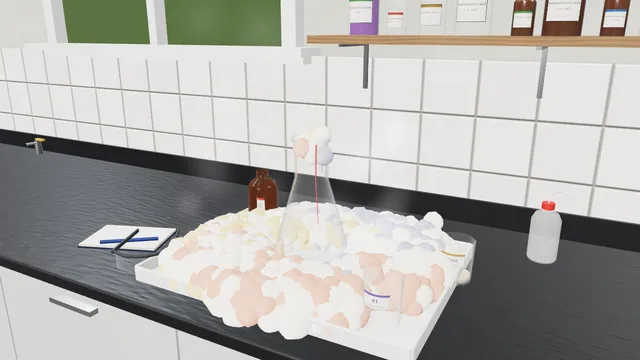
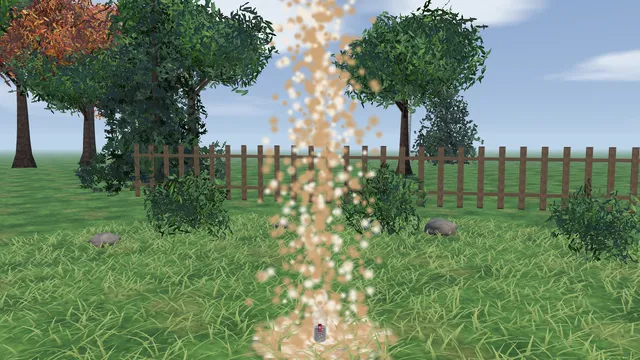
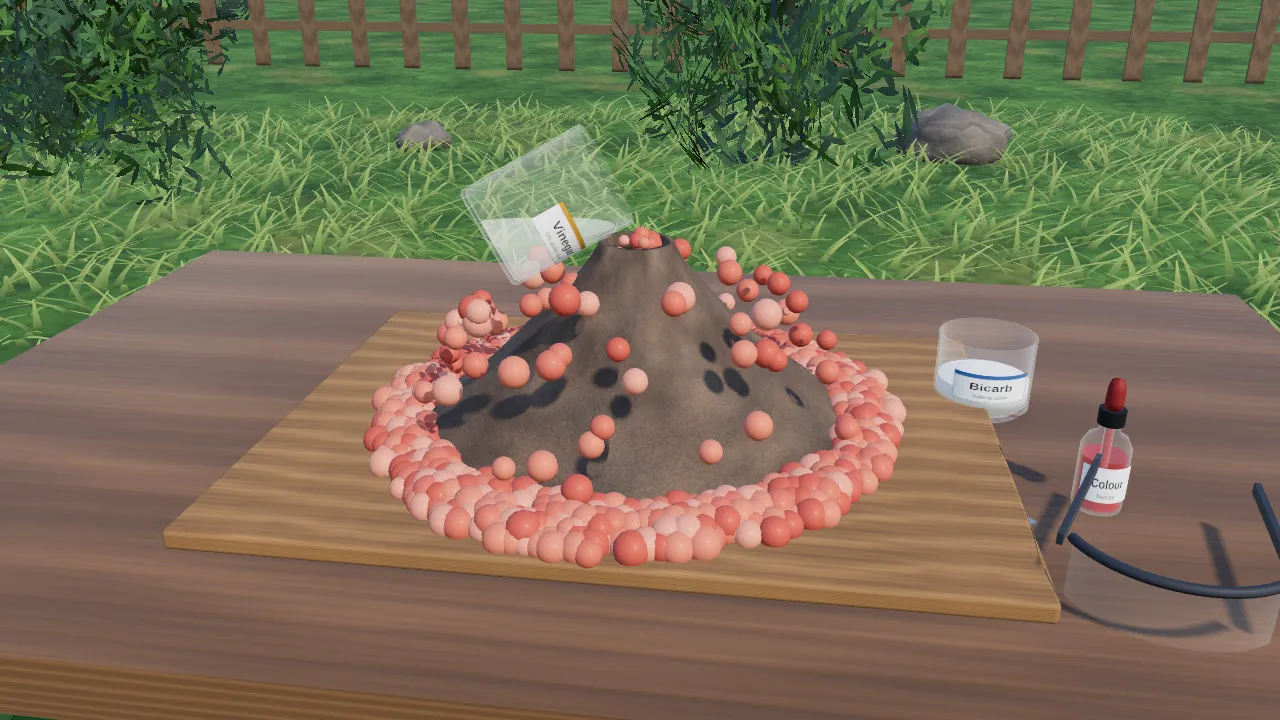
Pour vinegar into a baking soda volcano and make the lava foam.
How to play
- Drag the jug of vinegar over the crater and keep pushing: it tips and the vinegar pours in. Tip it further for a faster gush.
- Drag the spoon into the tub of baking soda to scoop some up, then hold it over the crater to tip it in.
- Drag the food-colouring dropper over the crater for a few drops of colour.
- Try the three Challenges, or open Lab to change the starting soda, the soap and the colour.
Challenges
- Pour vinegar into the crater and make the volcano erupt
- Keep pouring until every grain of baking soda has reacted
- Spoon in more baking soda and make 4 litres of gas in total
Try this
- Set the starting soda to 5 g in the Lab and pour a whole jug. The eruption stops early: the baking soda is the limiting reagent.
- Now start with 40 g and pour only a little. This time the vinegar runs out, and the readout shows soda left over.
- Switch off the dish soap. You still get the gas, but it fizzes away instead of being trapped as a foam.
Fun facts
- Baking soda is sodium bicarbonate, NaHCO₃. Household vinegar is a dilute solution of acetic acid, usually about 5%.
- The bubbles are carbon dioxide, the same gas that makes cakes rise when baking powder (baking soda plus a dry acid) gets wet.
- The reaction takes in heat rather than giving it out, so the mixture feels slightly cooler afterwards.
- Real volcanoes are driven by molten rock and expanding gases such as water vapour and carbon dioxide, not by acids and bases.
An acid, a base and a lot of gas
The baking soda volcano is a classic acid–base reaction. Vinegar contains acetic acid; baking soda is sodium bicarbonate, a mild base. When they meet, the acid hands a hydrogen ion to the bicarbonate, forming carbonic acid, which immediately falls apart into water and carbon dioxide gas:
NaHCO₃ + CH₃COOH → CH₃COONa + H₂O + CO₂
The leftover sodium acetate stays dissolved in the water. All the drama comes from the gas: carbon dioxide takes up far more room than the solids and liquids it came from, so it pushes everything up and out of the crater.
Foam and colour
On its own, the gas would simply fizz away. A squirt of dish soap changes that: soap molecules line the surface of each bubble and stop it bursting so quickly, so the gas is trapped as a thick foam that flows down the slopes like lava. A few drops of red and orange food colouring do the rest.
How much gas? The limiting reagent
The equation tells you the reaction works one-for-one: one mole of baking soda (84 g) reacts with one mole of acetic acid (60 g, which is about 1.2 litres of 5% vinegar) to make one mole of carbon dioxide. At room temperature a mole of any gas fills about 24 litres. Whichever ingredient runs out first, the limiting reagent, decides how much gas you get. Two tablespoons of baking soda with a cup of vinegar is a typical home recipe; there the vinegar usually runs out first, which is why it is worth having more ready for a second eruption.
Why it feels cool
Some reactions release energy as heat. This one is endothermic: it takes a little heat from its surroundings, so the mixture ends up slightly cooler than it started.
For the curious: the model
The simulation tracks moles of acid and bicarbonate. Vinegar is added as it is poured, and the reaction rate is r = k·n(acid)·(n(soda)/n₀)2/3: the acid reacts at the surface of the powder, and a shrinking pile has less surface (area scales as volume to the power ⅔). Each litre of CO₂ produces a set number of foam blobs. These use position-based dynamics: they push apart, cling together a little and collide with the cone along its surface normal, so they slide downhill. The rate constant is tuned to look like a real eruption.
Safety
This is kitchen-safe chemistry, but vinegar stings eyes, so keep faces back from the crater and do it on a tray. Please read our disclaimer before any real experiment.
Questions people ask
Why do baking soda and vinegar fizz?
The acetic acid in vinegar reacts with sodium bicarbonate to make carbonic acid, which immediately breaks down into water and carbon dioxide gas. The gas forms the bubbles.
How much vinegar and baking soda do you need for a volcano?
A common recipe is about two tablespoons of baking soda with a cup of vinegar and a squirt of dish soap. To use all the baking soda you need a lot of vinegar: 84 g of baking soda needs about 1.2 litres of 5% vinegar.
Is the baking soda volcano safe?
Yes, it uses kitchen ingredients. Keep vinegar away from eyes, do it on a tray or outdoors, and have an adult help younger children.