Water Molecule in 3D
Pull water’s hydrogens and click neighbours on with hydrogen bonds.
How to play
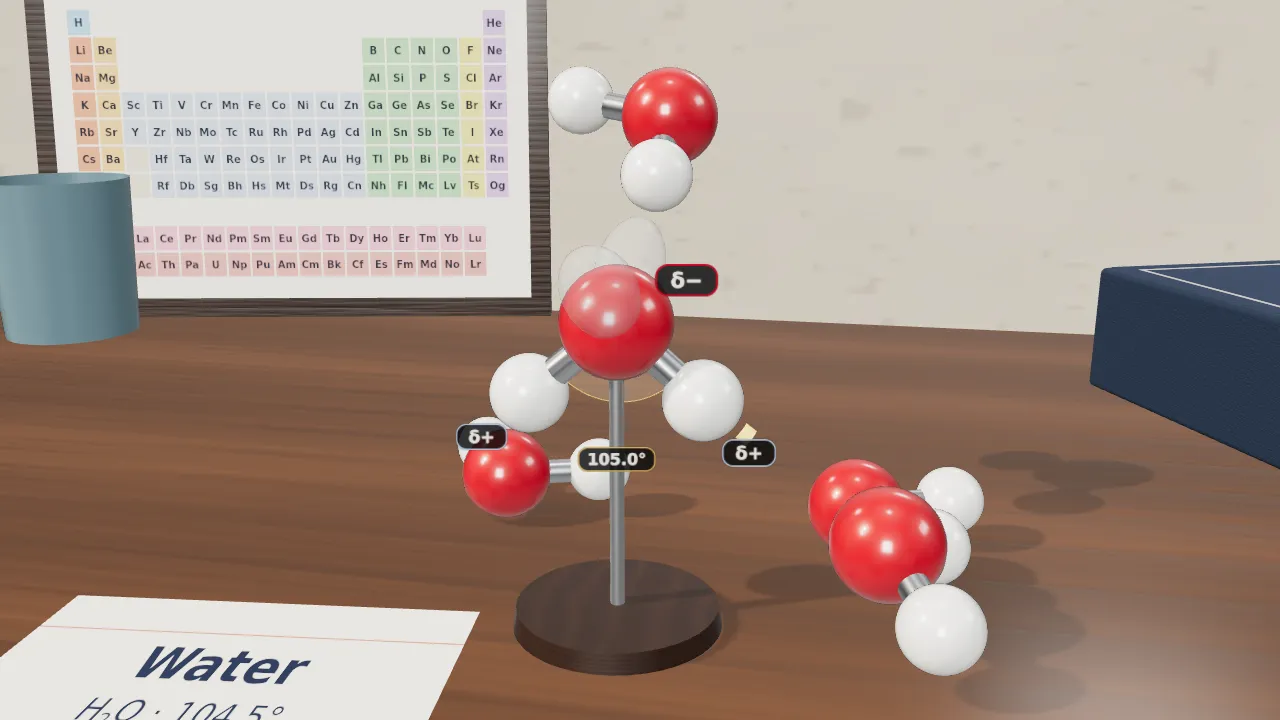
- Grab a hydrogen and pull: the O–H bond stretches and rings when you let go. Pull sideways to bend the 104.5° angle.
- Pick up one of the loose water molecules on the desk and bring it close. Near a free spot it turns and clicks on with a hydrogen bond.
- Two partners attach through our hydrogens and two through our lone pairs. Pull one away to break its bond.
- Open Lab to show the bonding sites, the partial charges, the three vibrations or a space-filling view.
Challenges
- Pull a hydrogen to stretch an O–H bond, then let it ring
- Bring a second water molecule close enough to form a hydrogen bond
- Surround the molecule with four hydrogen-bonded neighbours, as in ice
Try this
- Pick the bend vibration and watch the H–O–H angle swing a few degrees either side of 104.5°.
- Compare the dipole moment during the symmetric and asymmetric stretches. Both change it, which is why water absorbs infrared.
- Attach all four neighbours and count the hydrogen bonds: two from its hydrogens, two to its lone pairs.
Fun facts
- The H–O–H angle in a water molecule is about 104.5°, a little less than the 109.5° of a perfect tetrahedron.
- Water’s dipole moment is about 1.85 debye, which helps make it an excellent solvent for salts.
- Microwave ovens heat food mainly by making water molecules twist back and forth in a rapidly changing electric field.
- Each water molecule can take part in up to four hydrogen bonds: two through its hydrogens and two through its lone pairs.
Why water is bent, and why it matters
A water molecule is one oxygen atom bonded to two hydrogens. You might expect the three atoms to sit in a straight line, but they don’t: the molecule is bent, with an angle of about 104.5° between the two O–H bonds, each about 0.96 Å long.
The VSEPR explanation
Oxygen has six outer electrons. Two are used in bonds to the hydrogens, and the remaining four form two lone pairs. Electron pairs repel each other, so the four pairs around oxygen (two bonding, two lone) spread out roughly towards the corners of a tetrahedron. This is the valence shell electron pair repulsion (VSEPR) model. Lone pairs sit closer to the oxygen and push a little harder than bonding pairs, so they squeeze the H–O–H angle down from the tetrahedral 109.5° to 104.5°.
A polar molecule
Oxygen attracts electrons much more strongly than hydrogen does. The shared electrons spend more time near the oxygen, which becomes slightly negative (δ−), while the hydrogens become slightly positive (δ+). Because the molecule is bent, these charges don’t cancel: water has a permanent dipole moment of about 1.85 debye. If it were straight, like carbon dioxide, the two bond dipoles would cancel out.
Hydrogen bonds
The δ+ hydrogen of one water molecule is attracted to a lone pair on the oxygen of another. This attraction, a hydrogen bond, is much weaker than a covalent bond but far stronger than the forces between most small molecules. It gives water its high boiling point for such a light molecule, its strong surface tension and its ability to dissolve salts and sugars. In ice, every molecule makes four hydrogen bonds in a regular tetrahedral network.
For the curious: vibrations
A molecule of three atoms has three ways to vibrate. In gas-phase water the symmetric stretch is at 3657 cm⁻¹, the bend at 1595 cm⁻¹ and the asymmetric stretch at 3756 cm⁻¹ (wavenumbers are proportional to frequency). All three change the dipole moment, so all three absorb infrared light, one reason water vapour is a powerful greenhouse gas. In this model the bond lengths and angle are measured values; the partial charges (O −0.66, H +0.33) are chosen to reproduce the measured 1.85 D dipole, and the dipole readout recalculates μ = Σ q·r from the live atom positions. The atoms are joined by springs fitted to those three measured vibrations, so a plucked bond rings at the right frequency, slowed about 40 trillion times: real vibrations happen about 10¹⁴ times a second. Thermal jiggle comes from the same springs, drawn a little larger than life.
Questions people ask
Why is water a bent molecule?
The oxygen atom has two bonding pairs and two lone pairs of electrons. All four pairs repel each other and spread out roughly into a tetrahedron, so the two O–H bonds end up at an angle of about 104.5° instead of in a straight line.
Why is water polar?
Oxygen pulls the shared electrons towards itself, making the oxygen slightly negative and the hydrogens slightly positive. Because the molecule is bent, these charges do not cancel, giving water a permanent dipole.
What is a hydrogen bond?
It is the attraction between a slightly positive hydrogen atom on one molecule and a lone pair on a strongly electronegative atom, such as oxygen, on another. In water these bonds hold the molecules together and give water many of its unusual properties.