The Water Cycle
Push clouds over a mountain and follow one drop round the water cycle.
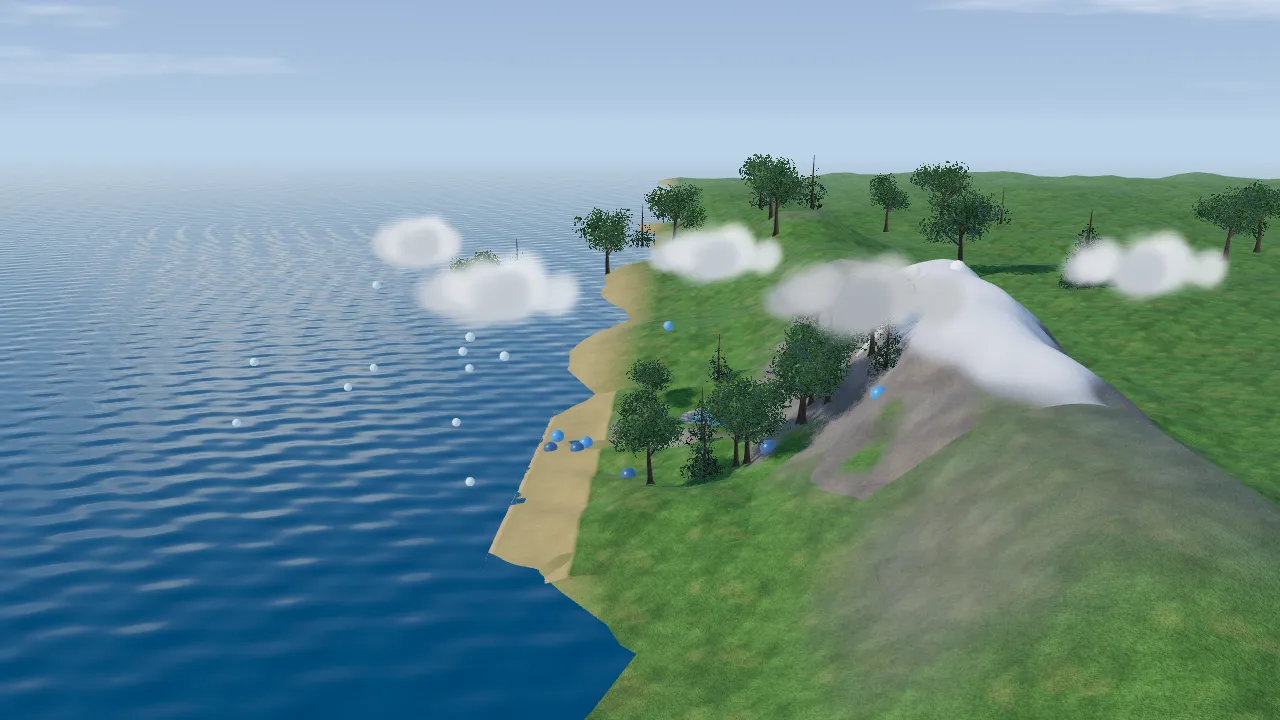
How to play
- Drag a cloud towards the mountain. As the air is pushed up it cools, and loaded clouds rain, or snow on the peak.
- Grab the mountain top and pull it higher or lower, and watch where the rain falls on each side.
- Tap the sea, or any drop, to follow one parcel of water. The readout tells you where it is now.
- Try the three Challenges, or open Lab for the sunshine, the wind and climate warming.
Challenges
- Push a heavy cloud over the mountain until snow falls on the peak
- Tap the sea and follow one drop up to a cloud, down to the land and back
- Pull the peak up high and watch its far side stay dry: a rain shadow
Try this
- Pull the mountain up as high as it goes. More rain falls on the side facing the wind, and the land beyond stays dry: a rain shadow.
- Turn up the sunshine. Warmer sea water evaporates faster, so clouds build more quickly.
- Add a few degrees of warming and watch the snowline climb up the mountain.
Fun facts
- About 97% of the Earth’s water is salt water in the oceans.
- At any moment the atmosphere holds only about one thousandth of one percent of the Earth’s water.
- A water molecule stays in the atmosphere for about nine days on average before it falls again as rain or snow.
- Evaporating a kilogram of water takes roughly 2.5 million joules at everyday temperatures, and that energy is released again when the vapour condenses into cloud.
One drop of water, around and around
The water on Earth is not used up; it is moved around. Sunlight warms the sea, and water molecules escape from the surface as invisible water vapour. Warm, moist air rises, and as it rises it expands and cools. At a certain height, called the lifting condensation level, it has cooled to its dew point, and the vapour condenses onto tiny particles of dust and salt to form cloud droplets. That is why the flat bases of fair-weather clouds all sit at about the same height.
Mountains make rain
When the wind pushes moist air against a mountain, the air is forced upwards, cools further and drops much of its water as rain or snow on the slopes facing the wind. By the time it crosses the top it has lost much of its moisture, and as it sinks down the far side it warms up and its clouds evaporate. The land behind the mountain stays dry: a rain shadow. Raise the mountain in the Lab and you can watch it happen.
Back to the sea
Rain that lands on high ground cold enough for snow builds a snowpack that melts slowly in the sunshine. On lower ground, some water runs off into streams and rivers, some soaks into the soil and seeps slowly through the rock as groundwater, and some is taken up by plants and returned to the air through their leaves. One way or another, it all finds its way back to the sea.
A warmer world
Warm air can hold more water vapour than cold air, about seven percent more for every degree Celsius. In a warmer climate, evaporation speeds up and heavy rain can become heavier, while the snowline moves up the mountains.
For the curious
Every dot here is the same parcel of water for as long as the simulation runs. None is ever created or destroyed, so the three readouts always add up to 100%. The rate of evaporation follows the saturation vapour pressure of water, given by Bolton’s formula es = 6.112 exp(17.67T / (T + 243.5)) hectopascals, with T in °C. Clouds form at a set height above the sea, rise when the wind carries them over the mountain, and rain harder the more they are lifted. Snow falls where the air is below freezing, which happens higher up because the air cools by roughly 6.5 °C for every kilometre of height. The island is not to scale, and the share of water in the air is far larger here than on the real Earth so that you can see it.
Questions people ask
What are the main stages of the water cycle?
Evaporation from the sea and land, condensation into clouds, precipitation as rain or snow, and the return of water to the sea through rivers, groundwater and melting snow. Plants also release water vapour through their leaves.
Why does it rain more on one side of a mountain?
Moist wind blowing against a mountain is forced upwards, cools and drops its water on the slopes facing the wind. The air that comes down the other side is drier and warming up, so the far side stays dry. This is called a rain shadow.
Is the amount of water on Earth always the same?
Very nearly. Water changes between liquid, vapour and ice and moves between the sea, the air and the land, but it is not used up. Only a tiny amount escapes to space from the top of the atmosphere.