Water Balloon Toss
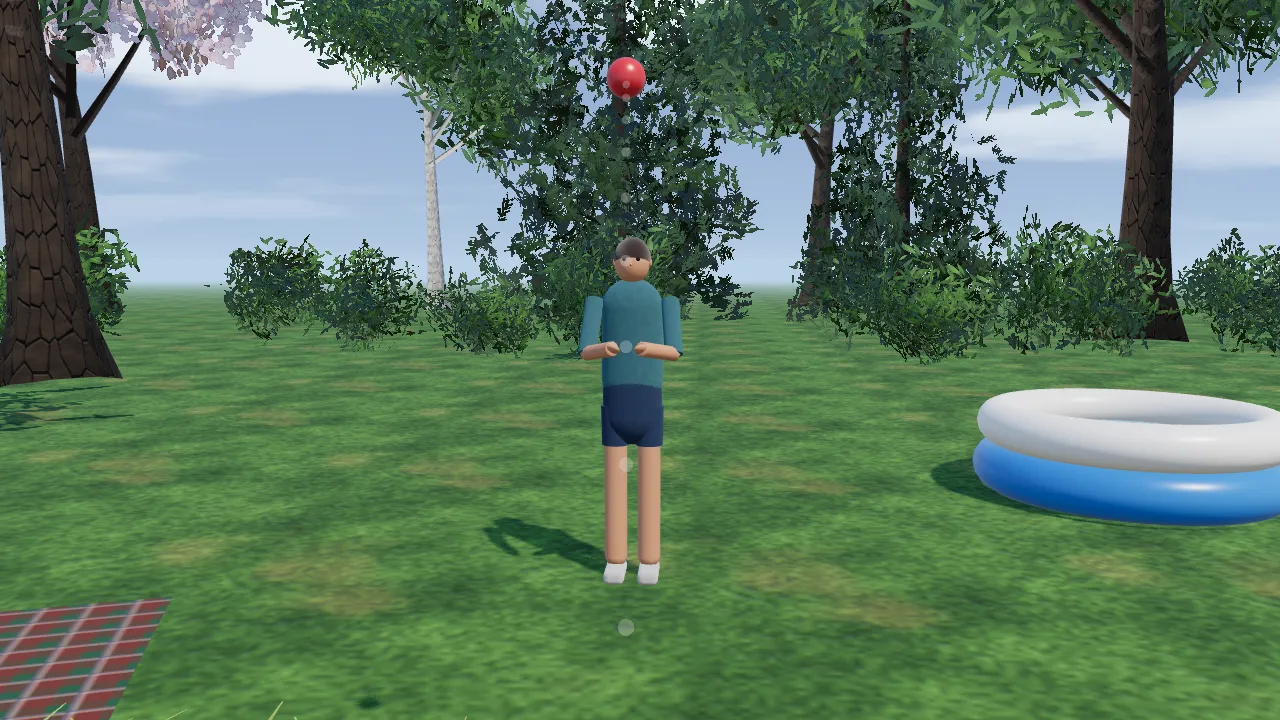
Lob water balloons to a friend who steps back after every catch.
How to play
- Drag back from anywhere and let go to lob a balloon to your friend. The further you pull, the faster it flies.
- Drag a little left or right to aim. Your friend walks over to catch what they can reach.
- Tap your friend to change how they catch: stiff hands give 15 cm, soft hands reach out and give up to 60 cm. The readout shows the force of each catch.
- After every catch your friend steps back one metre, and a burst ends the game. Try the three Challenges, or make tougher balloons in Lab.
Challenges
- Make a catch so gentle it takes less than 15 newtons
- Keep the game going until your friend catches at 6 metres
- Reach a catch at 8 metres without a burst
Try this
- At 6 m, try a flat fast throw and then a high lob. Which one arrives more gently?
- Tap your friend for stiff hands, then soft ones. The same throw that bursts with stiff hands is caught easily with soft ones.
- Try the Moon’s gravity. The balloon needs much less speed to cover the same distance, so it arrives far more gently.
Fun facts
- Water is about 800 times denser than air, which is why a balloon full of water flies almost like a solid ball.
- Moving your hands back as you catch spreads the stop over a longer distance and time, which lowers the force on whatever you catch.
- Stopping an object moving twice as fast over the same distance takes four times the force.
The physics of a soft catch
Every catch has to remove the balloon’s momentum, mass times velocity. Newton’s second law says the force needed depends on how quickly you do it: F = Δp / Δt. Stop the balloon in a short time and the force is big; stretch the stop out and the force is small. That is the whole art of catching an egg, a cricket ball or a water balloon, and it is the rule this game is built on.
Soft hands, smaller force
It is often easier to think about distance than time. If your hands give way by a distance d while the balloon slows from speed v to zero, the average force is F = m v² / (2d). The balloon in this game holds about 0.36 kg of water. Arriving at 6 m/s and caught over 30 cm, it feels about 21 N, a firm squeeze. The same balloon arriving at 10 m/s needs about 60 N, enough to split its thin rubber skin. Notice the v²: twice the speed needs four times the force, or four times the give.
Why each step back is harder
The further away your friend stands, the faster you have to throw, and a balloon lands at roughly the speed it was thrown. Ignoring air, the slowest throw that covers a distance R between equal heights is the 45° lob, with speed √(gR). So every extra metre makes the minimum arrival speed creep up. With the default settings, the catching force rises from about 20 N at 3 m to around 43 N at 7 m, and at 8 m even a well-aimed lob goes past the balloon’s limit of 45 N.
Splats on the grass
Grass is far stiffer than a pair of hands, so a balloon that misses stops in a much shorter distance and usually bursts. A gentle bounce is possible if it lands slowly, which is why some low, soft lobs survive a miss.
For the curious
The balloon is a sphere of water 8.8 cm across, integrated 240 times a second with gravity and drag. When it reaches your friend’s hands, the game computes its speed v and the force m v² / 2d using the distance d your friend’s hands give (tap them, or set it in Lab). It bursts if that force exceeds the Lab’s balloon strength. Your friend predicts the landing point the moment you throw, using the same physics, and walks there if it is within reach.
Questions people ask
How do you catch a water balloon without it breaking?
Reach out early and let your hands travel back with the balloon as you catch it, like catching an egg. Spreading the stop over more distance lowers the force on the balloon’s skin.
What is the best way to throw in a water balloon toss?
A smooth, fairly high underarm lob. A lob around 45 degrees needs the least speed for a given distance, so the balloon arrives as gently as possible.
Why do water balloons burst when they hit the ground?
The ground stops them in a tiny distance, so the force on the rubber is huge. Hands that give way can stop the same balloon over many centimetres with a much smaller force.