Volcano Eruption
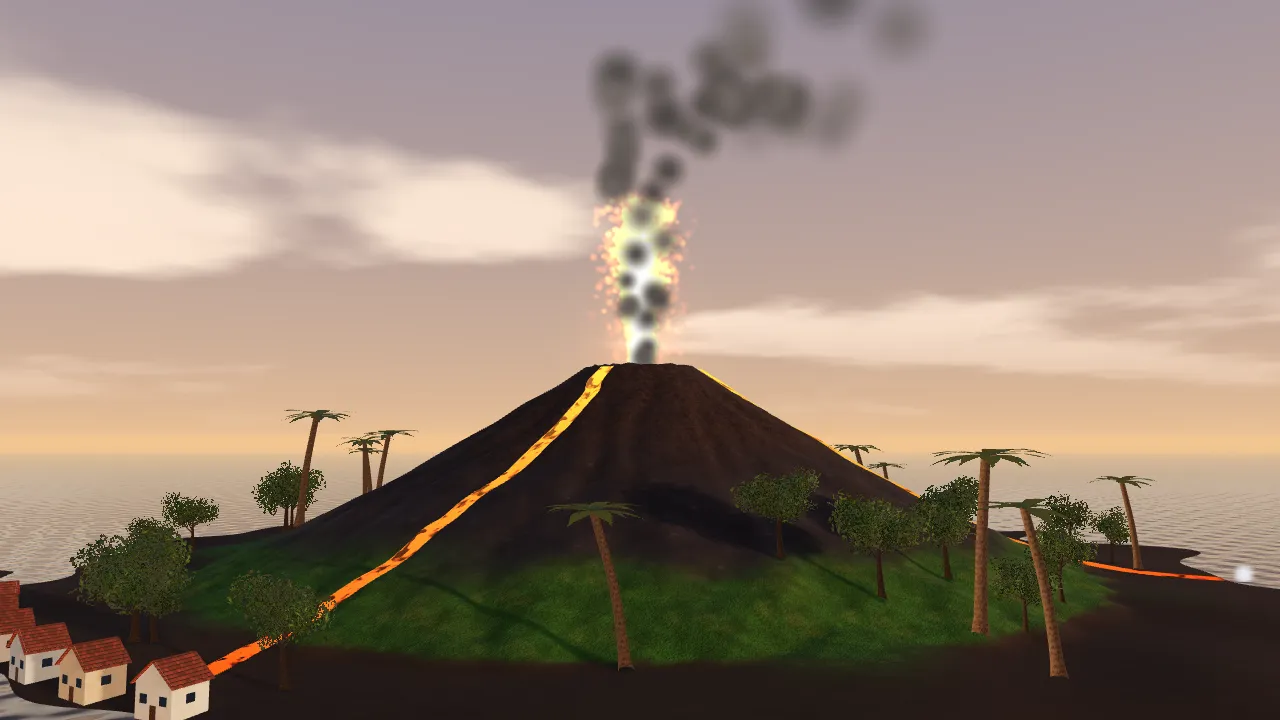
Pump magma into an island volcano and open vents on its slopes.
How to play
- Drag the crater up to pump more magma into the vent, or down to ease off. The fountain grows with the pressure.
- Tap a slope to open a flank vent. Its lava follows the steepest way down, along the gullies.
- Tap the crater for a sudden surge. Push the pressure right up and the eruption turns explosive.
- Try the three Challenges, or open Lab to pick a style, set the exit speed or turn up the wind.
Challenges
- Drag the crater up to pump a lava fountain more than 400 m high
- Open a vent on a slope and let its lava run all the way to the sea
- Pump so hard the eruption turns explosive, with an ash column over 20 km
Try this
- Double the exit speed and watch the fountain grow about four times taller: its height goes with the speed squared.
- Switch to the Plinian column and raise the eruption rate by a factor of 10,000. The plume only climbs about ten times higher.
- Turn up the wind and watch the umbrella cloud drift downwind of the vent.
Fun facts
- Basaltic lava, like that of Hawaiian volcanoes, typically erupts at around 1,100 to 1,200 °C.
- Plinian eruptions are named after Pliny the Younger, who described the eruption of Vesuvius in AD 79.
- Volcanic ash is made of tiny shards of rock and volcanic glass, not soft ash like that left by a fire.
- An ash column rises because the hot mixture is less dense than the air around it, and it spreads sideways where it reaches air of the same density.
Fountains, bombs and buoyant plumes
Magma deep underground holds dissolved gas, mostly water vapour and carbon dioxide, the way a sealed bottle of fizzy drink holds carbon dioxide. As the magma rises, the pressure on it falls and the gas comes out of solution as bubbles. What happens next depends on how runny the magma is.
Hawaiian fountains
Hot, runny basalt lets bubbles grow and escape fairly easily. The expanding gas throws lava upwards in glowing fountains. Once a clot of lava leaves the vent, it flies like a ball thrown upwards: it rises until gravity stops it, then falls. Its greatest height is h = v²/2g, so doubling the exit speed makes the fountain about four times taller. Clots cool as they fly and land, glowing yellow-white when hottest and fading through orange to dull red, and the lava that pools at the vent feeds rivers that run down the gullies to the sea.
Strombolian bursts
If gas gathers into big pockets before it reaches the surface, they burst at the vent one at a time, flinging out showers of glowing bombs every few seconds. The style is named after Stromboli, the Italian island volcano that has been erupting this way for a very long time.
Plinian ash columns
Sticky, gas-rich magma cannot let its bubbles go gently. Instead the gas tears it into ash: tiny shards of glass and rock. The mixture leaves the vent as a jet, but its height is mostly set by buoyancy. Hot ash and gas are lighter than the surrounding air, so the column rises, pulling in cold air at its edges. As it mixes and cools, it slows, and where it becomes as dense as the air around it, it spreads sideways into an umbrella cloud. Friction between ash grains can build up so much electric charge that lightning flickers inside the cloud.
For the curious
Plume theory, developed by Morton, Taylor and Turner in 1956, predicts that a buoyant plume in a stable atmosphere rises to about H ≈ 5 F¼ N−¾. Here F is the buoyancy flux, which grows with the rate at which heat leaves the vent, and N describes how stable the air is. Because of the fourth root, ten thousand times more magma per second raises the plume only about ten times higher. This simulation turns the eruption rate into heat with a magma heat capacity of 1,100 J/kg/K and a temperature excess of 1,000 K. The readout shows the predicted height; the plume itself is drawn much smaller than real life so that it fits on screen.
Questions people ask
How hot is lava?
Runny basaltic lava, the kind seen in Hawaii and Iceland, usually erupts at about 1,100 to 1,200 °C. Stickier lavas rich in silica are cooler, often 800 to 1,000 °C.
What makes some volcanoes explosive?
Sticky, gas-rich magma. When gas cannot escape easily, it builds up and then expands violently, shattering the magma into ash. Runny magma lets gas escape more gently, so it erupts as fountains and flows.
Why does lava glow?
Anything hot enough gives off visible light. As lava cools its glow shifts from yellow-white through orange to dull red, and a black crust forms on top while the inside can stay hot and molten.