Trebuchet Engineer
Tune an oak trebuchet by hand, then pull the trigger and let fly.
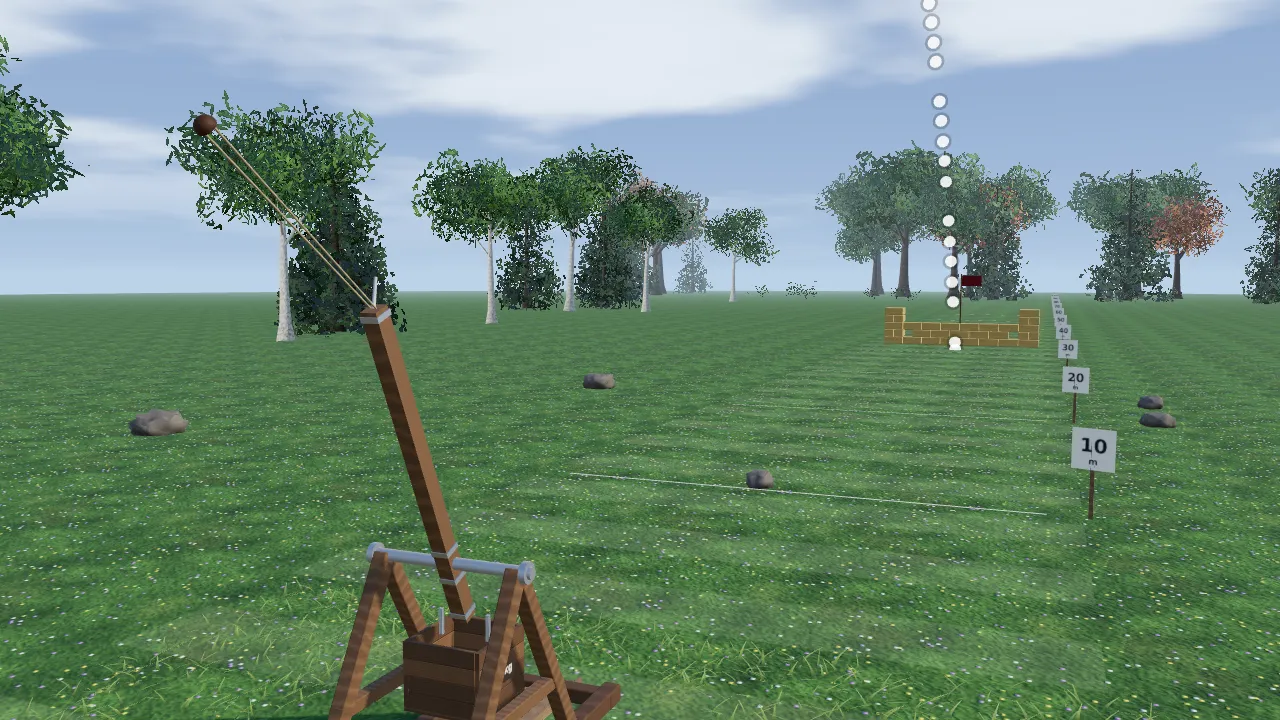
How to play
- Pull the wooden handle on the trigger rope, lying on the grass beside the machine, to let the counterweight fall. The camera follows the stone downrange.
- Drag the counterweight box up or down to add or remove river stones. Drag the leather pouch along the trough to lengthen or shorten the sling.
- Drag the steel hook at the tip of the arm up or down to change the release angle, and tap a granite ball on the rack to load it.
- The dotted arc, launch speed and efficiency update as you tune. Try the three Challenges, or type in exact values in Lab.
Challenges
- Throw a stone past the 50 metre board
- Hit the straw-bale castle at 45 metres full on, before the stone lands
- Tune it so 60 percent of the falling weight’s energy goes into the ball
Try this
- Slide the pouch in until the sling is 0.8 m, then out to 2.4 m. Watch the launch speed and efficiency change.
- Find the release angle that throws furthest. It is less than 45°, because the projectile is released high above the ground.
- Double the counterweight. Does the range double too?
Fun facts
- Counterweight trebuchets were among the most powerful siege engines of medieval Europe and the Middle East.
- A trebuchet works by gravity alone: lifting the counterweight stores potential energy, and its fall swings the arm.
- The sling acts like an extra joint, letting the projectile whip round faster than the tip of the arm itself is moving.
How a falling weight becomes a flying stone
A trebuchet is a beautifully simple energy converter. Winching the arm down lifts the counterweight, storing gravitational potential energy, Mgh. Pull the pin and the weight falls, swinging the long arm up and over. A sling on the end of the arm whips the projectile round and lets go at the right moment. All the power comes from gravity, and the only question is how much of the falling weight’s energy ends up in the projectile.
The lever
The counterweight hangs on the short end of the arm (0.5 m here) and the sling on the long end (2 m). A lever trades force for speed: the long end moves four times as fast as the short end. A heavy weight moving slowly becomes a light projectile moving fast.
The sling
The sling is the trebuchet’s secret. It adds a second, free-swinging joint at the tip of the arm. As the arm rotates, the sling trails behind, then whips round, a bit like the end of a towel when you flick it. Near release the projectile can be travelling much faster than the arm tip. In this model a 1.6 m sling throws a 1 kg ball at about 21 m/s with the default 60 kg counterweight. Shorten the sling to 0.8 m and the launch speed drops to under 13 m/s.
The release
Real trebuchets release when one loop of the sling slides off a pin, and the angle of the pin sets when that happens. Here you choose the release angle directly: the sling lets go when the projectile’s velocity points at that angle. Because the projectile is released about 4 m up and air slows it a little, the longest throw is at a bit under 45°, around 37° with the default settings.
Efficiency
Not all the counterweight’s energy reaches the projectile. Some stays in the swinging arm and weight, which is why the arm keeps swinging after the shot. The efficiency readout divides the projectile’s kinetic energy at release by the energy the counterweight has given up by then. With the default settings it is about 45 percent. A longer sling raises it, and so does a better match between weight and ball: with the default weight and sling, the efficiency peaks at about 50 percent for a 1.5 to 2 kg ball, while a light 0.3 kg ball receives only about a fifth of the energy. Many trebuchets, old and new, hang the counterweight on a hinge, which typically wastes less energy still.
For the curious
The model has two generalised coordinates, the arm angle θ and the sling angle φ, and is derived from the Lagrangian L = ½Aθ̇² + ½Bφ̇² + Dθ̇φ̇·cos(θ−φ) − V. It is integrated with fourth-order Runge–Kutta 4000 times a second. While it is still in the trough, the projectile rests on a stiff spring contact. After release, the ballistics engine flies it with gravity and drag, and the dotted arc runs the whole sequence ahead of time. The balls are granite (2650 kg/m³), so a heavier ball is also a bigger one: 1 kg is 9 cm across, 3 kg is 13 cm.
Questions people ask
How does a trebuchet work?
A heavy counterweight on the short end of a long arm is raised and then released. As it falls, the arm swings up, and a sling on the long end whips the projectile round and lets go, flinging it in a high arc.
What makes a trebuchet throw further?
A heavier counterweight, a lighter projectile, a well-tuned sling length and the right release angle. The sling and release are the subtle parts: they decide how much of the falling weight’s energy reaches the projectile.
What is the difference between a trebuchet and a catapult?
Catapult is a broad name for throwing machines. Many catapults, such as the Roman onager, stored energy in twisted rope or springy wood. A counterweight trebuchet stores it by lifting a heavy weight and uses gravity to throw.