Table Tennis
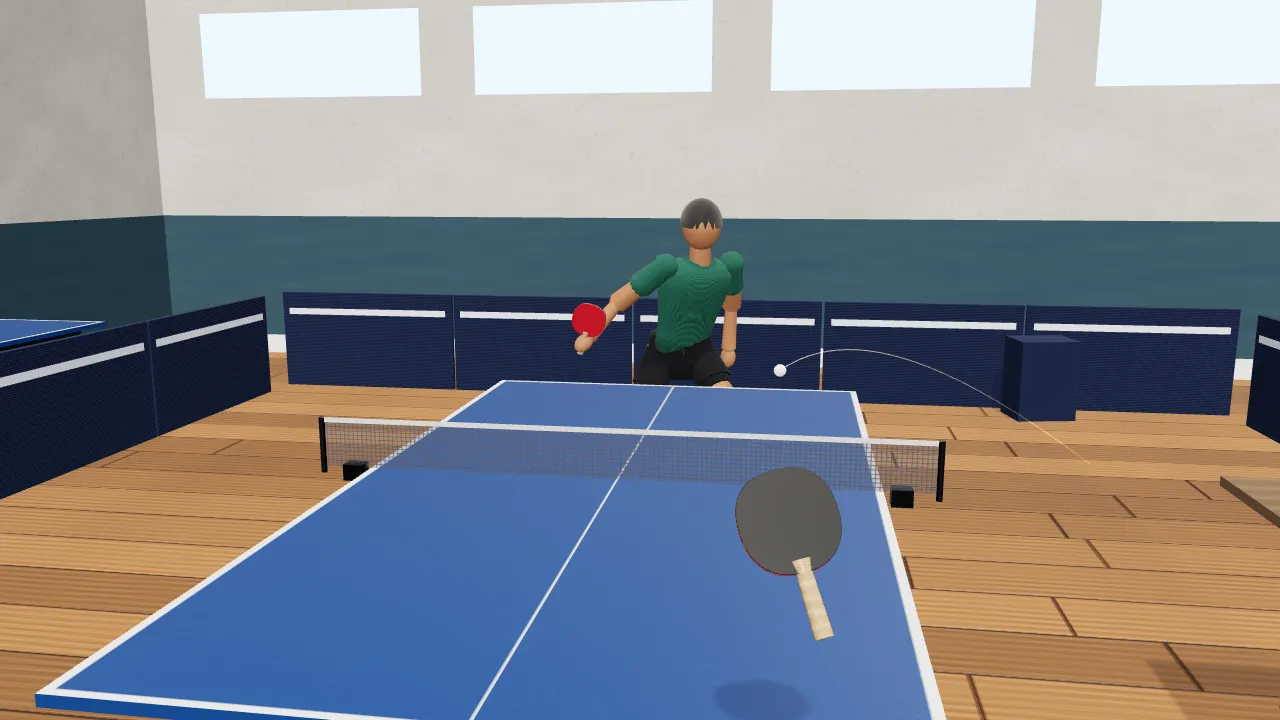
Rally against the computer and win a game to 11 with real spin.
On Amazon.in. As an Amazon Associate I earn from qualifying purchases.
How to play
- Drag anywhere to move your paddle. It follows your finger (or mouse) along a plane just behind your end of the table.
- Swipe through the ball as it arrives: a faster swipe hits harder. Swipe up for topspin, down for backspin and sideways to curve it.
- To serve, tap to toss the ball up, then swipe through it as it falls. Serves change every two points; a game goes to 11.
- Open Lab to choose the computer. Easy reaches for the ball with you and keeps your shots on the table; hard leaves it all to you.
Challenges
- Keep a rally going for 10 shots
- Win a point with a topspin shot
- Beat the computer in a game to 11
Try this
- Swipe up through a few balls, then down through a few. Watch the trail: orange topspin shots dip and skid on, blue backspin shots float and slow.
- Hold your paddle still in the ball’s path. A block works too: the ball bounces off the rubber with much of its own speed.
- Serve with a sideways swipe and watch the ball curve in the air and kick sideways off the table.
Fun facts
- A regulation table is 2.74 m long, 1.525 m wide and 76 cm high, and the net is 15.25 cm high.
- The ball is 40 mm across and weighs 2.7 g. The rules say a ball dropped from 30 cm must bounce up about 23 cm from the table.
- Games used to go to 21 points. Since 2001 a game goes to 11, and from 10–10 you need a two-point lead.
- Table tennis has been an Olympic sport since the 1988 Games in Seoul.
Spin, air and the bounce: the physics of table tennis
A table tennis ball is light, just 2.7 g, and large for its weight, so the air around it matters almost as much as the paddle. Three things shape every shot: how fast the paddle meets the ball, the angle of the rubber, and how much the rubber brushes the ball instead of hitting it squarely.
Spin comes from friction
Paddle rubber grips. When it moves across the ball as well as into it, friction drags the ball’s surface along and sets it spinning. Brush up the back of the ball and it leaves with topspin: the top turns forward. Brush down under it and you get backspin. Brush across it and you get sidespin. A firm, square hit with little brushing sends the ball fast but with hardly any spin.
Spin bends the flight
A spinning ball drags a thin layer of air around with it, so the air leaves the ball deflected to one side, and the ball is pushed the opposite way. This is the Magnus effect. Topspin pushes the ball down, so a fast topspin drive dips onto the table where a flat hit at the same speed would sail long. Backspin pushes up and makes the ball float. Sidespin curves it left or right. Because the ball is so light, the push is large: over the length of the table, heavy spin moves the ball tens of centimetres in this game.
Spin changes the bounce
When the ball lands, its lowest point slides across the table and friction acts against the sliding. On a topspin ball that point already moves backwards relative to the ball’s centre, so it slides less, keeps more speed and skids on low. On a backspin ball it rushes forwards, friction brakes the ball harder and it slows. Spin also matters on your paddle: a backspin ball grabs the rubber and comes off heading down, which is why a flat block puts it in the net unless you open the face or lift it.
Air slows it quickly
Drag grows with the square of the speed. For a 40 mm ball of 2.7 g, drag equals the ball’s weight at about 9 m/s in this model, so even a hard smash loses a good part of its speed before it reaches the far end.
For the curious
The game moves the ball 2,000 times a second with m·dv/dt = m·g − ½ρCdA|v|v + ½ρACL|v|²(ω̂ × v̂), where ρ = 1.2 kg/m³ is the air density, A = πr² the ball’s cross-section, Cd = 0.45, and the lift coefficient CL grows with the spin ratio rω/v. Every bounce is an impulse: the speed into the surface reverses with restitution e (0.88 on the table, which is what the 30 cm drop and 23 cm bounce of the rules require), and friction works on the sliding contact point u = v + ω × (−r·n) until it stops slipping, changing the spin by Δω = (−r·n) × J / I, with I = ⅔·m·r² for a thin hollow ball. On the paddle the same equations run in the paddle’s moving frame, which is how a brushing stroke creates spin.
Questions people ask
Why does topspin make a table tennis ball dip?
A spinning ball drags air around with it. With topspin the top of the ball turns forward into the oncoming air, the air leaves the ball deflected upward and the ball is pushed down: the Magnus effect. That is why a topspin drive can be hit hard and still land on the table.
What are the basic rules of a game of table tennis?
A game goes to 11 points and must be won by two clear points. Each player serves two points in turn, and from 10–10 the serve changes every point. The server tosses the ball up from an open hand and strikes it from behind the end line; it must bounce once on the server’s side and then on the receiver’s. After that every return must clear the net and land on the other half.
Why is a backspin ball hard to return?
Backspin makes the ball grab the rubber as it leaves your paddle, so it comes off heading downward. Met with a flat or closed face, it drops into the net. Open the face a little, brush up under the ball, or lift it with topspin of your own.