Basketball Free Throws
Shoot free throws on a park court and find the arc that drops in.
How to play
- Drag down from anywhere and let go to shoot. The further you pull, the harder the throw.
- Drag a little to the left or right to aim the other way, just like a slingshot.
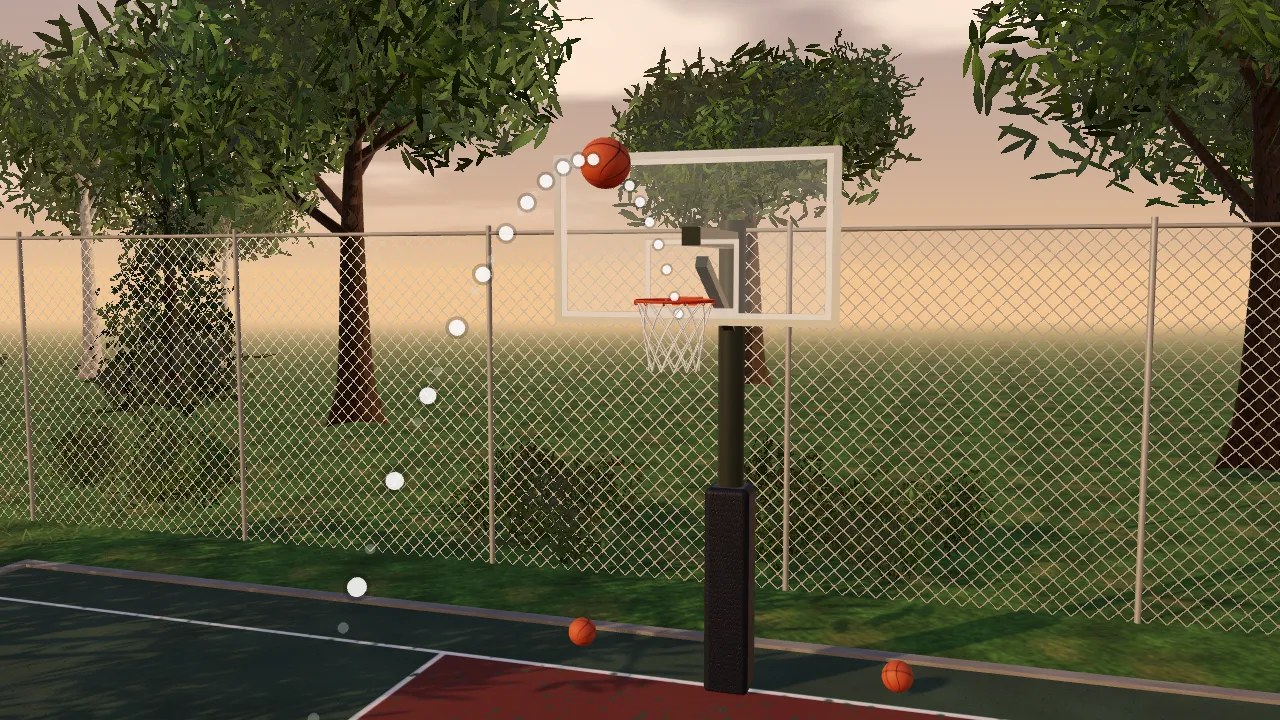
- The dotted line shows the first half of the arc. Open Lab to show the whole arc or hide it.
- Try the three Challenges, or change the Release angle and Backspin in Lab and shoot on the Moon.
Challenges
- Sink a swish: nothing but net
- Bank a shot in off the backboard
- Make three free throws in a row
Try this
- Set the release angle to 40°, then to 60°. Which angle needs the least effort, and which one forgives a slightly wrong pull?
- Turn backspin to zero and shoot ten balls, then try 3 rev/s. Watch how differently the ball behaves when it clips the rim.
- Switch gravity to the Moon. You need much less speed, but the ball hangs in the air for a long time and the arc grows enormous.
Fun facts
- James Naismith invented basketball in December 1891 in Springfield, Massachusetts. The first goals were peach baskets.
- A regulation rim is 3.05 m (10 ft) above the floor. Its inner diameter of 45.7 cm (18 in) is nearly twice the width of a full-size ball.
- In the NBA and in US college basketball, the free-throw line is 15 ft (4.57 m) from the backboard.
- A free throw is worth one point, and it is the only shot in the game taken with nobody allowed to guard you.
The physics of a perfect free throw
Once the ball leaves your hands, only three things act on it: gravity, air resistance and a small sideways push from its spin. Everything else, the swish or the clank, was decided in the instant you let go. A free throw is a pure projectile problem with two numbers to choose: the launch speed and the launch angle.
Speed and angle work together
For any angle there is exactly one speed that carries the ball from your hands to the hoop. Ignoring air, it is v² = g·x² / (2·cos²θ·(x·tanθ − Δh)), where x is the horizontal distance (about 3.95 m here), Δh is how far the rim sits above the release point (0.95 m) and θ is the launch angle. Flat shots need a lot of speed. Very high lobs need even more. In between there is a minimum, and at that sweet spot a small error in speed changes the landing point the least.
Why a high arc is forgiving
The rim is 45.7 cm wide but the ball is about 24 cm across, so there is room for error only if the ball drops in steeply. A ball falling at 45° sees an opening of roughly 45.7 × sin 45° ≈ 32 cm. A flat shot that comes in at 30° sees only about 23 cm, less than the ball itself, so it must bounce in or miss. That is why good shooters loft the ball. A computer study by engineers at North Carolina State University recommended a release angle of about 52° with roughly three backspin revolutions per second, and those are the starting values in the Lab.
What backspin does
A ball spinning backwards drags air around with it. The air is deflected downward behind the ball, so the ball is pushed slightly up: the Magnus effect. More important, backspin changes how the ball bounces. When a spinning ball touches the rim or backboard, friction acts on its surface and steals forward speed, so a ball that clips the rim tends to lose energy and drop softly instead of rocketing away. Turn the backspin off in the Lab and you will see more harsh rebounds.
How precise do you need to be?
In this simulation, from a release height of 2.1 m at 52°, the right speed is about 7.3 m/s, and shots more than about two percent too fast or too slow usually miss. Air drag matters a little: at that speed it is about a tenth of the ball’s weight, enough to shorten the shot by a few centimetres.
For the curious
The ball is a 0.62 kg sphere of radius 0.119 m. Each step adds drag F = ½ρCdAv² (Cd = 0.5) and Magnus lift F = ½ρACLv², where CL grows with the spin ratio rω/v. The motion is integrated 240 times a second. The rim is a torus, the board a box, and every contact applies a bounce (restitution 0.55 on the rim, 0.8 on the court) plus friction that couples the spin to the bounce.
Questions people ask
What is the best angle to shoot a free throw?
Somewhere around 50 degrees for most players. A high arc lets the ball drop through a bigger effective opening, while the speed needed stays close to its minimum, so small mistakes matter less. Taller players can use a slightly flatter shot.
Why do basketball players put backspin on the ball?
Backspin softens contact with the rim and backboard. Friction on the spinning ball removes forward speed when it touches, so near misses are more likely to drop in. It also makes the flight a little more stable and gives a small upward Magnus force.
How high is a basketball hoop?
The top of a regulation rim is 10 feet, or 3.05 metres, above the floor, and the rim is 18 inches (45.7 cm) across.