Cricket Nets
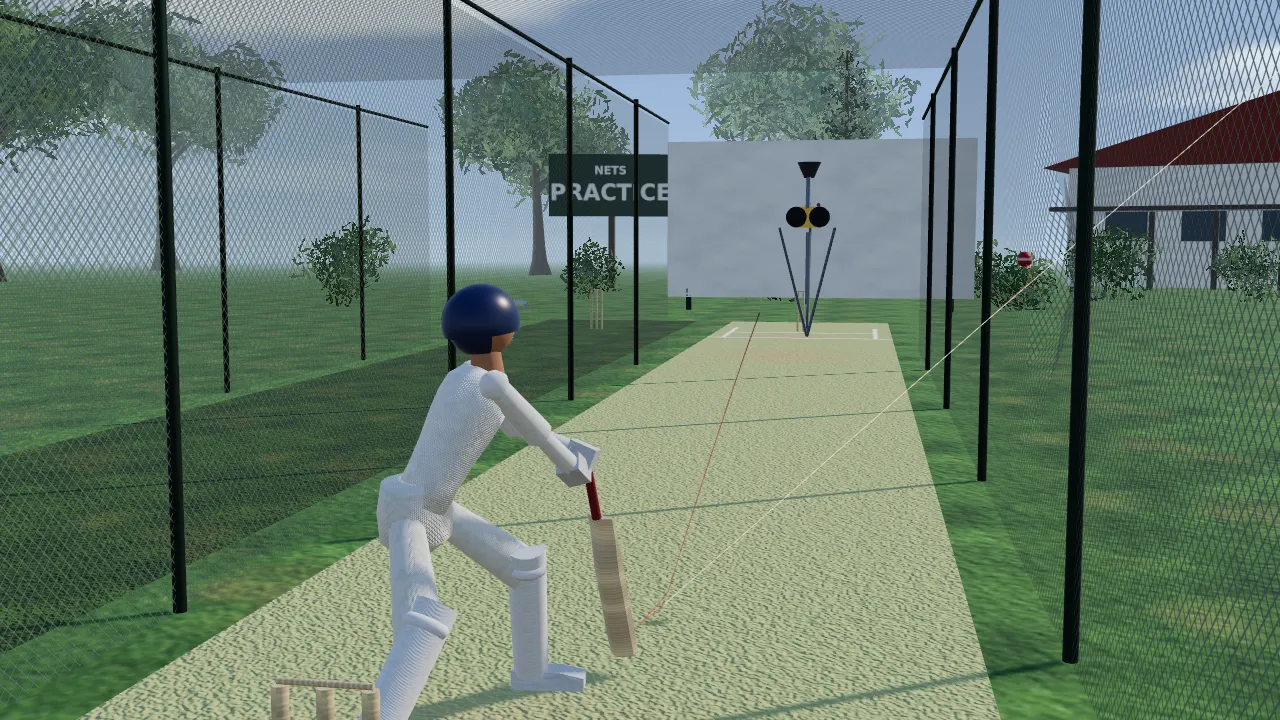
Bat against a bowling machine in the nets: time drives, pulls, cuts.
How to play
- Watch the machine at the far end: its lamp lights as it feeds a ball. Swipe anywhere on the lower part of the screen as the ball reaches you.
- The swipe picks the shot: up for a straight drive, up and right for a cover drive, right for a cut, left for a pull, down (or a tap) for a soft block. A very fast swipe lofts a drive.
- Timing decides the contact: meet the ball at the right moment for the middle of the bat; too early or too late gives a toe-end or an edge.
- The nets stop the ball, and a line through the net shows where it would have gone: a four, a six, a run or a catch. An over is six balls.
- Open Lab to set the machine’s pace, swing, spin and length.
Challenges
- Middle a straight drive back past the machine
- Face a whole over without being bowled
- Hit a six
Try this
- Set the length to short and try to drive: the ball sits up above your bat. Then swipe left and pull it instead.
- Turn on out-swing and play straight drives. A ball that moves late finds the outside edge, so wait for it and play a touch later.
- Choose a leg-break at 75 km/h and watch the ball grip the pitch and turn away from you after it lands.
Fun facts
- A cricket pitch is 22 yards (20.12 m) from one set of stumps to the other and 10 feet (3.05 m) wide.
- The stumps stand 28 inches (71.1 cm) high, and with the bails on top the wicket is 9 inches (22.86 cm) wide.
- The popping crease, where the batter takes guard, is 4 feet (1.22 m) in front of the stumps.
- A men’s cricket ball must weigh 155.9–163 g and measure 22.4–22.9 cm round.
Timing, the sweet spot and the moving ball: the physics of batting
A drive that races to the boundary and one that dribbles off the edge can come from the same bat speed. What changes is where the ball meets the bat, and when. Batting is a collision problem, made harder by a ball that moves in the air and off the pitch.
The collision
For the few milliseconds of contact the ball and the bat push on each other with a huge force. How fast the ball leaves depends on three things: the speed of the bat at the point of contact, how much of the bat’s mass the ball “feels” there, and how springy the collision is (its coefficient of restitution). Near the middle of the blade the ball feels most of the bat’s weight and little energy goes into vibrating the bat, so the ball springs off fast and your hands feel almost nothing. Near the toe, the shoulder or an edge the bat twists and rings, and the ball comes off slowly.
Why timing matters
The bat swings in an arc, so meeting the ball a fraction early or late changes both the contact point and the angle of the face. Early, the face has already turned down and across the line: the ball goes into the ground or squirts to the leg side. Late, the face is still open: the ball balloons up or flies off the outside edge toward the slips. In this game the shot you choose sets the face and the swing, and your timing sets where on the blade the ball lands.
Swing in the air
A new ball has a raised seam. Bowled with the seam tilted, the air flowing over one side trips over it and turns turbulent, so it clings to the ball for longer on that side than on the smooth side. The air leaves the ball pushed one way, and the ball is pushed the other: it swings toward the side the seam points. The effect is strongest at medium-fast pace and fades for very fast or slow balls. Older balls, scuffed on one side, can swing the opposite way at high speed.
Spin off the pitch
A spinning ball lands with its bottom sliding across the pitch. Friction grabs it and turns spin into sideways speed: an off-break turns in toward a right-handed batter, a leg-break turns away. A dry, dusty pitch grips more, so the ball turns more.
For the curious
Treat the contact as a collision between the ball (mass m = 0.16 kg) and an effective bat mass M. With restitution e, the ball leaves at vout = eA·vin + (1 + eA)·Vbat, where eA = (e − m/M)/(1 + m/M). In this game the middle of the bat has M = 1.25 kg and e = 0.5, so eA ≈ 0.33: a 30 m/s ball met by the bat at 25 m/s leaves at about 43 m/s. Off the middle M and e both drop, and the ball can leave at half that speed. In flight the ball feels gravity, drag ½ρCdAv² and, before it lands, a sideways swing force ½ρACsv²; the bounce applies friction at the contact point, which is how spin becomes turn.
Questions people ask
Where is the sweet spot on a cricket bat?
Low on the blade, a little way above the toe, in the thickest part of the wood. Struck there, the ball feels most of the bat’s mass and the bat hardly vibrates, so the ball flies fastest and the impact barely stings your hands.
Why does a cricket ball swing?
The seam disturbs the air on one side of the ball, making it turbulent so that it stays attached to the ball longer there. The air leaves the ball deflected to one side, so the ball is pushed the other way and drifts toward the side the seam points.
What is the difference between an off-break and a leg-break?
Both are spinning deliveries that change direction when they land. For a right-handed batter an off-break turns in from the off side toward the batter’s legs, and a leg-break turns away from the batter toward the off side.