Archery in the Wind
Read the wind flags, draw your bow and land arrows in the gold.
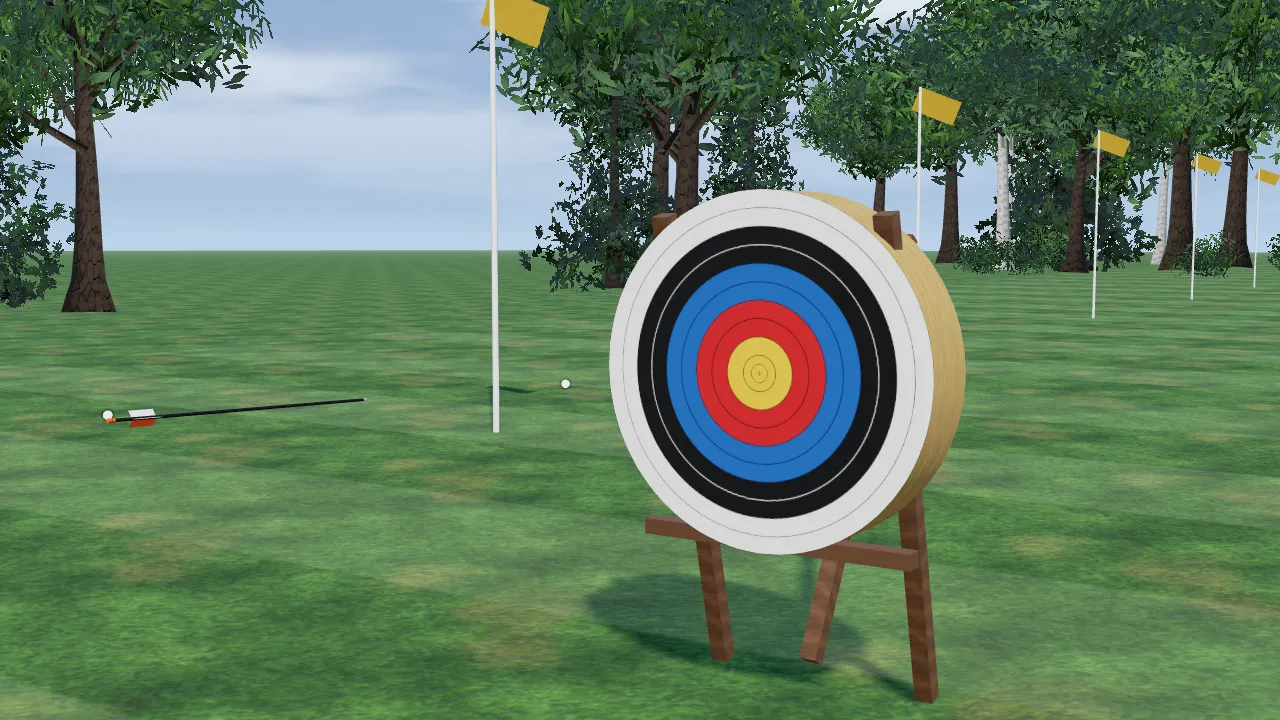
How to play
- Drag down to draw the bow. Keep pulling to raise your aim, then let go to shoot.
- Drag a little left or right to aim off, like a slingshot. Your view zooms in while you aim.
- The dotted line shows the flight in still air. Watch the flags: the wind pushes the arrow away from that line.
- Each end has six arrows and the target moves further back each end. Try the three Challenges, or set your own wind and distance in Lab.
Challenges
- Hit the gold: score a 9 or a 10
- Score a 10 with a crosswind of 4 m/s or more
- Land an arrow on the target face from 50 metres
Try this
- At 20 m, aim straight at the gold in a 4 m/s crosswind and note where the arrow lands. Try the same at 70 m. The drift is far more than 3.5 times bigger.
- Turn Air resistance off in Lab. The wind no longer pushes the arrow at all.
- Turn off Gusts and the wind holds steady. With gusts on, wait for the flags to settle before you release.
Fun facts
- In Olympic archery, recurve archers shoot at a target 70 m away. Its face is 122 cm across and the gold 10 ring is just 12.2 cm wide.
- A standard target face has ten scoring rings in five colours: gold, red, blue, black and white.
- The “archer’s paradox” describes how an arrow, released from the side of the bow, flexes and snakes around it yet still flies true to the target.
Why wind pushes an arrow sideways (and how much)
You might expect a crosswind to shove an arrow sideways the whole time it is in the air, so that an arrow flying for one second in a 4 m/s wind drifts 4 m. In reality it drifts only a few centimetres. The reason is subtle and beautiful, and it is exactly what this simulation reproduces.
Arrows ride the air
Wind is simply air moving. The arrow feels drag from the air flowing past it, so what matters is its velocity relative to the air. In a crosswind that relative flow comes slightly from the side. Fletching at the back acts like a weathervane and swings the arrow’s nose a fraction into the wind, so drag still acts almost straight along the shaft. Drag slows the arrow along its line of flight, but it pushes sideways only by a tiny amount.
The lag rule
Shooters use a neat result: the sideways drift equals the wind speed × the lag time, where the lag is how much longer the flight takes than it would in a vacuum. An arrow that never slowed down would have zero lag and no drift at all, however strong the wind. In this simulation a 55 m/s arrow takes about 1.36 s to cover 70 m, roughly 0.08 s longer than it would without air. So every metre per second of crosswind moves the arrow about 8 cm at 70 m.
Why distance matters so much
The lag grows much faster than the distance, because the arrow keeps losing speed and spends longer and longer in the air. Here a crosswind moves the arrow about 1.5 cm per m/s at 30 m, 3.5 cm at 50 m and around 8 cm at 70 m: more than five times the drift for a little over twice the distance. That is why a breeze barely matters on a short indoor range and decides medals at 70 m.
Aiming higher
Gravity pulls the arrow down throughout its flight. Over 20 m it falls about 0.7 m, and over 70 m about 9 m, so you need an elevation of only about 1.4° at short range but nearly 7° at long range. Real archers set this with an adjustable sight. In this game, pulling further raises your aim.
For the curious
The 20 g arrow leaves at 55 m/s. Each step adds gravity and drag a = −(ρCdA / 2m)·|v − w|·(v − w), where w is the wind (with gentle gusts), A is the shaft’s cross-section and Cd is set so the arrow loses about 8 percent of its speed over 50 m. Fast arrows are sub-stepped so they can never skip through the 30 cm straw boss.
Questions people ask
How much does wind affect an arrow?
Less than you might think at short range and much more at long range. The drift is roughly the wind speed multiplied by the extra time the arrow spends in the air because of drag. In this simulation a 1 m/s crosswind moves an arrow about 1.5 cm at 30 m and about 8 cm at 70 m.
Should you aim into the wind in archery?
Yes. If the wind blows from the left, the arrow drifts right, so you aim a little to the left of the gold. Experienced archers read flags, grass and trees and wait for steady moments before releasing.
How far away is the Olympic archery target?
For recurve archery at the Olympic Games the target is 70 metres away. The face is 122 cm across and has ten scoring rings, with the 10 ring in the middle of the gold.