Sulfur Hexafluoride: The Octahedron
Pull fluorines off SF₆ and watch the rest spread into VSEPR shapes.
How to play
- Grab a fluorine and pull a little: the S–F bond stretches and rings when you let go.
- Pull hard and the fluorine comes right off. The remaining bonds push apart into a new shape.
- Bring a loose fluorine back to the sulfur to bond it again, or use Put all six fluorines back in the Lab.
- The readouts name the shape and its smallest angle. Open Lab to hide the polyhedron or switch to space-filling.
Challenges
- Pull a fluorine a little way, then let it ring
- Pull one fluorine right off and watch the other five rearrange
- Take off two fluorines so that the four left form a tetrahedron
Try this
- Take fluorines off one at a time and note the smallest angle each time: 90°, 90°, 109.5°, 120° and finally 180°.
- At five bonds (the PCl₅ shape), compare the angles: the axial bonds meet the equatorial ones at 90°, the equatorial ones meet each other at 120°.
- Switch SF₆ to space-filling. The six fluorines wrap the sulfur completely, part of why the molecule is so unreactive.
Fun facts
- SF₆ is about five times denser than air, so a light foil boat can float on an invisible layer of it in a tank.
- It is an excellent electrical insulator and is used inside high-voltage switchgear and circuit breakers.
- It is one of the most potent greenhouse gases known: per kilogram it traps more than 20,000 times as much heat as CO₂ over a century, and it lasts for thousands of years.
Six bonds, perfectly spread out
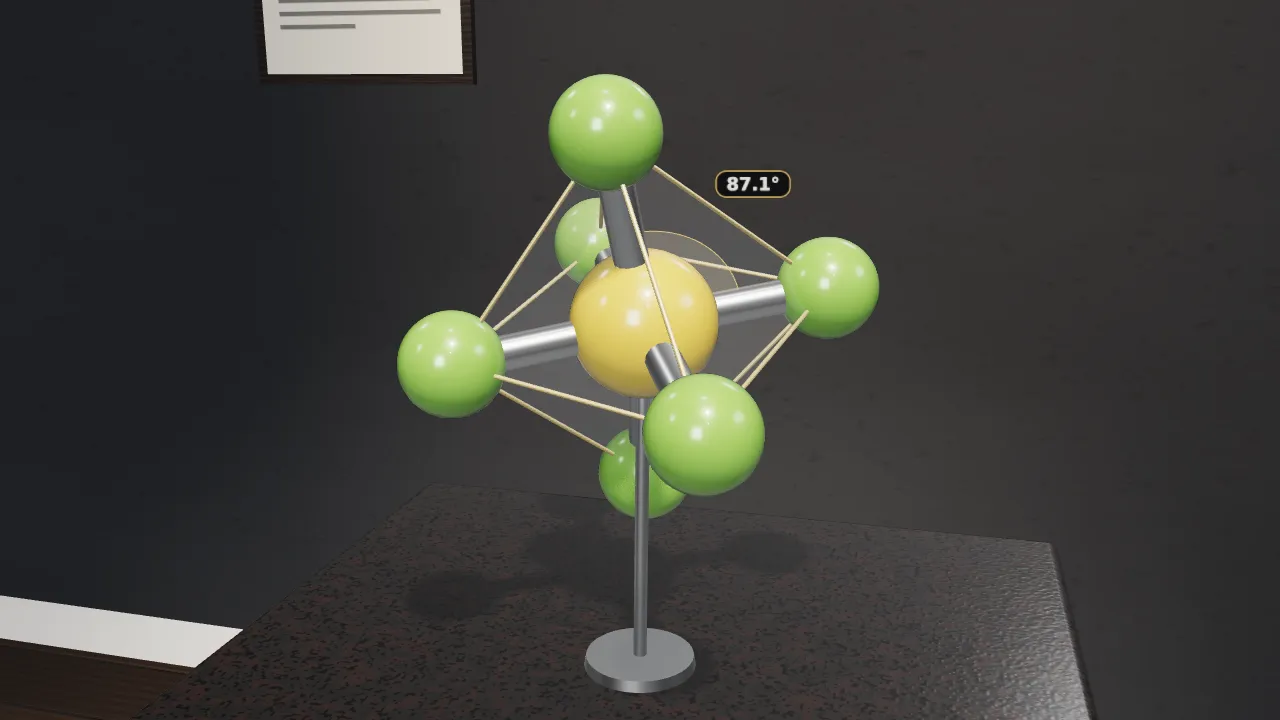
Sulfur hexafluoride is a sulfur atom with six fluorine atoms around it. Six bonding pairs of electrons around one central atom, and no lone pairs, spread out as far apart as possible, and the arrangement that does that is the octahedron: fluorines above and below, and four around the middle, pointing along the x, y and z axes. Every neighbouring pair of bonds is at 90° and every opposite pair at 180°. Each S–F bond is about 1.56 Å long.
The VSEPR family of shapes
The valence shell electron pair repulsion (VSEPR) model predicts a molecule’s shape by assuming that electron pairs around the central atom repel each other and move as far apart as possible. When all the pairs are bonds, there is one ideal shape for each number:
- 2 pairs: linear, 180° (beryllium chloride, BeCl₂, in the gas phase)
- 3 pairs: trigonal planar, 120° (boron trifluoride, BF₃)
- 4 pairs: tetrahedral, 109.5° (methane, CH₄)
- 5 pairs: trigonal bipyramidal, 90° and 120° (phosphorus pentachloride, PCl₅)
- 6 pairs: octahedral, 90° (sulfur hexafluoride, SF₆)
Replace some bonding pairs with lone pairs and the shapes change: four pairs with one lone pair gives ammonia’s pyramid, with two gives water’s bent shape. Pulling fluorines off the model lets you step through the five basic shapes.
More than an octet
Sulfur in SF₆ seems to share twelve electrons, breaking the usual rule of eight. Older textbooks explained this with sulfur’s empty d orbitals; modern calculations suggest the bonds are better described as highly polar, with a lot of positive charge on the sulfur and negative charge on the fluorines. Either way, the octahedral shape is exactly what VSEPR predicts.
A useful but problematic gas
SF₆ is colourless, odourless, non-flammable and very unreactive, partly because the six fluorines shield the sulfur on all sides. It is excellent at stopping electric sparks, so it is used to insulate high-voltage electrical equipment. The same stability is its downside: it lasts for thousands of years in the atmosphere and absorbs infrared very strongly, making it one of the most potent greenhouse gases known, so its use is closely controlled.
For the curious: the model
In the model every bond keeps the S–F length of 1.56 Å; real molecules with these shapes have their own bond lengths (B–F 1.31 Å, C–H 1.09 Å, Be–Cl 1.80 Å; in PCl₅ the axial bonds, about 2.14 Å, are longer than the equatorial ones, about 2.02 Å). The springs are fitted to SF₆’s stretching vibrations, and when a bond is removed the others spread out by pushing each other apart on a sphere, which is the heart of the VSEPR idea. Real SF₄ and SF₅⁻ keep a lone pair, so their true shapes differ. The angle labels are measured live from the jiggling atoms, so they wobble a little around their ideal values.
Questions people ask
Why is SF6 octahedral?
The sulfur atom has six bonding pairs of electrons and no lone pairs. Six pairs repel each other least when they point to the corners of an octahedron, so that is the shape the molecule takes.
What are the bond angles in SF6?
Neighbouring S–F bonds are at 90° to each other and opposite bonds are at 180°.
Why is SF6 so unreactive?
The sulfur is surrounded on all sides by six fluorine atoms, which shield it from attack, and the S–F bonds are strong. That stability makes SF6 useful as an electrical insulator but also means it lasts for thousands of years in the atmosphere.