Stone Skipping
Tilt, spin and flick a flat stone to skip it across a golden lake.
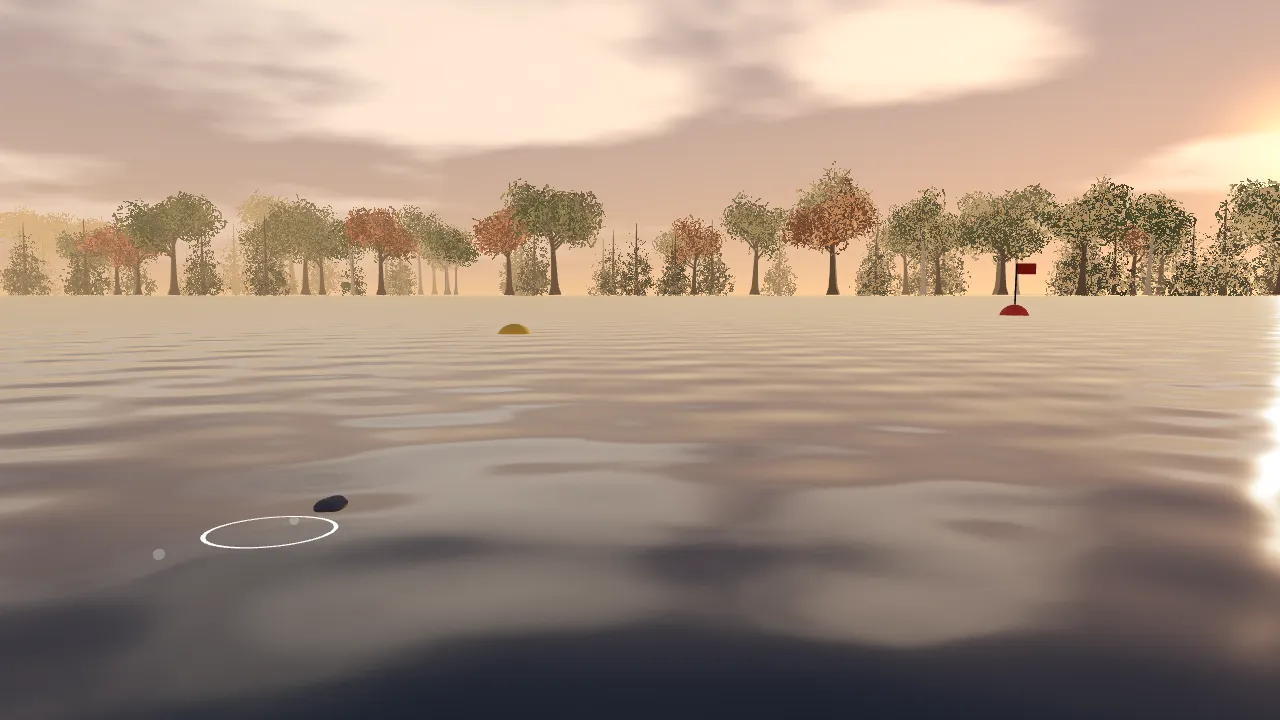
How to play
- Drag the stone in your hand up or down to tilt its front edge, and sideways to give it more or less spin. The pale fan shows the tilt and the circling dots show the spin.
- Then drag back from anywhere on the lake and let go to throw. Pull further for a faster throw, and drag a little sideways to aim.
- The camera follows the stone. Every touch of the water leaves a ripple, and the readout counts the skips and the distance.
- Try the three Challenges, or set an exact tilt and spin in Lab.
Challenges
- Skip a stone five times in one throw
- Get ten skips from a single throw
- Skip a stone all the way out to the far buoy, 30 metres away
Try this
- Throw the same way with no spin, then with plenty. Without spin the stone loses its tilt after a bounce or two and digs in.
- Try a flat stone (0°), a steep one (45°) and one near 20°. The flat one slaps and stops; the steep one brakes and knifes in.
- Throw a little harder each time. Speed helps twice over: more skips, and longer hops between them.
Fun facts
- A 2004 study in the journal Nature by Christophe Clanet, Fabien Hersen and Lydéric Bocquet launched a spinning disc at a pool of water and found that a tilt of about 20° gave the shortest contact with the water.
- Spin keeps a stone steady. Like a spinning top or a gyroscope, a spinning stone resists being tipped, so its tilt survives the knock of each bounce.
- A skipping stone does not bounce off a hard surface: for a moment it planes across the water like a water-skier, pushing water down and away, then lifts off.
Why a stone skips: planing, tilt and spin
A ball bounces because the floor is hard. Water is not hard at all, yet a flat stone can hop across it a dozen times. The secret is speed: for the brief moment it touches, the stone planes across the surface like a water-skier, and the water it shoves aside pushes back.
The push of the water
When the tilted stone touches down, only its back edge dips in. The water pushes on that wet patch roughly in proportion to the patch’s area and to the square of the stone’s speed. The further the stone sinks, the bigger the wet patch and the harder the push, until the stone stops falling and is lifted back out. At 12 m/s the whole contact lasts a few hundredths of a second, and the stone dips only a few millimetres.
The tilt
The push acts at right angles to the stone’s face, so the tilt decides where it points. A stone held flat meets the water with almost no angle between its face and its path: the push is weak, so it sinks deep, and the drag of all that wet area stops it. A steep stone gets a strong push, but one aimed mostly backwards, which brakes it hard. In between there is a sweet spot. In experiments with a spinning disc, Clanet, Hersen and Bocquet found that about 20° gave the shortest, most forgiving contact, and in this game a tilt near 20° also gives the most skips.
The spin
Every touch pushes up on the stone’s back edge, which tries to tip its nose down. A spinning stone behaves like a gyroscope and barely responds, so it keeps its tilt from bounce to bounce. A stone thrown without spin is knocked off its angle at the first or second touch and digs in. That is why good skippers flick their wrist as they let go.
The end of the run
Each bounce costs some speed, partly to friction and partly because the push leans backwards. As the stone slows, its hops get shorter and closer together, until it patters to a stop and sinks.
For the curious
The stone is a 7 cm slate disc, 1 cm thick and about 100 g. On the water the push is F = ½·ρ·U²·A·Cn·sin β along the face, with β the angle between the face and the stone’s path and Cn = 2, plus friction ½·ρ·U²·A·Cf along the path with Cf = 0.03. The wet area is a slice of a circle, A = ½·a²·(θ − sin θ) with θ = 2·arccos(1 − s/a), where s is how far up the face the water reaches. The gyroscope is simplified: after each bounce the tilt drops by an amount proportional to the bounce’s change in vertical speed divided by the spin. Steps are 0.17 ms long while the stone touches the water.
Questions people ask
What is the best angle to skip a stone?
Tilt the stone so its front edge is raised by about 20° and throw low and fast, so it meets the water at a shallow angle. Experiments with a spinning disc found that this tilt gives the shortest, most forgiving contact with the water.
Why does spin help a skipping stone?
A spinning stone behaves like a gyroscope and resists being tipped. Each bounce knocks its back edge up, and without spin that knock quickly changes its tilt until the stone digs in and sinks.
What kind of stone skips best?
A flat, thin, roundish stone that fits your hand and spins cleanly. A thin stone has plenty of face for the water to push on, and a round outline keeps its spin steady.