Frog Lily-Pad Jump
Hop a pond frog across the water, pad to pad, snapping dragonflies.
How to play
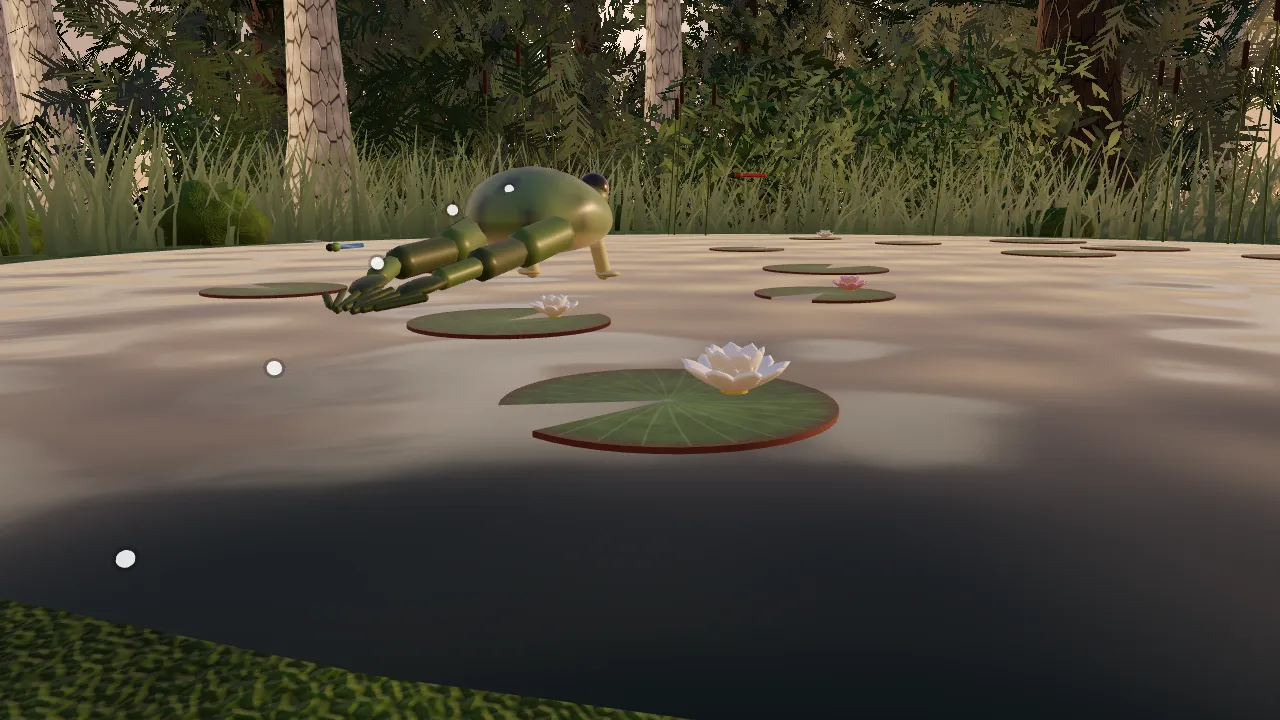
- Drag back from anywhere and let go to jump. The further you pull, the further the frog leaps, and it crouches lower as you pull.
- Drag to the left or right to choose a lily pad. The frog turns to face where you aim, and the dots show the start of its arc.
- Leap through a hovering dragonfly to snap it up. Miss a pad and the frog swims back to try again.
- Reach the far bank to finish the pond. Try the three Challenges, or change the Take-off angle and gravity in Lab.
Challenges
- Snap a dragonfly out of the air in mid-leap
- Leap more than a metre in one jump and land on a lily pad
- Cross the whole pond without a single splash
Try this
- Pick a pad and reach it with a 30° take-off, then with 60°. One of them needs a much harder push.
- Set the take-off angle to 45° and see how far a full-strength jump goes. No other angle will beat it on flat water.
- Switch gravity to the Moon and try crossing the pond in three giant hops.
Fun facts
- Studies of Cuban tree frogs found that they jump using a catapult: a leg tendon is stretched slowly before the jump, then recoils fast, releasing more power than the muscles could alone.
- A frog’s long hind legs give it a long push-off distance, so it can reach take-off speed while its feet are still on the ground.
- Water lily leaves float because they contain air spaces, and their waxy upper surface sheds water.
How a frog turns a push into a long jump
Once its feet leave the pad, a jumping frog is a projectile. Gravity curves its path into a parabola, and air resistance hardly matters for something so small and compact over such short hops. So the length of every jump is decided in the instant of take-off by just two things: how fast the frog is moving and the angle it leaves at.
The range formula
On flat ground, a jump that starts at speed v and angle θ lands a distance R = v² sin 2θ / g away. The sin 2θ part is largest when θ = 45°, so that is the angle for the longest jump at a given speed. Angles that add up to 90°, such as 30° and 60°, land in the same place, but the 60° hop stays in the air much longer. The v² is the dramatic part: doubling take-off speed quadruples the range. In this game a full-strength push of about 3.4 m/s carries the frog roughly 1.2 m at 45°, more than twelve times its own length.
Where the speed comes from
Muscles can only shorten so fast. Biologists studying Cuban tree frogs found that they get around this with a catapult. Before the jump, the leg muscles slowly stretch a springy tendon while the leg is held in place. When the leg is released, the tendon recoils in a fraction of the time it took to load it. Releasing stored energy quickly means much higher power, so the frog reaches take-off speed during the brief push. Long hind legs help too, because a longer push gives the legs more distance to accelerate the body.
Landing on a floating pad
A lily pad floats because air spaces in the leaf make it less dense than water. When the frog lands, the pad is pushed down and water pushes back up, so it bobs and settles like a damped spring. In this pond, every pad is a small spring with a little damping, and the ripples spread from wherever something touches the water.
For the curious
The frog, about 9 cm long, is simulated as a small sphere of 0.05 kg with gravity and a little drag, integrated 240 times a second. Lily pads are floating discs on damped springs: ÿ = −k·y − c·ẏ. A landing on a pad stops the frog dead (no bounce, high friction) and gives the pad a downward kick. The dotted preview runs the same equations ahead of the jump.
Questions people ask
How do frogs jump so far?
Long hind legs and, in the frogs that have been studied, an elastic tendon that works like a catapult. The muscles slowly load the tendon, which then snaps back very quickly, giving more power than the muscles could produce on their own.
What is the best angle for the longest jump?
On flat ground and without air resistance, 45 degrees gives the longest jump for a given take-off speed. Animals often jump lower than that in real life because they also need to move forward quickly or clear obstacles.
Why don’t lily pads sink when a frog lands on them?
The leaves are full of air spaces, which make them buoyant, and they are wide, so a small frog only pushes them down a little before the water pushes back.