Paper Plane Glider
Pick a dart or a glider, bend its flaps and throw it across the park.
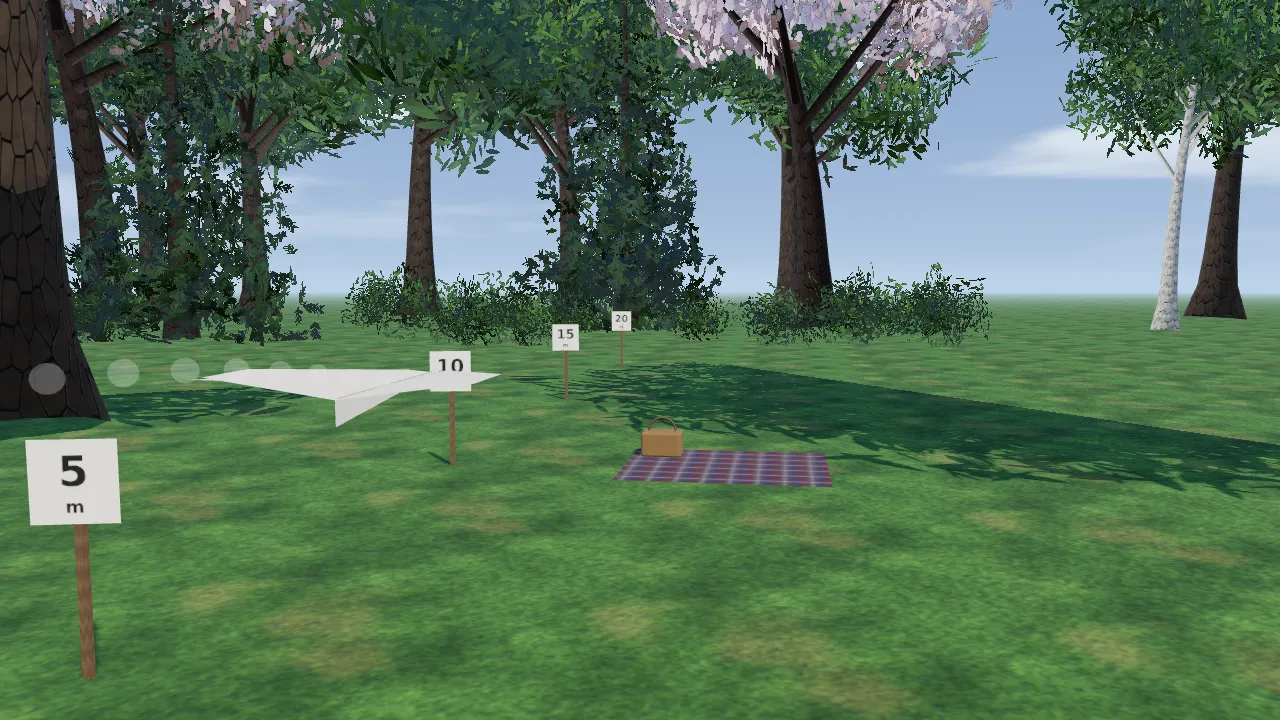
How to play
- Drag back from anywhere and let go to throw. Pull further for a faster throw, and drag a little sideways to aim.
- Drag the plane in your hand up or down to bend the elevator flaps at its tail. Flaps up lift the nose, flaps down drop it, and the dotted line previews the flight.
- Tap the spare plane on the bench to swap between the broad-winged glider and the narrow dart.
- Try the three Challenges, or change the launch angle and gravity in Lab.
Challenges
- Fly a paper plane more than 15 metres
- Land a plane on the picnic blanket, 10 metres away
- Throw a loop the loop
Try this
- With the glider, try a gentle throw and a hard one with the same flaps. The gentle one often goes further: the hard one climbs, stalls and dives.
- Bend the flaps right up and throw hard. The plane pulls up so strongly that it goes over the top in a loop.
- Throw the dart and the glider as far as you can. The dart needs speed; the glider floats away on a light touch.
Fun facts
- A sheet of ordinary 80 g/m² A4 paper weighs about 5 grams.
- A glider’s glide ratio is how far it travels for each metre it sinks. It equals its lift divided by its drag: about 8 for the glider here and about 4 for the dart.
- A wing stalls when it meets the air at too steep an angle: the airflow breaks away from its upper surface, lift falls and drag shoots up.
- Elevators are the hinged surfaces at the back of a plane’s tail. Raising them pushes the tail down and the nose up.
Lift, drag and trim: how a paper plane glides
Once it leaves your hand, a paper plane has no engine. Gravity pulls it down, and the air does everything else. By tilting its wings slightly into the oncoming air, the plane turns some of its fall into forward motion, the way a sledge turns a hillside into speed.
Lift and drag
Air flowing over a tilted wing is pushed downwards, and the wing is pushed up in return. This lift grows with the square of the speed, with the wing area and with the wing’s angle to the airflow, called the angle of attack. The air also holds the plane back with drag: friction over the paper, plus extra drag that comes with making lift. Past about 13° for the glider, the airflow can no longer follow the top of the wing. It stalls: lift falls and drag soars.
Trim: what the flaps do
A plane settles at the angle of attack where the forces on it stop trying to turn it nose up or nose down. The small elevator flaps at the back set that angle. Bend them up and the plane flies nose high, slowly, with lots of lift for its speed. Flatten them and it flies nose low and fast. Each setting has its own natural speed: for the 5 g glider with a few degrees of up-flap, about 2 m/s.
Why gentle throws go further
Throw a plane much faster than its natural speed and the extra lift makes it climb. It slows, the wing stalls, the nose drops and it dives to pick up speed again. These swoops, called phugoids, waste energy. A gentle throw near the plane’s own speed lets it settle straight into its best glide, sinking a metre for every eight metres it travels.
Loops
Now bend the flaps right up and throw hard. At four or five times its natural speed the lift is many times the plane’s weight, so its path curves up, over the top and round. Paper planes are so light that drag slows them quickly, which keeps their loops tight.
For the curious
Lift is L = ½·ρ·V²·S·CL and drag D = ½·ρ·V²·S·(CD0 + k·CL²), so the best glide ratio is (L/D)max = 1 / (2·√(CD0·k)). The glider has 3 dm² of wing, CD0 = 0.04 and k = 0.08; the dart has 1.6 dm², CD0 = 0.06 and k = 0.24, because its stubby wings make more drag for their lift. The pitching moment Cm = Cmδ·δ + Cmα·α + Cmq·(qc/2V) turns the plane: δ is the flap angle, α the angle of attack and q the pitch rate. The flight is stepped with a midpoint method about a thousand times a second, and the dotted preview runs the same equations ahead of you.
Questions people ask
What makes a paper plane fly further?
A smooth throw at about the speed the plane wants to fly, with the flaps set so it neither climbs nor dives. A well-trimmed glider then sinks slowly and covers several metres for each metre of height.
Why does my paper plane swoop up and then dive?
It was thrown too fast for its trim, or its flaps are bent up too far. The extra lift makes it climb, it slows until the wing stalls and the nose drops. Throw more gently or flatten the flaps a little.
How do you make a paper plane loop?
Bend the elevator flaps at the back up and throw hard. At high speed the lift is far bigger than the weight, so the plane pulls up and over in a tight loop.