Steam Engine Crank
Open the steam valve, spin the flywheel and tame a mill engine.
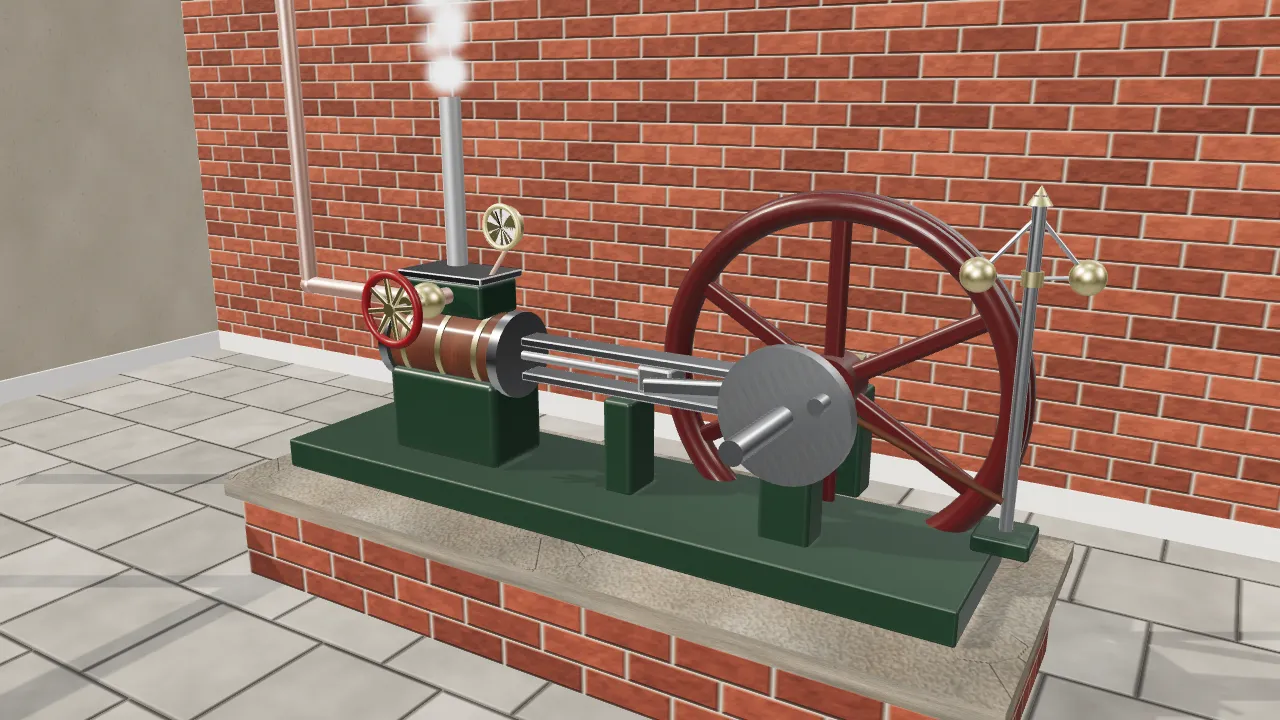
How to play
- Turn the brass handwheel on the steam pipe to open the valve. Steam pushes the piston and the engine starts.
- Grab the flywheel to turn the engine by hand or hold it still. Let go and the steam takes over again.
- Lift the brass governor balls with your finger: the throttle closes and the engine slows down.
- Open Lab for the boiler pressure, the cut-off, the flywheel size and the load.
Challenges
- Open the steam valve and get the engine up to 120 rpm
- Stop the flywheel on a dead centre, then start the engine with a push
- Lift the governor balls by hand until the engine slows below 60 rpm
Try this
- Fit the small flywheel. The speed surges and slows twice every turn, as each stroke pushes and the dead centres coast.
- Stop the engine, then try to start it with the crank exactly in line with the piston rod. There is no turning force at a dead centre.
- Shorten the cut-off to 15 %. The engine uses less steam per stroke but still runs, because expanding steam keeps pushing.
Fun facts
- James Watt’s separate condenser, patented in 1769, made steam engines far more efficient.
- Watt adapted the centrifugal governor to control the speed of rotating steam engines in the late 1780s.
- A flywheel stores energy and carries the crank through the dead centres, where the piston cannot turn it.
From a push to a spin: crank, flywheel and governor
Steam pushes a piston in a straight line. A factory needs a turning shaft. The crank, the connecting rod and the flywheel solve that problem, and the governor keeps the result steady.
The push
Steam at gauge pressure p presses on the piston’s area A with a force F = pA. This engine is double-acting: steam enters on alternate sides, so it pushes on both strokes. The valve shuts off the steam early in each stroke, at the “cut-off”. After that the trapped steam expands and its pressure falls roughly as p ∝ 1/V (Boyle’s law). Expansion gets extra work from each puff of steam, which is why engines with an early cut-off were more economical.
The crank
The connecting rod turns the piston’s force into a turning effect on the crank. How much depends on the angle: the torque is F × |dx/dθ|, where x(θ) = r cos θ + √(l² − r² sin² θ) is the piston’s position for crank angle θ, r the crank radius and l the rod length. Twice each turn the crank lines up with the rod. There dx/dθ = 0, so the piston can push as hard as it likes and the shaft gets no turning force. These are the dead centres.
The flywheel
A heavy flywheel stores kinetic energy, ½Jω², and smooths out the uneven push. It speeds up a little during each power stroke and gives energy back through the dead centres. In this model, with the governor holding about 150 rpm, a small flywheel lets the speed swing by roughly ±40 % every turn, the medium one about ±5 % and the huge one about ±1.5 %.
The governor
Two heavy balls swing round on the governor spindle. The faster it turns, the further they fly out and up, like a conical pendulum, with cos α = g/(ω²L). Linked to the throttle valve, rising balls close it and falling balls open it. This automatic feedback keeps the speed nearly constant as the load changes, one of the first widely used control systems.
For the curious
The shaft obeys J·ω′ = τsteam(θ) − c·ω − τfriction, integrated 600 times a second, with a 10 cm bore, 20 cm stroke and a 45 cm connecting rod. The load c·ω stands for the machinery the engine drives, and the power readout is c·ω².
Questions people ask
What does the flywheel do on a steam engine?
It stores energy and smooths the motion. The piston pushes unevenly and gives no turning force at the two dead centres, so the flywheel’s momentum carries the crank round between power strokes.
What is a dead centre?
It is the crank position where the connecting rod and crank lie in a straight line. At that moment the piston’s push cannot turn the shaft, so a single-cylinder engine stopped there will not start without help.
How does a Watt governor work?
Weights on hinged arms spin with the engine. As speed rises they swing outward and upward, and a linkage closes the throttle valve. As speed falls they drop and open it, holding the engine near a set speed.