Spider Web Builder
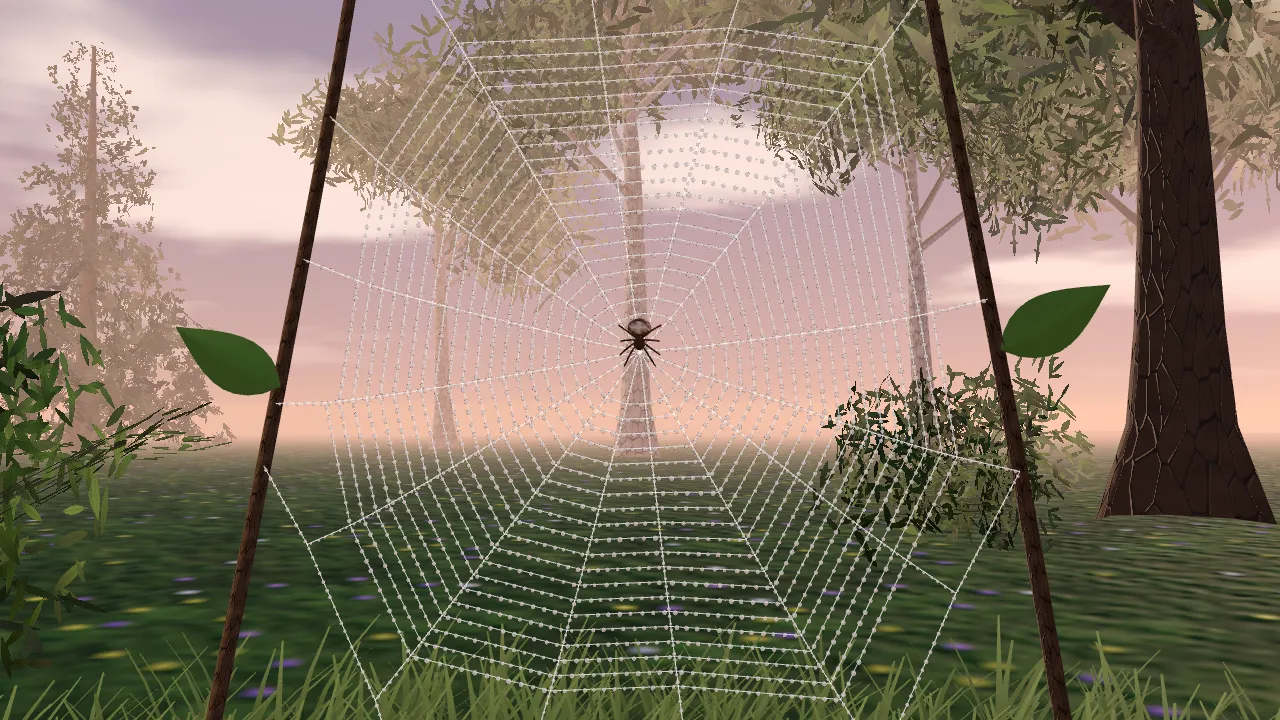
Lay the threads of an orb web, let the spider spin it, then catch a fly.
How to play
- Drag from the middle of the space out to a stem or to the thread at the top to lay a spoke. The first spoke fixes the hub. Drag from stem to stem for extra frame threads.
- Lay spokes all the way round the hub, then tap the spider. It spins the sticky spiral from the outside in.
- Tap the air beside the web to let a fly loose; it flies at the web. Tap a thread to pluck it and see the spider come to check.
- Drag across the finished web to drift mist over it, and watch the silk bead up with dew. Try the three Challenges, or open Lab to start a new web.
Challenges
- Build a web with at least 12 spokes
- Catch a fly in the sticky spiral
- Bead every turn of the spiral with dew
Try this
- Pluck a spoke near the edge. The vibration runs along the spoke to the hub, and the spider sets off along it to see what is there.
- Let a fly loose close to the hub, inside the small open zone with no spiral. It can pass through, because the spokes there are not sticky.
- Bead the whole web with dew and watch it sag a little. Every drop adds weight, and a heavy dew can weigh far more than the silk itself.
Fun facts
- Many orb-weavers build a fresh web every day or two, and often eat the old silk to recycle its protein.
- An orb web uses different silks: strong, stiff dragline silk for the frame and spokes, and stretchy capture silk coated in sticky glue for the spiral.
- Weight for weight, dragline silk is stronger than steel, and it can absorb more energy before it breaks than almost any material people make.
- Some hunting spiders, such as Portia jumping spiders, pluck other spiders’ webs to imitate a trapped insect and lure the owner out.
How an orb web catches insects, and why it beads with dew
An orb web looks delicate, but it is a carefully engineered trap. It must stop an insect flying at a metre or two per second without tearing, hold on to it, and tell the spider exactly where it is, all with silk thinner than a human hair.
Building in order
A garden spider starts by letting a thread drift on the breeze until it snags on something: the bridge line at the top of this web. It strengthens that line, drops down to make a Y-shaped frame, and adds more frame threads. Then it lays the spokes, or radii, from a central hub out to the frame. It walks a temporary spiral outwards to hold everything steady, and finally spins the sticky capture spiral from the outside in, crossing each spoke once per turn.
Two kinds of silk
The frame and spokes are made of dragline silk, which is stiff and very strong. The capture spiral is a different silk: soft and so stretchy that it can extend to several times its length, and coated with droplets of glue. When an insect hits, the stretchy spiral and the slightly springy spokes give way together, turning its energy of motion into stretch and then into heat, so the insect is stopped gently enough that it bounces back into the glue rather than snapping straight through.
Feeling the catch
A struggling insect shakes the threads, and the tight spokes carry those vibrations to the hub like strings on an instrument. The spider waits there with a leg on several spokes and can tell which way the shaking comes from, so it runs straight out to the right place and wraps its prey in silk.
Beads of dew
On a cool morning, water coats the threads. A thin cylinder of liquid is unstable: surface tension squeezes it more where it is narrow, so tiny ripples grow until the film breaks into a row of evenly spaced beads, with smaller satellite drops between them. This is the Plateau–Rayleigh instability, the same effect that breaks a thin stream from a tap into drops, and it is also how the glue on a capture thread gathers into droplets. The dew adds weight, so a beaded web sags.
For the curious
Each thread here pulls with F = EA·ε, where ε is its strain, with EA = 0.06 N for spokes and frame and 0.004 N for the spiral; threads go slack instead of pushing. Waves travel along a thread under tension T with mass per length μ at c = √(T/μ). A fly of mass mf arriving at speed v hands the web its momentum, setting the nearby threads moving at about mfv/(mf + mweb). A liquid cylinder of radius r is unstable to ripples longer than its circumference, 2πr, and breaks up fastest at a wavelength of about 9r.
Questions people ask
How does a spider build an orb web?
It floats a bridge line on the breeze, builds a frame around it, lays spokes from a central hub to the frame, walks a temporary spiral outwards and then spins the sticky capture spiral from the outside in. A garden spider can build a complete web within about an hour.
Why don’t spiders stick to their own webs?
They walk mostly on the spokes and frame, which are not sticky, and touch the capture spiral carefully with the tips of their legs. Their legs are covered in fine hairs and a coating that resists the glue, which also helps.
Why do spider webs collect dew?
On cool, still mornings, water condenses on the thin threads, and the glue on the capture spiral draws in moisture from the air. The thin film of water on each thread then breaks into evenly spaced beads because of surface tension, which is why dewy webs look strung with pearls.