Chameleon Tongue
Tap a cricket and a chameleon fires its tongue; walk it into the sun.
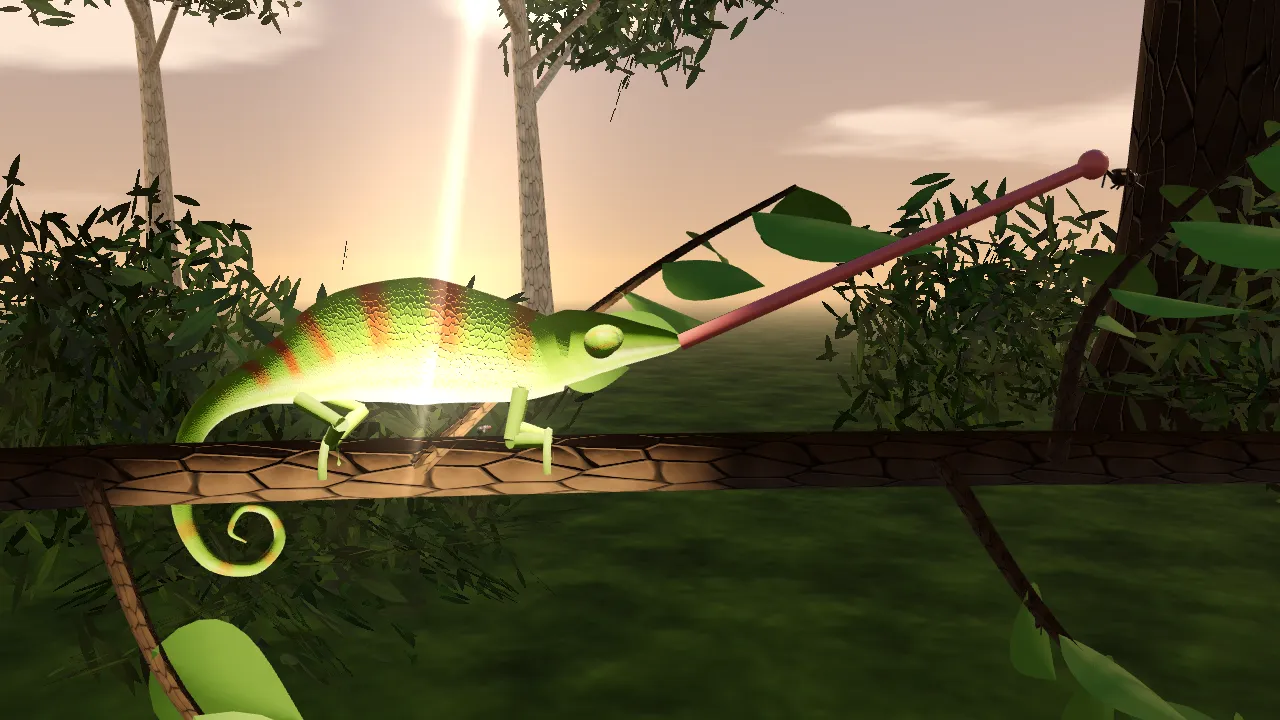
How to play
- Tap a cricket, or a buzzing fly. Both eyes lock on, the head turns, and the tongue shoots out, shown in slow motion.
- Drag the chameleon to walk it along the branch: closer to its prey, or into the beam of sunlight to warm up.
- Drag a cricket onto a different leaf to test the chameleon’s reach. Tap the chameleon to excite it and see its colours shift.
- Try the three Challenges, or open Lab to change the air temperature and show the tongue’s reach.
Challenges
- Catch a cricket with the chameleon’s tongue
- Catch an insect at full stretch, at least 29 cm from its mouth
- Warm the chameleon in the sunbeam until its colours brighten
Try this
- Set the air to 15 °C in the Lab, keep the chameleon in the shade and catch a cricket. The tongue still shoots out just as fast, but it takes about twice as long to pull back in.
- Switch on the reach ring in the Lab and put a cricket just outside it. The chameleon will still try, and its tongue stops a little short.
- Tap the chameleon a few times. As it gets excited, the crystals in its skin spread apart and its green turns towards yellow and orange.
Fun facts
- A chameleon’s tongue is launched like a catapult: elastic tissue around the tongue bone is stretched beforehand and released all at once. In one small species, high-speed filming measured the tip accelerating at more than 250 times the pull of gravity.
- Because the launch runs on stored elastic energy, it works almost as well in the cold. Pulling the tongue back in uses muscle directly, and that slows down when the chameleon is cool.
- The tongue tip is coated in mucus hundreds of times more viscous than human saliva, which helps it hold on to slippery prey.
- Chameleons change colour mostly to signal to each other and to manage their temperature, rather than to match their background.
How a chameleon’s tongue and colours work
A chameleon sits still for long minutes, swivelling its eyes, then catches an insect faster than you can blink. Two remarkable pieces of biology are on show here: a tongue powered by stored elastic energy, and skin that changes colour by rearranging tiny crystals.
A tongue that works like a catapult
The tongue is wrapped around a slender bone that points out of the mouth. Before a strike, a ring-shaped accelerator muscle squeezes the tongue and stretches springy sheaths of collagen packed around that bone. When the chameleon lets go, the sheaths recoil all at once and fling the tongue forward. Muscles on their own could never reach that speed, because they cannot shorten fast enough; storing the work slowly and releasing it in a few hundredths of a second is how the chameleon multiplies its power. The tongue can reach around twice the length of the body, or more in small species, and its sticky, cup-shaped tip grips the prey for the trip back.
Warm or cold
Chameleons are cold-blooded, so their muscles work more slowly when they are cool. The launch hardly cares, because the energy was already stored in the elastic tissue. Pulling the tongue back in is done by muscle in real time, so it slows down in the cold, which you can test with the Lab’s air temperature.
Colour from crystals
Much of a chameleon’s colour is not pigment but structure. Cells called iridophores hold a lattice of tiny guanine crystals. Light reflecting from the many layers of that lattice adds up for one band of wavelengths, set by the spacing of the crystals. In a calm panther chameleon the crystals sit close together and reflect blue. A layer of yellow pigment above them filters that blue, and blue seen through yellow looks green. When the animal is excited, the lattice spreads out and reflects longer wavelengths, so the skin shifts to yellow, orange and red. A deeper layer of larger crystals reflects infrared light from the sun.
Dark when cold
Cells filled with dark melanin can spread their pigment through the skin or pull it back. A cold chameleon darkens, which helps it absorb sunlight and warm up; once it is warm the melanin retreats and the bright colours show again. In this scene the skin colour is calculated from these layers: the reflected spectrum of the crystals, filtered by the yellow pigment and dimmed by the melanin.
For the curious
Here the launch force falls as the sheaths unload: a = a₀(1 − t/T) with a₀ = 600 m/s² and T = 18 ms, so the tip leaves at v = a₀T/2 ≈ 5.4 m/s after 6.5 cm. It then slows at 57 m/s² as the tongue stretches, stopping at the 32 cm reach. Retraction takes 0.28 s × 2(30 − T)/10 at a body temperature of T °C. A stack of layers with spacing d reflects most strongly at λ ≈ 2neffd, where neff is the average refractive index; here the reflected peak moves from 482 nm when calm to about 594 nm when excited.
Questions people ask
How far can a chameleon shoot its tongue?
Around twice the length of its body, not counting the tail. Small species reach relatively furthest, sometimes more than twice their body length. In this scene a chameleon with a 19 cm body reaches 32 cm, and prey further away than that is out of range.
Why do chameleons change colour?
Mainly to communicate, for example when males display to rivals or females signal that they are not interested, and to control their temperature by darkening to absorb heat. The colour comes from crystals in the skin that change their spacing, together with yellow pigment and dark melanin.
How does a chameleon hold on to its prey?
The tongue tip is covered in very thick, sticky mucus, and it hits the insect fast enough to make good contact. The tip also bunches into a small cup around the prey. Then muscles pull the tongue back into the mouth with the insect stuck to it.