Hummingbird Hovering
Guide a hovering hummingbird to flowers and see its wingbeat slowed.
How to play
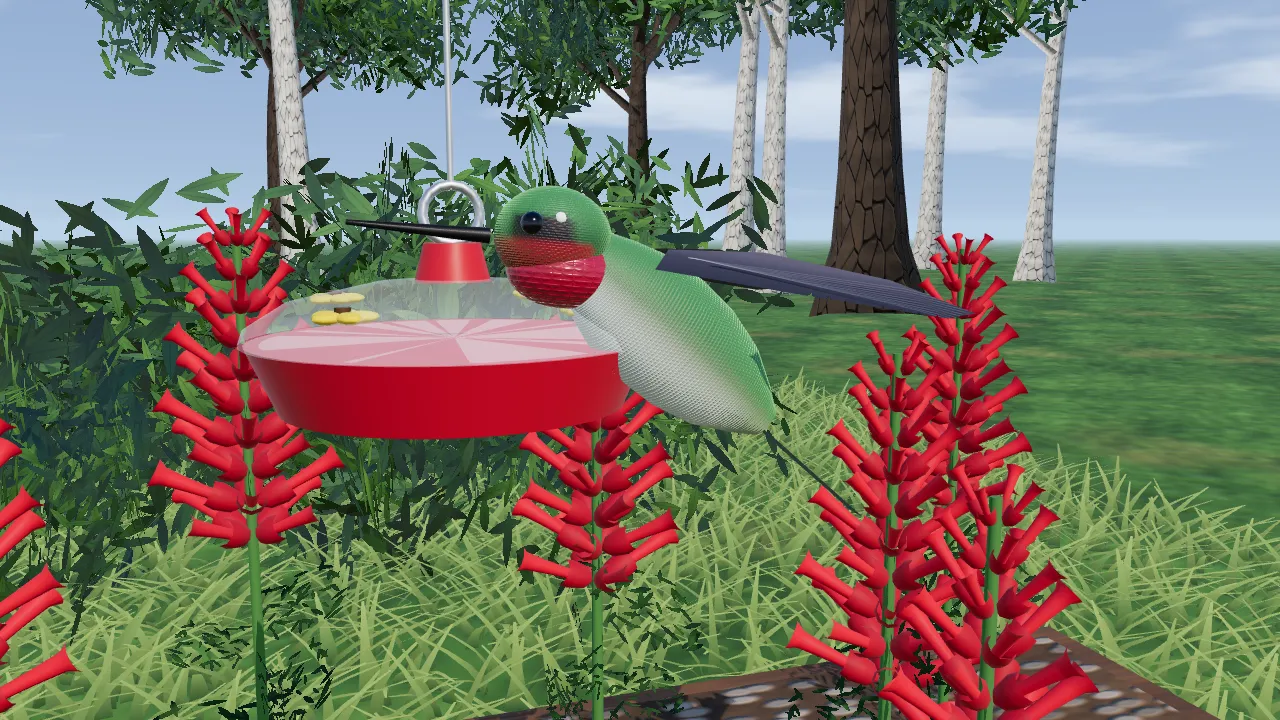
- Drag the feeder somewhere new and the hummingbird follows, tilting its wing strokes to fly there.
- Tap a red salvia flower and the bird flies over and feeds from it.
- Swipe across the bird to send a puff of air at it, and watch it steady itself. Tap the bird to switch between slow motion and real speed.
- Try the three Challenges, or open Lab to trace the wingtip, show the lift on each wing, or change the bird’s mass and the air.
Challenges
- Lead the hummingbird around by dragging the feeder a good 25 cm
- Send the hummingbird to feed at three different salvia flowers
- Puff air at the hovering bird and watch it fly back to its spot
Try this
- Turn on the wingtip trace and look at the bird from above, then from the side. The tip sweeps a flattened figure eight, almost level with the ground.
- Choose the 4,500 m air. The air is thinner, so the stroke angle needed to stay up grows. Then make the bird heavier and watch it grow again.
- Show the lift arrows in the Lab and watch them through one beat. They are longer during the forward stroke, which in this model carries about three quarters of the bird’s weight.
Fun facts
- In 2005, researchers measuring the airflow around hovering rufous hummingbirds found that the downstroke supported about 75% of the bird’s weight and the upstroke about 25%.
- Hummingbirds can fly backwards, which very few other birds can do for more than a moment.
- A ruby-throated hummingbird weighs about 3 grams, roughly as much as a small coin.
- The male’s ruby throat is iridescent: its colour comes from the structure of the feathers, so it flashes red at some angles and looks dark at others.
How a hummingbird stands still in the air
Hovering is one of the hardest things a flying animal can do. With no forward speed, the only air moving over the wings is the air the wings move themselves, so they must beat fast, around 50 times a second for a ruby-throated hummingbird. Even so, the trick isn’t only speed but the shape of the stroke.
A sideways figure eight
When a hummingbird hovers, its body is tilted steeply upward and its wings sweep forward and backward in a nearly horizontal plane, rather than flapping up and down. The wingtip also rises and dips a little, twice each beat, so seen from the side it traces a flattened figure eight. Turn on the wingtip trace to see it.
Lift on both strokes
Most birds get almost all their lift on the downstroke. A hummingbird’s wing can flip over at the end of each stroke by rotating at the shoulder, so its leading edge still leads on the way back, at a positive angle to the air. This lets it make lift on the backstroke as well. The two strokes are not equal, though. Measurements of the airflow around hovering hummingbirds found that the downstroke supports about three quarters of the weight and the upstroke about a quarter. The lift arrows in this simulation show the same imbalance.
Pushing air down
To stay up, the bird must push air downward hard enough that the reaction balances its weight. Treating the wings as a disc of air, momentum theory gives the speed of the downwash, w = √(mg / 2ρA), where A is the area swept by the wings. For a 3.4 gram bird with wings 4.5 cm long, that is about 1.5 metres per second at sea level. In thin mountain air there is less air to push, so the bird has to work harder. Experiments suggest that hummingbirds respond mainly by sweeping their wings through a wider arc.
For the curious
The stroke angle is φ(t) = (Φ/2) cos(2πft) and the up-and-down deviation is θ(t) = 0.14 sin(4πft), with f = 53 Hz. At the radius of gyration r₂, the wing moves at U = r₂|dφ/dt|. Each wing makes lift L = ½ρSCLU², with CL = 1.6 sin(2α), using an angle of attack of 40° on the forward stroke and 14° on the backstroke, when the twisted wing is also less effective. Averaging over a beat and setting mean lift equal to weight gives the stroke angle Φ the bird needs, shown in the readout. The model ignores unsteady effects such as the leading-edge vortex that real wings rely on, so treat the numbers as estimates.
Questions people ask
How do hummingbirds hover?
They sweep their wings forward and back in a nearly horizontal stroke, flipping each wing over at the end of the stroke so it makes lift in both directions. The downstroke still does most of the work, about three quarters in hovering rufous hummingbirds.
How fast do hummingbird wings beat?
It depends on the species and what the bird is doing. A hovering ruby-throated hummingbird beats its wings around 50 times a second, while larger species beat more slowly.
Why do hummingbirds’ wings make a figure-eight shape?
As the wing sweeps forward and back, it also rises and dips slightly twice in each beat, and it twists at each end of the stroke. Seen from the side, the wingtip traces a flattened figure eight.