Honeybees and Flowers
Plant flowers, move the sun and read honeybees’ waggle dances.
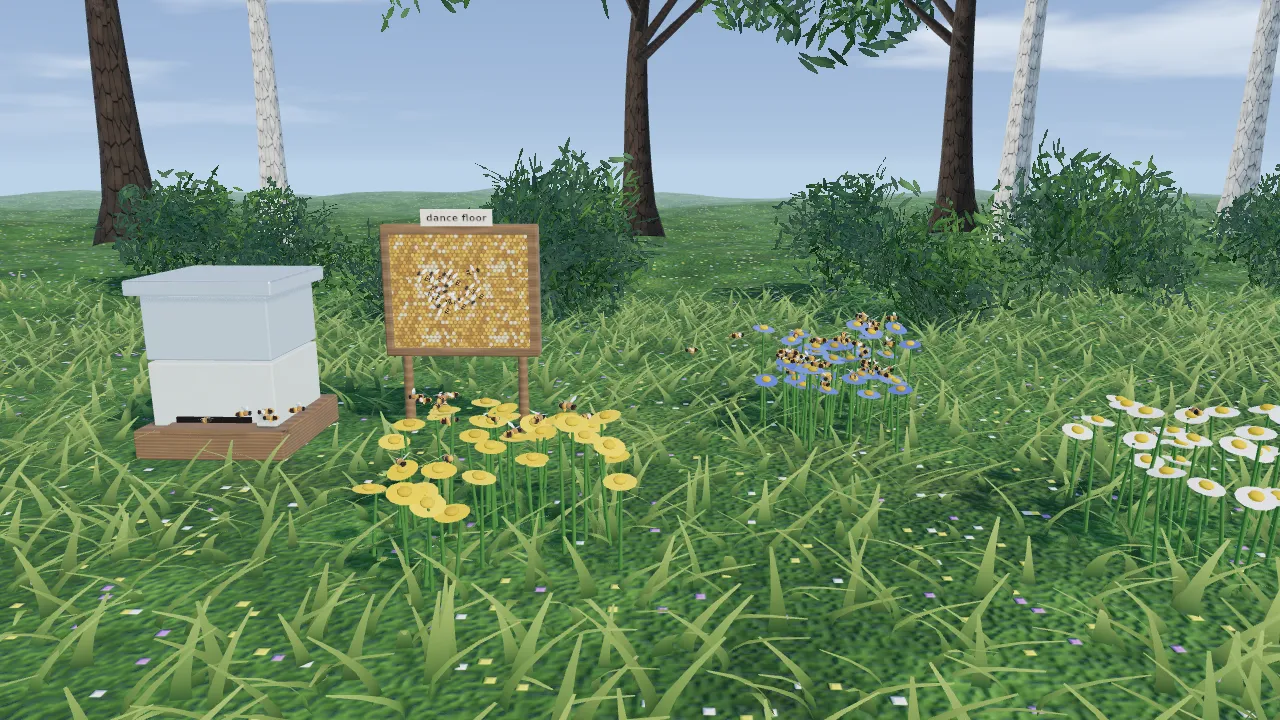
How to play
- Tap the meadow to plant a patch of flowers. A scout soon finds it, drinks, and flies home in a beeline.
- Zoom in on the glass-fronted comb labelled “dance floor”: bees from rich patches dance there, and the waggle run points the way.
- Drag across the sky to move the sun round, as the hours would. The flowers stay put, but every dance swings to a new angle.
- Try the three Challenges, or open Lab to show which patches the dancers are advertising.
Challenges
- Plant a patch of flowers and see a scout bee drink from it
- Watch a bee dance on the comb for flowers you planted
- Drag the sun across the sky while bees dance, and see the dances turn
Try this
- Zoom in on the dance floor. Bees dancing for the blue borage waggle in one direction and bees from the yellow patch in another. Each angle from straight up matches that patch’s direction from the sun.
- Drag the sun round by a quarter turn. Each dancer keeps the same angle to the sun, so every run on the comb turns by a quarter too.
- Turn on the dance lines and wait. Most dancers advertise the blue borage, the richest patch, and most foragers end up there.
Fun facts
- Karl von Frisch worked out the meaning of the honeybee waggle dance and shared the 1973 Nobel Prize in Physiology or Medicine for his studies of animal behaviour.
- On a vertical comb in the dark hive, bees use “straight up” to stand for the direction of the sun.
- Experiments by Thomas Seeley and colleagues showed that a colony shifts its foragers toward the richer of two food sources, even though no single bee compares them.
- Honeybee workers carry pollen home packed into baskets of stiff hairs on their hind legs.
How a dance sends bees to the best flowers
A honeybee colony has to find food across a landscape far bigger than any one bee could survey, and it does so without a leader. Each forager follows a few simple habits, and good decisions emerge from all of them together.
The waggle dance
A forager returning from a good patch of flowers often dances on the comb. She runs in a straight line while shaking her body from side to side, the waggle run, then loops back round, alternating left and right, and repeats. The direction of the waggle run carries the message. On the vertical comb, straight up stands for the direction of the sun. A run angled 40° to the right of vertical means “fly 40° to the right of the sun.” The duration of the waggle run tells the distance, with longer runs for food that is farther away. Bees following the dancer pick up this information along with the scent of the flowers.
In this meadow, the comb behind glass shows every dance. Dancers for each patch point in a different direction, and moving the sun in the Lab rotates them all. The meadow is a small model, so distances are scaled down: real bees advertise food hundreds or thousands of metres away.
Choosing without comparing
No bee visits every patch and picks the best. Instead, a forager dances longer and with more waggle runs when her flowers are rich and plentiful, and not at all when they are poor or nearly empty. Bees waiting in the hive follow dances more or less at random, so better patches, advertised by more dancing, recruit more foragers. As a patch is drained its dancers fall silent and recruits flow elsewhere. Scouts keep exploring, which is how the colony discovers the new flowers you plant.
Flowers on the other side
The flowers benefit too. Each visit leaves pollen dusted from earlier flowers, which is why bees are such important pollinators of wild plants and crops. Here, each flower’s centre fades from gold to brown as its nectar is drunk, then slowly refills.
For the curious
Each bee is a small state machine: resting in the hive, flying out, drinking at flowers, flying home in a straight line and dancing. A returning forager performs n = 10 × q × (0.35 + 0.65 L) − 1.2 dance circuits (rounded, and none if n ≤ 0), where q is the patch quality from 0 to 1 and L the share of nectar left. Its waggle angle from vertical is the patch’s compass bearing minus the sun’s bearing, and the run lasts longer for farther patches. A resting bee joins a dance with a probability that grows with the number of dancers, then picks a patch in proportion to how many bees are dancing for it.
Questions people ask
What is the honeybee waggle dance?
It is how a forager tells nestmates where she found food. She repeats a short straight run while waggling her body. The angle of the run from vertical on the comb gives the direction relative to the sun, and the length of the waggle run gives the distance.
How do bees know which flowers are best?
No single bee compares them. Foragers from rich, plentiful flowers dance longer and more often, so they recruit more nestmates, while bees from poor flowers dance little or not at all. The colony’s workforce shifts toward the best sources as a result.
Why do bees dance in the dark hive?
Inside the hive there is no sun to point at, so bees translate the sun’s direction into “straight up” on the vertical comb. Other bees follow the dancer closely, sensing her movements and the scent of the flowers she visited.