Monarch Butterfly Migration
Guide migrating monarchs through wind and thermals to a fir roost.
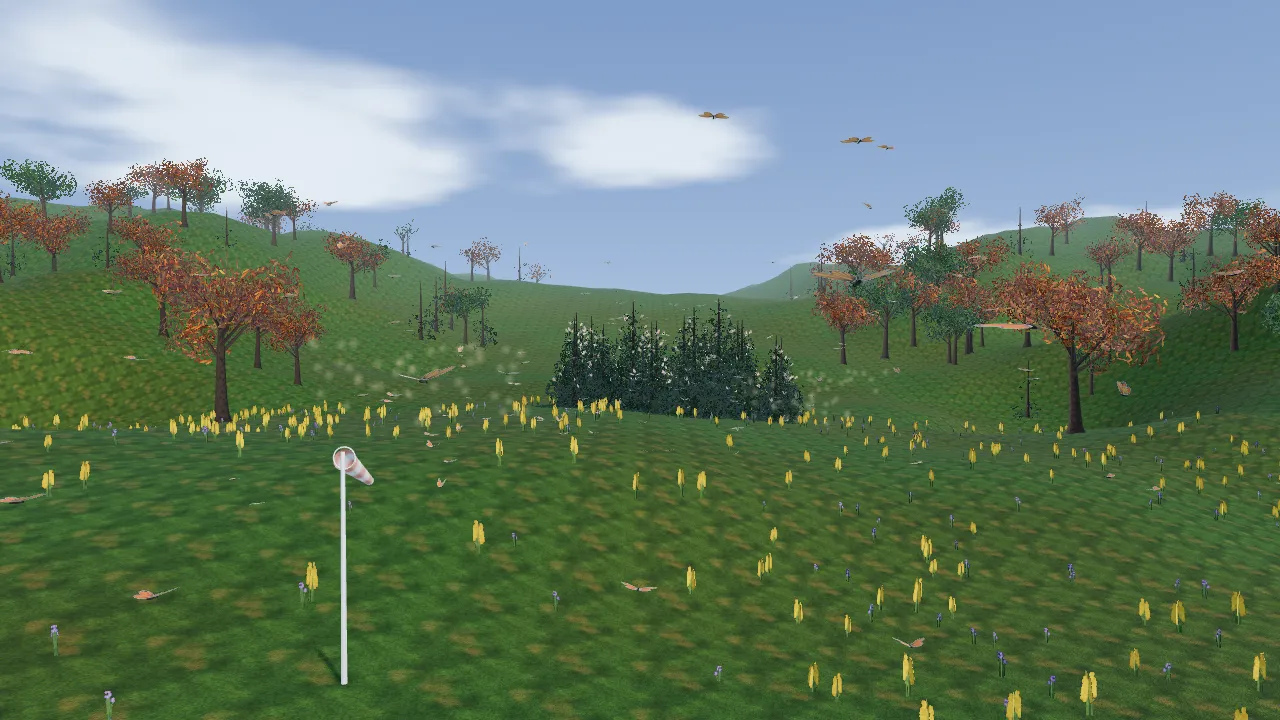
How to play
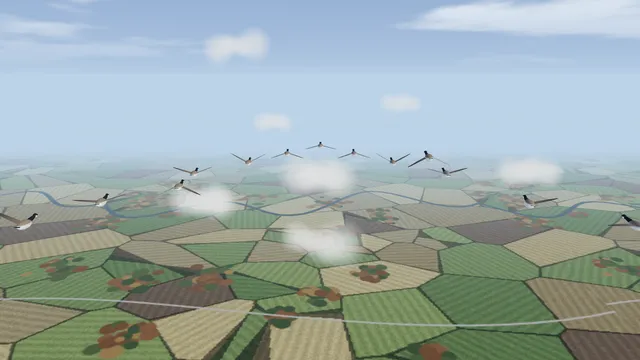
- Tap a sunny field to start a thermal. Monarchs that find it circle upward in the rising air, then glide on toward the fir trees.
- Grab the windsock and swing it round to change where the wind blows. Side-on, watch the monarchs aim into it to hold their course.
- Try the three Challenges, or open Lab for the wind’s speed, or to stop them correcting for drift.
- Drag the sky to look around. Pinch or scroll to zoom in on a butterfly.
Challenges
- Start a thermal and watch a monarch soar three metres up inside it
- Swing the windsock to a crosswind and see the monarchs aim into it
- Lift fifteen monarchs on your thermals and see them roost in the firs
Try this
- Set a crosswind and switch off “Monarchs correct for drift”. They keep pointing at the roost but slide sideways and miss it. Switch it back on and they angle into the wind, crabbing sideways but tracking straight.
- Try a headwind of 4 m/s or more. The monarchs’ airspeed is 4 m/s, so their ground speed falls to nothing and they hang in the air.
- Start several thermals in a row along the valley. Monarchs climb in each one and glide to the next, flapping far less.
Fun facts
- Eastern monarchs fly south each autumn from Canada and the United States to spend the winter in fir forests high in the mountains of central Mexico.
- The generation that migrates in autumn lives for several months, much longer than the summer generations, which live for a few weeks as adults.
- Monarchs steer with a sun compass corrected for the time of day by a body clock, and experiments show that clocks in their antennae help them do it.
- Monarch caterpillars feed only on milkweed plants.
Flying south on the wind
A monarch butterfly weighs about half a gram, yet the autumn generation in eastern North America flies thousands of kilometres to mountain forests in Mexico, a place none of them has ever seen. They manage it with a good compass, a lot of help from the weather, and the physics of moving through moving air.
The wind triangle
Any flyer moves through the air at its own airspeed in the direction it points. If the air itself is moving, the wind is added on top. The butterfly’s speed over the ground is the sum of two arrows, its own and the wind’s, which pilots call the wind triangle. A tailwind helps, a headwind slows, and a crosswind pushes the butterfly sideways. Pointing straight at the target in a crosswind makes a flyer drift off course. To travel in a straight line it must aim partly into the wind, so it flies slightly sideways, like a crab. The monarchs here do exactly that when “correct for drift” is on.
Thermals and gliding
Monarchs save energy by gliding. On sunny days, patches of warm ground heat the air above them, and that warm air rises in columns called thermals. A butterfly circling inside a thermal gains height for free, then glides out of the top and slowly sinks until it finds the next one, flapping only when it needs to. Thermals and favourable winds are one reason why migrating monarchs can cover long distances on a small store of fat.
Finding the way
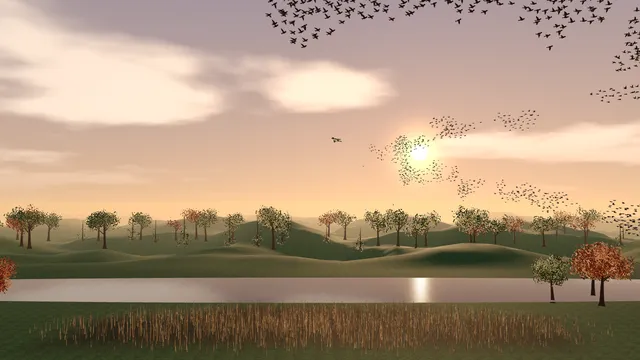
Monarchs use the sun as a compass. Because the sun moves across the sky during the day, they need a clock to interpret it, and research has shown that clocks in their antennae are involved. They also seem to have a magnetic compass for cloudy days. At dusk, migrating monarchs gather in trees to roost overnight, sometimes in large clusters, as they do in this valley.
For the curious
Each butterfly flies at an airspeed va = 4 m/s. The wind grows gently with height, w(y) = w₁₀ (y / 10 m)0.15. To hold its course toward the roost along unit vector d, a monarch rotates its heading upwind by an angle δ with sin δ = −wc / va, where wc is the crosswind part of the wind. That only works while the crosswind is weaker than its airspeed. Its ground velocity is va·heading + w. While gliding it sinks at 0.5 m/s. Inside a thermal it circles and the air lifts it by up to about 2 m/s at the centre, falling off toward the edge. The “Drift angle” readout is the average angle between where the butterflies point and where they actually go.
Questions people ask
How do monarch butterflies know where to migrate?
They use a sun compass, corrected for the time of day by a body clock, and research shows that clocks in their antennae help. They also appear to have a magnetic compass. The autumn migrants have never been to the overwintering sites before, so the route is inherited, not learned.
How far do monarch butterflies migrate?
Eastern monarchs travel thousands of kilometres, from southern Canada and the northern United States to forests in the mountains of central Mexico. Western monarchs mostly spend the winter along the coast of California.
Why do monarchs fly sideways in a crosswind?
To travel in a straight line across a crosswind, any flyer has to point partly into the wind. The butterfly’s body then faces a little upwind of its actual path, so it seems to fly slightly sideways. Pilots call this crabbing.