Space Station Docking
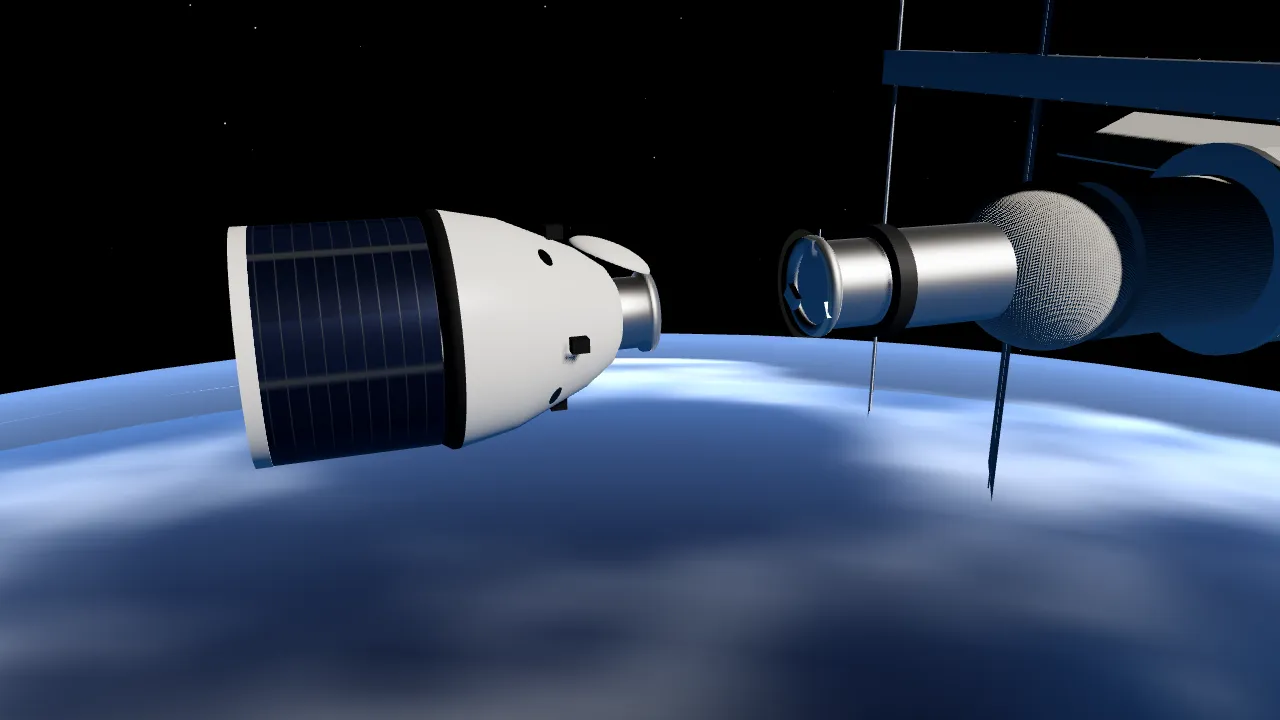
Steer a capsule to a space station’s port and dock gently.
How to play
- Press anywhere and drag: the capsule’s thrusters push it the way you drag, harder the further you drag. Let go to coast.
- Watch the dashed line. It shows where orbital drift will carry you over the next few minutes if you stop thrusting now.
- Line the capsule’s nose ring up with the green ring on the station’s docking port and close in slowly.
- Touch the port slower than 30 cm/s and within 35 cm of the centre line and the latches close. Tap to fly again; the Lab changes the time speed.
Challenges
- Fly the capsule within 10 m of the docking port
- Dock gently, slower than 10 cm/s
- Dock using less than 1.2 m/s of thrust: let orbital drift help
Try this
- Give one firm push straight towards the station and let go. The dashed line curves up and back: you have climbed into a higher, slower orbit.
- Park just below the station and wait without thrusting. Lower orbits are faster, so you creep ahead for free.
- Fly the whole approach in real time from the Lab. That patience is what real dockings take.
Fun facts
- The International Space Station orbits about 400 km up and goes round Earth roughly every 92 minutes.
- Moving at about 7.7 km/s, the station passes through around 16 sunrises and sunsets every day.
- Spacecraft usually close the last few metres to the station at only a few centimetres per second.
- The equations for motion near an orbiting target were published by Clohessy and Wiltshire in 1960, building on George Hill’s work on the Moon.
Why you can’t just aim and fly
Near the station, both you and it are falling around the Earth at about 7.7 km/s. Your motion relative to the station is small, but it is governed by orbital mechanics, not by the straight lines you would expect in empty space. The rules are the Clohessy–Wiltshire equations, which this toy solves as you fly.
Faster means higher, higher means slower
Push forward and you add speed to your orbit. That raises the far side of your path, so you begin to climb. A higher orbit takes longer to go round, so after a while you start to fall behind the station, even though you pushed towards it. Push backwards and the opposite happens: you sink and creep ahead. Below the station you drift forwards on your own; above it you drift back. The dashed line shows this drift for the next few minutes.
Letting the orbit do the work
The drift is not just a nuisance. Starting below and behind the station, a modest push forward makes the capsule rise of its own accord, so a patient pilot can let the orbit lift the capsule to the port and only spend thrust to start and stop. That is the idea behind the third challenge, and real mission planners use the same equations to save propellant.
The final metres
Real visiting craft hold at checkpoints, then close in along a straight line in front of or below the station, braking constantly so they arrive at a few centimetres per second. Docking systems are built to absorb only a gentle bump: here the latches catch if you arrive slower than 30 cm/s and within 35 cm of the centre line, and soft capture is anything under 10 cm/s.
What is simplified
The capsule keeps its nose pointed at the port and moves only in the plane of the orbit; sideways motion across the orbit is a separate, gentle sway that is left out. The Sun is held still so the station stays lit, and time runs three times faster than real by default. The Earth is drawn a thousand times smaller and closer than it really is, so it fills exactly the same part of the sky.
For the curious
With x pointing up and y along the orbit: ẍ = 3n²x + 2nẏ + ax and ÿ = −2nẋ + ay, where n = √(μ/a³) is the station’s orbital rate, 1.13 × 10⁻³ rad/s at 400 km. A capsule parked a height Δx below the station drifts ahead at 1.5·n·Δx: about 2 cm/s for every 12 m below.
Questions people ask
Why does pushing towards the station make the capsule rise?
Speeding up in orbit raises the far side of your path, so you climb into a slightly higher orbit. Higher orbits take longer, so after a while you fall behind where you started.
Why does docking have to be so slow?
Both spacecraft are heavy and their docking mechanisms can only absorb a gentle bump. A slow, steady contact lets the latches catch without damaging the ports.
Does the Earth really look that big from a space station?
Yes. From 400 km up the Earth fills most of the view below, with the horizon curving away on both sides. Here it is drawn smaller and closer so that it looks the same.