Rocket to Orbit
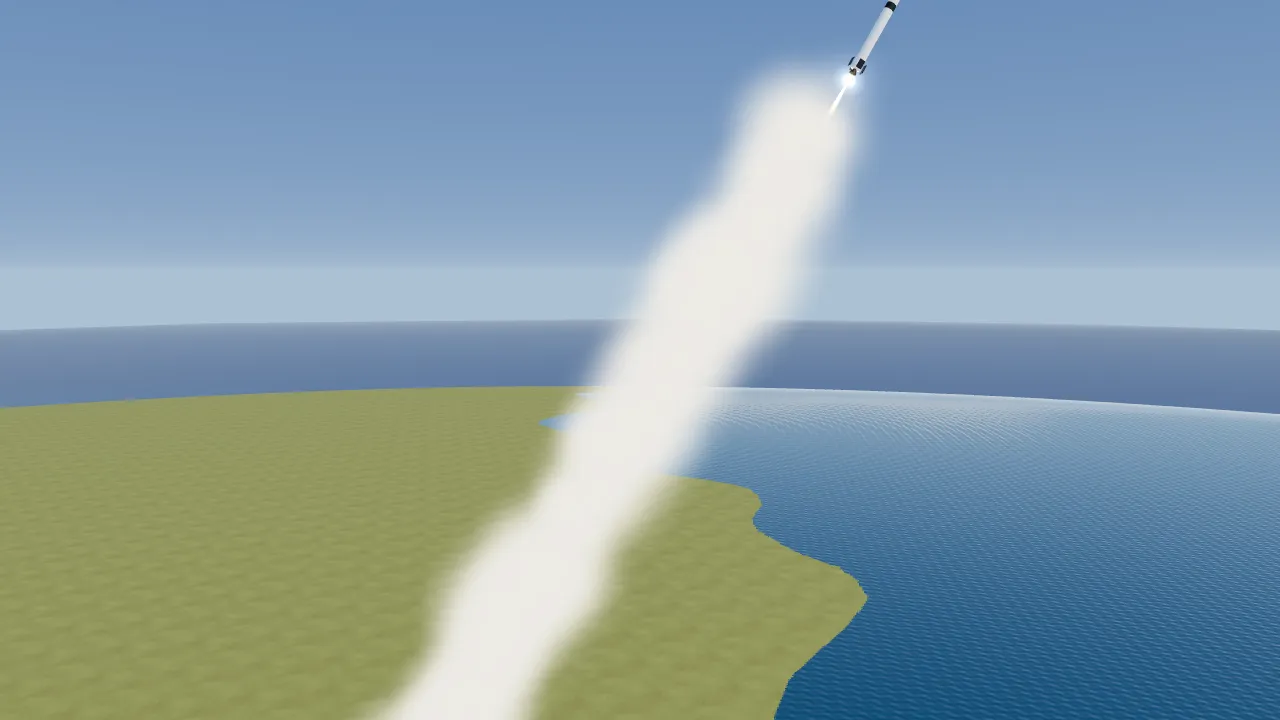
Fly a two-stage rocket from the pad into a circular orbit.
How to play
- Hold anywhere to fire the engine. The rocket rises slowly at first: it is heavy with fuel, and gravity takes most of the thrust.
- Once it is moving, keep holding and drag sideways to tip the nose over. Orbit is mostly about going sideways fast, about 2.3 km/s here.
- When the first stage runs dry, tap the rocket to drop it and the second stage carries on.
- Let go once the highest point of the dotted path is above 100 km, coast up to it, then burn sideways again to lift the lowest point. On a keyboard: ↑ fires, ← → steer, S drops a stage.
Challenges
- Fly above the Kármán line, 100 km up, where space begins
- Reach orbit: lift the lowest point of your path above 100 km
- Make your orbit nearly circular: high and low points within 25 km
Try this
- Fly straight up and never tip over. You reach space, then fall straight back: height alone is not an orbit.
- Tip over hard in the first seconds and watch the speed. Drag in the thick low air eats it, which is why real rockets climb steeply first.
- Burn sideways at the highest point and watch the lowest point rise on the far side of the planet. That is how orbits are made round.
Fun facts
- The Kármán line, 100 km up, is a widely used boundary between Earth’s atmosphere and outer space.
- To orbit the real Earth just above its atmosphere you need about 7.8 km/s, roughly 28,000 km/h.
- Konstantin Tsiolkovsky published the rocket equation in 1903.
- The first artificial satellite, Sputnik 1, reached orbit on 4 October 1957.
Why orbit is about speed, not height
Space is not far away: the Kármán line is just 100 km up. Staying there is the hard part. An orbit is a fall that never lands: you move sideways so fast that the ground curves away beneath you as quickly as you drop towards it. The planet in this toy is Earth shrunk to a tenth of its radius with the same gravity and the same air, so orbit needs about 2.3 km/s rather than the real 7.8 km/s, and a small rocket can get there. Time runs twice as fast unless you choose real time in the Lab.
The rocket equation
A rocket pushes itself forward by throwing propellant backwards. Tsiolkovsky’s equation, Δv = ve ln(m0/m1), says how much speed a load of propellant can buy, and it is stingy: to gain speed you need a rocket that is mostly fuel. That is why rockets have stages. Dropping an empty first stage means the second engine no longer drags dead weight along, so its propellant buys far more speed.
The gravity turn
At lift-off the rocket climbs straight up to leave the thick lower air quickly, where drag is fierce. Once moving it tips over, a little at a time, and gravity bends the path further, so more and more of the thrust builds sideways speed. Turn too early and drag steals your speed; turn too late and you waste fuel holding yourself up against gravity. The engine also strengthens as you climb, because exhaust pushes harder with no air pressing back on the nozzle.
Highest and lowest points
The dotted line is the path you would follow with the engine off, an ellipse with a highest point (apoapsis) and a lowest point (periapsis). While the lowest point is underground, you are still on a ballistic hop. Coast up to the highest point and burn sideways there: the far side of the ellipse lifts until the lowest point clears the air. Keep burning until the two match and the orbit is round.
What is simplified
This planet does not spin. Real rockets launch eastwards to borrow Earth’s rotation, about 465 m/s at the equator. The engine is fully on or off, the flight stays in one plane and there is no nose fairing to drop.
For the curious
Circular speed: v = √(μ/r) with μ = g0R², R = 637 km. Thrust: F = Fvac − (Fvac − Fsl)·p/p0. Propellant flow: ṁ = Fvac/(Isp g0). Drag: D = ½ρv²CdA, with air density from the US Standard Atmosphere. Orbit size from energy: a = −μ/(2E), E = v²/2 − μ/r.
Questions people ask
Why do rockets tip over instead of going straight up?
Because orbit needs sideways speed. A rocket climbs steeply at first to leave the thick lower air quickly, then gradually tips over so that most of its thrust goes into horizontal speed.
Why do rockets have stages?
Empty tanks are dead weight. Dropping them means the next engine pushes less mass, so the same propellant gives much more speed, as the rocket equation shows.
Is this planet the real Earth?
It is Earth scaled to a tenth of its size with the same gravity and air, so orbit needs about 2.3 km/s instead of 7.8 km/s and a flight takes minutes. Otherwise the physics is the same.