Lunar Lander
Fly a lander down to a pad on the Moon and touch down gently.
How to play
- Hold anywhere to fire the engine. Let go to coast: the Moon pulls you down 1.62 m/s faster every second.
- While holding, drag left or right to tilt the lander. Tilted thrust pushes you sideways; let go and the craft levels itself.
- The dotted line shows where you would hit the ground if you cut the engine now. Steer it onto the lit pad.
- Touch down upright and slower than 2 m/s, then tap to fly again. On a keyboard, ↑ or Space fires and ← → tilt; the Lab has other starts and slow motion.
Challenges
- Touch down gently, slower than 2 m/s
- Land safely on the lit landing pad
- Land softly with more than half of your fuel left
Try this
- Let go of the engine high up and watch the falling speed climb: 1.6 m/s more every second, a sixth of what it would be on Earth.
- Hover a few metres above the ground and watch the dust. With no air to slow it, it shoots out in flat, straight sheets.
- Compare the fuel left after a slow hover all the way down with a late, firm braking burn. Hovering spends fuel just holding you up.
Fun facts
- The Moon’s surface gravity is about 1.62 m/s², roughly one sixth of Earth’s.
- Apollo 11’s lunar module touched down in the Sea of Tranquillity on 20 July 1969.
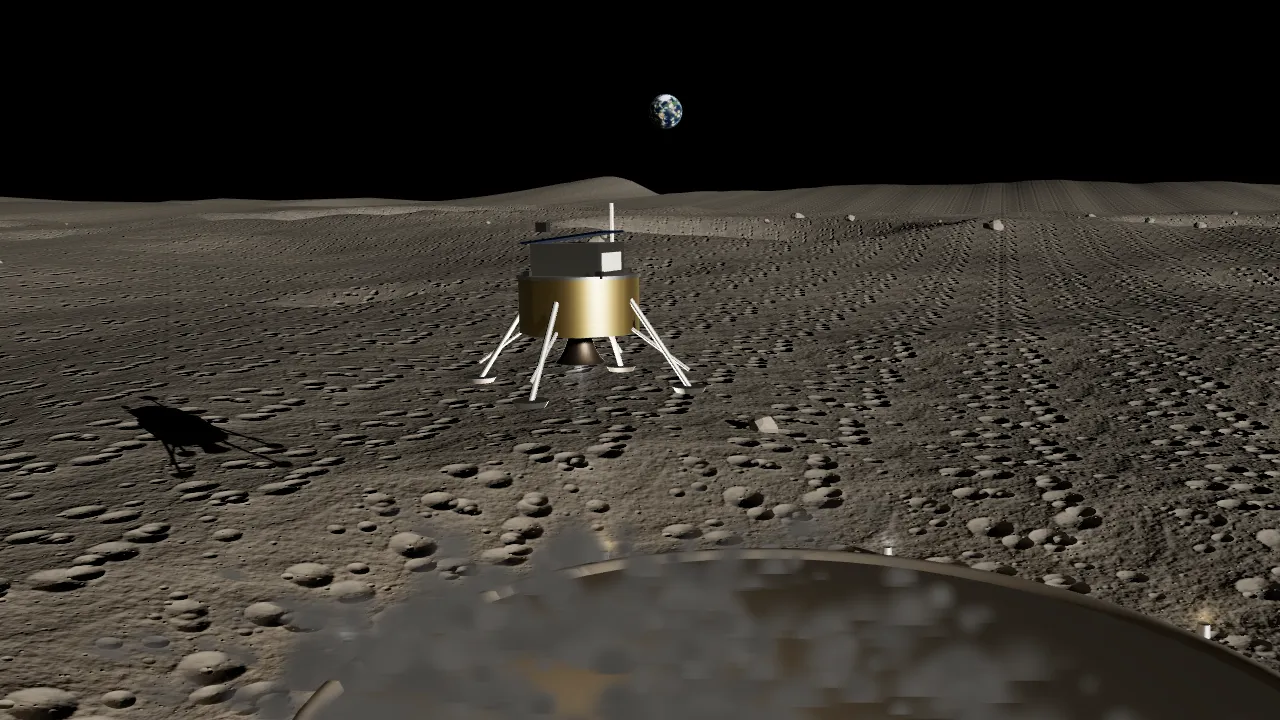
- Photos taken on the sunlit Moon show a black, starless sky: the bright ground needs such short exposures that faint stars do not register.
- The Moon has almost no atmosphere, so a lander cannot use parachutes or wings: only its rocket can take away its speed.
How to land where there is no air
On Earth, air does much of the work of landing: parachutes and wings turn speed into drag for free. The Moon has almost no atmosphere, so a lander has exactly one tool, its rocket engine, and every metre per second it removes costs propellant carried all the way from Earth. Meanwhile gravity keeps adding speed, 1.62 metres per second every second, about a sixth of Earth’s pull.
Thrust, tilt and weight
The lander here weighs about 1.27 tonnes and its engine pushes with 4.6 kilonewtons. Upright, that is an acceleration of about 3.6 m/s², a little over twice its lunar weight, so a full burn slows a fall by about 2 m/s every second. Tilt the craft and the same thrust splits into an upward part and a sideways part, which is how you steer: lean back against your motion to stop drifting, lean forward to move towards the pad. The engine here is simply on or off, so a hover is a rhythm of short burns.
The rocket equation
Propellant leaves the nozzle at about 3.1 km/s. Burning it makes the lander lighter, so each second of thrust brakes a little harder than the last. Konstantin Tsiolkovsky’s rocket equation gives the total change of speed a tank can buy: Δv = ve ln(m0/m1). This tank of 70 kg buys about 175 m/s. That sounds like plenty for a 90-metre drop, but a hover spends 1.62 m/s of it every second just staying up. That is why a short, late braking burn uses the least fuel, and why it leaves the least room for mistakes.
Dust without air
When the exhaust reaches the ground it blasts loose soil sideways. With no air to slow the grains or let them drift, each one flies on its own ballistic arc, low and fast, so the dust streams out in flat sheets instead of billowing. Apollo crews described blowing dust making the ground hard to see in the last tens of metres.
What is simplified
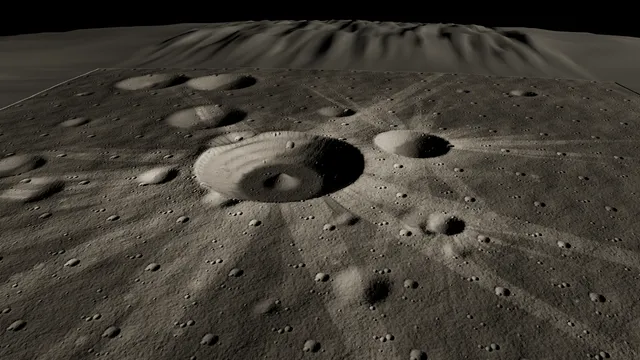
The lander moves in one vertical plane, the throttle is all or nothing, and the flight begins in the last 90 metres. Real descents start in orbit about 15 km up, moving at well over a kilometre per second, with throttleable engines and computers sharing the work. The ground is generated, though its craters follow the real shapes of fresh and worn lunar craters.
For the curious
Motion: a = (F/m)(sin θ, cos θ) − (0, g) with g = 1.62 m/s². Propellant flow: ṁ = F/(Isp g0) = 4600/(315 × 9.81) ≈ 1.49 kg/s. Stopping distance with a net braking acceleration anet: d = v²/(2anet), so from 10 m/s at 2 m/s² you need 25 m. Hovering costs g·t of Δv: 30 seconds of hover spends about 49 m/s.
Questions people ask
Why is landing on the Moon hard if its gravity is weak?
Because there is no air to help. On Earth a parachute or wings can take away speed for free; on the Moon only the rocket can, and every second of firing burns propellant the lander had to carry from Earth.
Why does the dust fly so far and so flat?
With no air, dust lifted by the exhaust does not slow down or float. Each grain flies on a ballistic arc, low and fast, until the Moon’s gravity brings it back down.
Why are there no stars in the sky?
The stars are there, but the sunlit ground is so bright that a camera or an eye adjusted to it cannot pick them out. That is why photos from the Moon’s surface show a black sky.