Earth, Moon and Tides
Drag the Moon and watch it raise two ocean bulges on a spinning Earth.
How to play
- Drag the Moon to a new place. Time pauses while you hold it; let go and it settles onto a circular orbit there. Closer means much bigger bulges, farther means smaller ones.
- Watch the dark water shell: it bulges towards the Moon and on the far side too. The lighthouse rides through two high tides a day, as the “Harbour water level” readout shows.
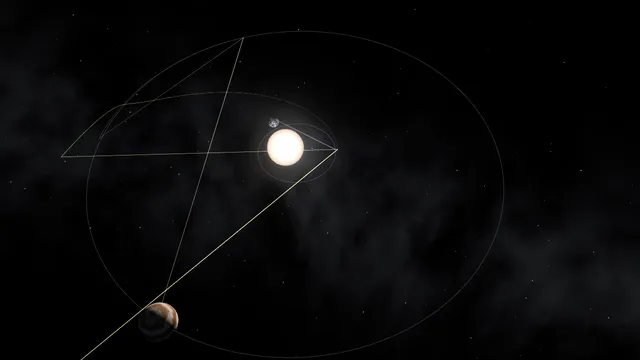
- Drag on empty space to add a second moon; the dotted line shows its path round Earth.
- Try the three Challenges, or open Lab to jump to New, Quarter or Full Moon, switch off the Sun’s tide, or hide the arrows.
Challenges
- Drag the Moon into line with the Sun to make spring tides
- Pull the Moon in to half its distance and watch the bulges grow eightfold
- Fling a second moon that circles Earth the wrong way round
Try this
- Compare Full Moon with First quarter. At full and new Moon the Sun and Moon pull in line and the tides are biggest; at quarter Moon they work against each other.
- Switch off the Sun’s tide and watch how much smaller the difference between high and low water becomes.
- Add a “Ten Moons” moon and watch the bulges grow and swing round to follow it.
Fun facts
- Most coasts get two high tides and two low tides every lunar day of about 24 hours 50 minutes.
- The Sun’s tidal pull on Earth is a little under half the Moon’s, even though the Sun is far more massive, because tides weaken with the cube of distance.
- The Bay of Fundy in Canada has the highest tides in the world, with a range of up to about 16 metres.
- Tidal friction is slowly lengthening Earth’s day and pushing the Moon away, by about 3.8 cm a year.
Why there are two tides a day
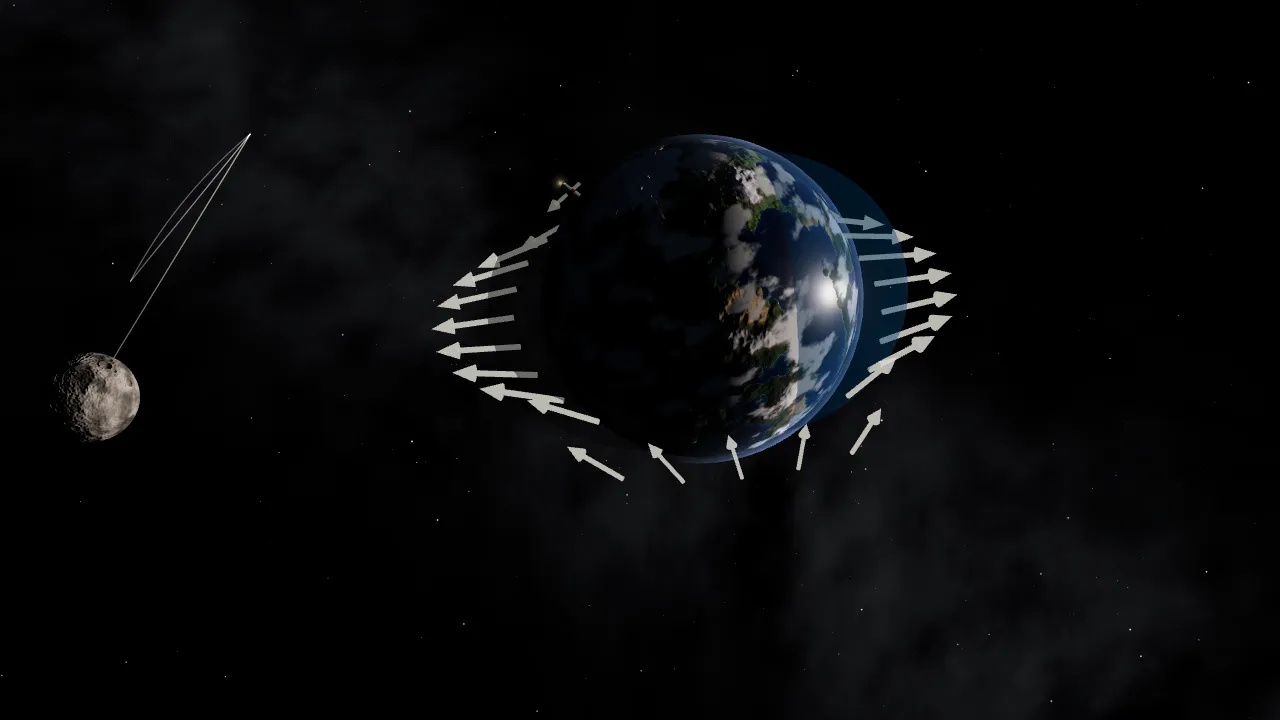
The Moon pulls on the whole Earth, but not equally. The ocean on the side facing the Moon is about 6,400 km closer to it than Earth’s centre, so it is pulled a little harder; the ocean on the far side is pulled a little less. What matters for the tides is this difference in pull across the planet, the tidal force. Seen from Earth’s centre, it stretches the oceans outwards along the Earth–Moon line and squeezes them inwards around the middle. The yellow arrows show it.
So there are two bulges, one facing the Moon and one facing away. Earth turns underneath them once a day, carrying every coast through two high tides and two low tides. Because the Moon moves along its orbit in the same direction, it takes about 24 hours 50 minutes for a spot on Earth to face the Moon again, which is why the tides come about 50 minutes later each day.
Spring and neap tides
The Sun raises tides too, a little under half as strong as the Moon’s. At new Moon and full Moon the Sun and Moon line up and their bulges add together: bigger spring tides, nothing to do with the season. At first and last quarter they pull at right angles and partly cancel: smaller neap tides. Use the Lab buttons to compare.
How big are the bulges?
For an ocean covering the whole Earth, Newton’s theory predicts a height of h = (m/M)·(R/d)³·R·P₂(cos θ), where m and d are the Moon’s mass and distance, M and R are Earth’s, θ is the angle from the Moon and P₂(c) = (3c² − 1)/2. That gives about 0.36 m for the Moon and 0.16 m for the Sun. The harbour readout uses this formula with true distances. The blue shell is exaggerated more than a million times so you can see the shape. Real coastal tides can be far larger or smaller, because water sloshing in real ocean basins and bays responds like a bath, building up in some places and cancelling in others.
What is simulated
The Sun, Earth and Moon move on Newton’s gravity with their real masses and distances, in units of Earth radii and days, using leapfrog steps of about 15 minutes. Earth turns once every sidereal day of 23 hours 56 minutes. Distances on screen are squeezed so the Moon and the distant Sun fit: the Moon is really about 60 Earth radii away.
For the curious
The tidal acceleration at a point at distance R from Earth’s centre, in the direction n, is about (Gm/d³)·R·(3(n·d̂)d̂ − n), which is what the arrows draw. It falls with the cube of the distance d, which is why the nearby Moon beats the giant but distant Sun.
Questions people ask
Why are there two high tides a day?
The Moon’s pull is stronger on the near side of Earth and weaker on the far side, which stretches the oceans into two bulges. Earth spins through both bulges each day.
What are spring tides and neap tides?
Spring tides are the larger tides near new and full Moon, when the Sun and Moon pull in line. Neap tides are the smaller tides near the quarter Moons, when they pull at right angles.
Why is the Moon’s tidal effect stronger than the Sun’s?
Tidal forces depend on how much the pull changes across Earth, which falls with the cube of distance. The Moon is so much closer that its tidal effect is about twice the Sun’s.