Galaxy Collision
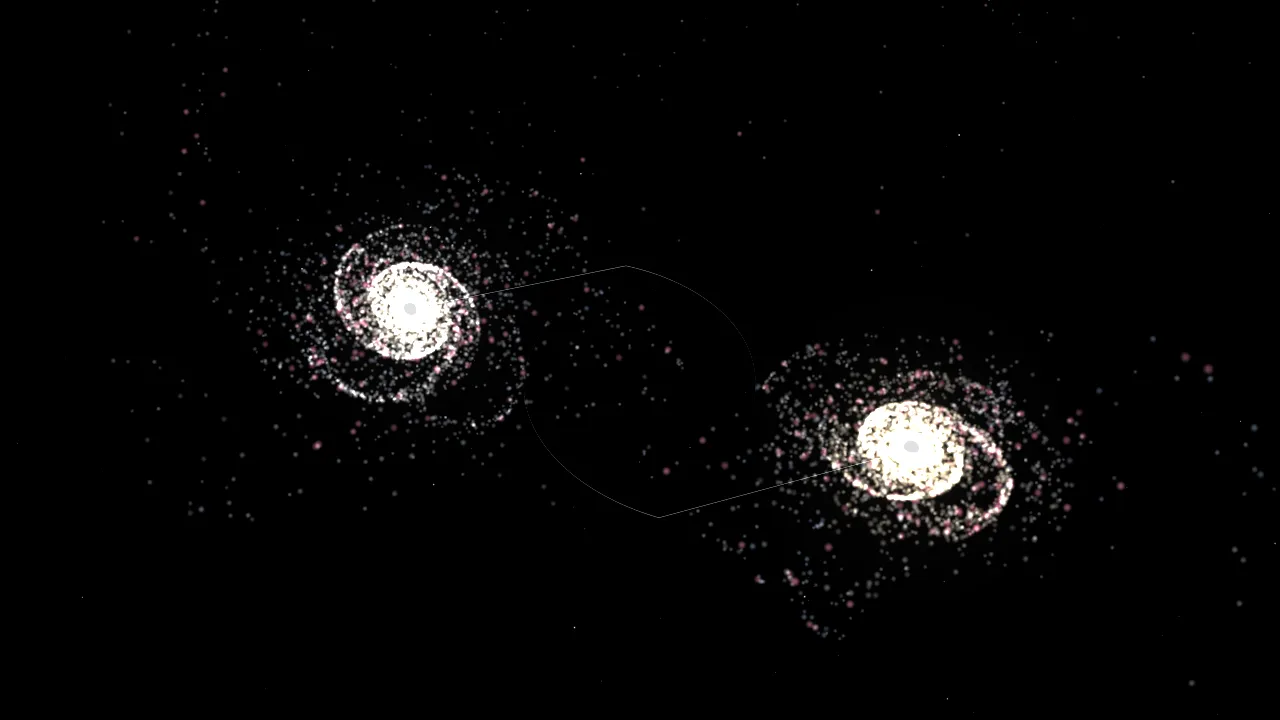
Aim two spiral galaxies at each other and pull out tidal tails.
How to play
- Press on a galaxy’s bright core and drag out an arrow to re-aim it. The dotted line shows its new path; time pauses while you aim.
- Drag on empty space to throw in a small galaxy of your own. Each dot is a star.
- Watch the “Stars flung far out” readout as tidal tails and bridges form over hundreds of millions of years.
- Try the three Challenges, or open Lab for other encounters (retrograde, a bullseye ring galaxy, big meets small) and the time speed.
Challenges
- Re-aim or throw a galaxy so that a third of all stars end up in tails
- Steer two galaxies into each other until their cores merge
- Drop a small galaxy straight through a big disc, like the Cartwheel
Try this
- Compare “Prograde” with “Retrograde” and watch the “Stars flung far out” readout. When the discs spin the same way as the encounter, far more stars are pulled into tails.
- Choose “Bullseye” and watch a ripple of stars race outwards from the centre after the small galaxy passes straight through.
- Throw a dwarf galaxy slowly past one of the discs and see a thin stream of stars peel off it.
Fun facts
- In 1972 the brothers Alar and Juri Toomre used simple computer models to show that the long tails and bridges seen in some galaxies are made by gravity during close encounters.
- When galaxies collide, their stars almost never hit one another, because the gaps between stars are enormous compared with the stars themselves.
- The Antennae Galaxies, NGC 4038 and NGC 4039, are a famous colliding pair whose two long tidal tails look like an insect’s antennae.
- The Cartwheel Galaxy is a ring galaxy, thought to have formed when a smaller galaxy plunged through a larger one.
How gravity spins out tidal tails
A galaxy is a vast disc of stars orbiting a heavy centre. When a second galaxy swings close, it pulls hardest on the near side of the disc and least on the far side. That difference, the tidal force, stretches the disc along the line between the two galaxies. Stars on the near side are flung towards the visitor, forming a bridge; stars on the far side are left behind and swing out into a long curving tail.
This simulation uses the method Alar and Juri Toomre made famous in 1972. Each galaxy has a heavy core, standing in for the combined mass of its stars and its unseen dark matter, and thousands of stars that feel the pull of both cores but not of each other. That shortcut, called the restricted method, is enough to reproduce tails, bridges and rings remarkably well, and it lets a phone move ten thousand stars smoothly.
Why spin direction matters
If a disc rotates in the same direction as the visitor sweeps past (a prograde encounter), its stars travel alongside the passing galaxy for a long time and receive a long, steady tug, so many are thrown out. In a retrograde encounter the stars rush past the visitor in the opposite direction, the tug is brief, and the disc survives almost untouched. Try both in the Lab and compare the readout.
Ring galaxies
If a compact galaxy drops straight through the middle of a disc, every star is first pulled inwards and then, once the intruder has gone, springs back outwards. Stars at different distances bounce at different times, so a wave of crowded stars travels outwards like a ripple from a stone thrown into a pond: a ring galaxy.
What is stylised
Real galaxies lose orbital energy to their dark-matter haloes in a process called dynamical friction, which is why colliding galaxies eventually merge into one. Here a gentle drag between overlapping cores plays that part. Real stars also pull on each other, which this simplified model leaves out.
For the curious
Units: G = 1, one length unit is 10 kiloparsecs (about 32,600 light-years) and one mass unit is 10¹¹ suns, which makes one time unit about 47 million years. Each core is a Plummer sphere, so a star at distance r feels an acceleration GM·r/(r² + a²)^(3/2), where a is the core’s size. Stars start on circular orbits with speed v = √(GM·r²/(r² + a²)^(3/2)), and everything moves with a leapfrog integrator in steps of about half a million years.
Questions people ask
Do stars crash into each other when galaxies collide?
Almost never. Stars are tiny compared with the distances between them, so the two galaxies pass through each other. Gas clouds do collide, though, and that often triggers bursts of new stars.
How long does a galaxy collision take?
Hundreds of millions to a few billion years. In this simulation the first close pass happens after a few hundred million years and the cores merge after roughly two billion.
What makes the tidal tails?
The difference in the visitor’s pull across a galaxy. The near side is pulled harder than the far side, which stretches the disc and throws stars out into long curved streams.