Gravity Slingshot
Launch a probe past a giant planet and steal a little of its speed.
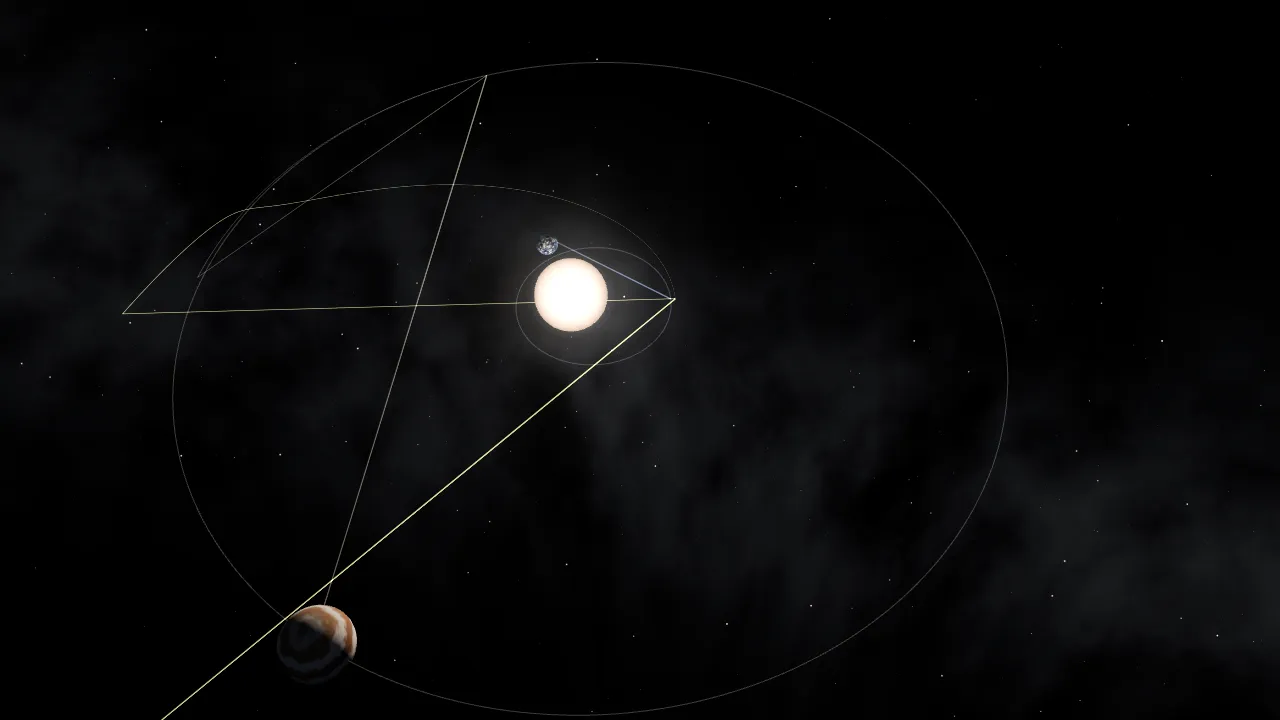
How to play
- Drag from near Earth to launch a probe. The dotted line shows its path, and time slows while you aim.
- Drag the giant planet along its orbit to time the meeting: aim to pass just behind it, on the side it is moving away from.
- Press on a flying probe and drag out an arrow for a course correction. A quick tap shows its speed.
- Try the three Challenges, or open Lab to change the planet’s mass or to try a braking pass in front of it.
Challenges
- Slingshot your own probe past the giant planet and gain speed
- Pass in front of the planet so the flyby slows your probe by 2 km/s
- Send a probe fast enough to escape the Solar System for good
Try this
- Compare the two speed readouts before and after a flyby. In the planet’s frame the probe leaves as fast as it arrived; in the Sun’s frame it can be several km/s faster.
- Run “Pass in front: slow down”. Passing ahead of the planet steals speed instead, which is how probes are slowed to reach Mercury.
- Switch to “Real Jupiter” mass and try to get a big boost. You will need a much closer pass, which is why mission planners calculate flybys so carefully.
Fun facts
- Voyager 2 is the only spacecraft to have visited Uranus and Neptune, using gravity assists from Jupiter and Saturn on the way.
- In the ideal case, a single flyby can add up to twice the planet’s orbital speed to a spacecraft’s speed.
- The planet pays for every boost by slowing down, but because it is so massive the change is far too small to measure.
- Jupiter travels around the Sun at about 13 km/s.
Speed for free? How a gravity assist works
A gravity assist looks like magic: a spacecraft flies close to a planet and comes away faster, without burning fuel. The trick is that a planet is not standing still. It is racing around the Sun, and a probe that swings round behind it is dragged along for part of the way.
Two points of view
Imagine riding on the planet. The probe falls towards you, whips round, and climbs away again. Because gravity neither adds nor removes energy in that frame, the probe leaves exactly as fast as it arrived, only in a new direction. The middle readout, “Probe speed (planet frame)”, shows this: compare it at the same distance before and after the pass.
Now watch from the Sun. The probe’s new direction means its velocity now includes more of the planet’s own motion. Add the planet’s velocity to the probe’s turned-around velocity and the total can be much larger. In the ideal case of a complete U-turn, the probe gains twice the planet’s speed. It is the same physics as a tennis ball bouncing off a racket that is swinging towards it.
Nothing is free, of course. The planet slows down by exactly the momentum the probe gains, but a planet is so heavy that the change is utterly undetectable.
Escaping the Sun
To leave the Solar System, a probe needs more than the local escape speed, √(2GM/r), which falls with distance from the Sun. The third readout shows it for wherever your probe is. When the probe’s speed beats it and the probe is heading outwards, it will never come back.
What we changed
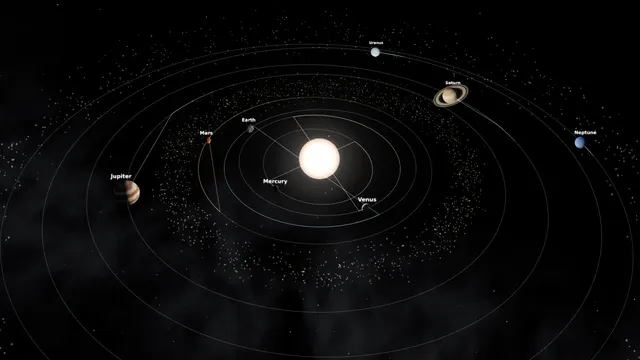
The real Jupiter is so compact on this scale that a hand-thrown probe would need to pass within a hair of it to be turned much. By default the giant planet here is 30 times heavier than Jupiter, so its pull reaches farther and aiming is fun. Switch to the real mass in the Lab and the physics is the same, but the target becomes tiny. Everything else is real: the planet’s distance, the Sun’s gravity and Earth’s orbit.
For the curious
Units are AU, years and solar masses, so G = 4π² and 1 AU per year is about 4.74 km/s. The probe has no mass and the planets move under leapfrog integration with adaptive steps, shortened near close approach as h ∝ √(r³/GM). The “Voyager-style” launch is found by trying 31 launch timings close to a Hohmann transfer and keeping the one that gains the most energy.
Questions people ask
How does a gravity assist speed up a spacecraft?
The spacecraft swings round behind a moving planet. In the planet’s frame its speed is unchanged, but its direction turns, and in the Sun’s frame that adds part of the planet’s own orbital velocity to the spacecraft.
Does a gravity assist slow the planet down?
Yes, by exactly the momentum the spacecraft gains. Because planets are so massive, the change in the planet’s speed is far too small to measure.
Can a gravity assist slow a spacecraft down?
Yes. Passing in front of a planet instead of behind it removes speed. Missions to Mercury use several such flybys to brake as they fall towards the Sun.