Solar System in Motion
Drag planets onto new orbits and fling new worlds on real gravity.
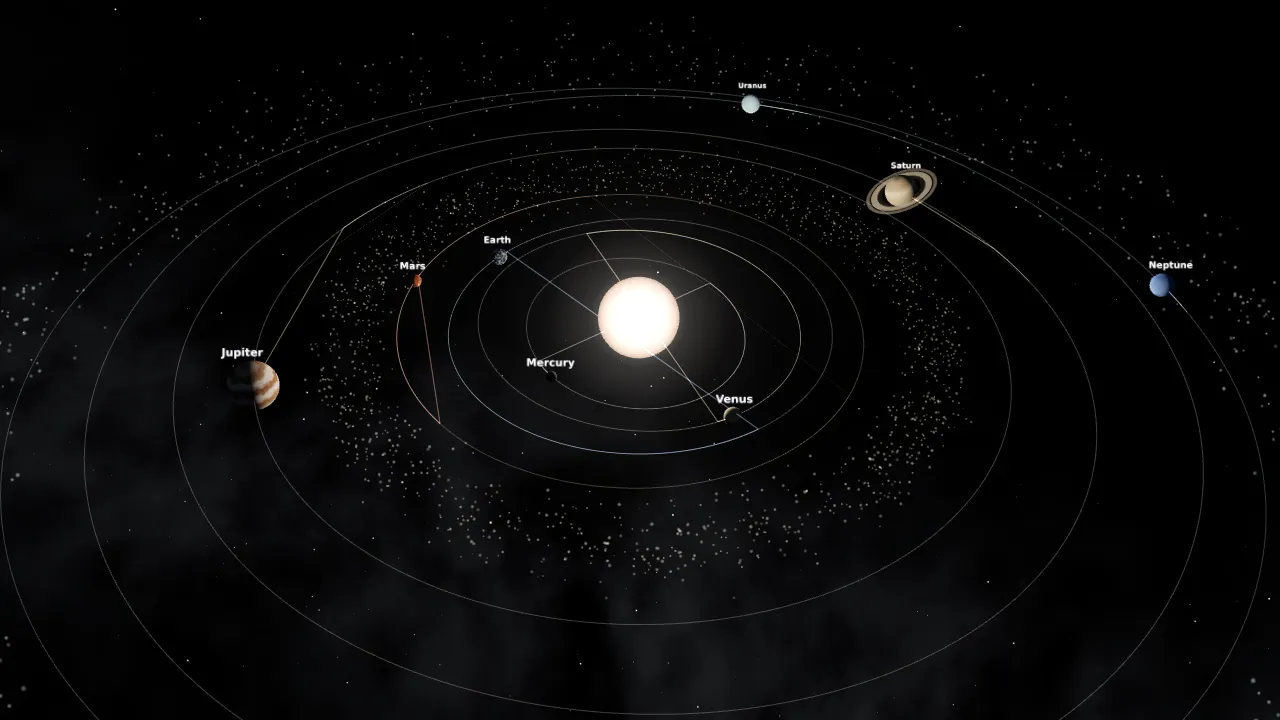
How to play
- Drag a planet to a new place. Time pauses while you hold it, and when you let go it settles onto a circular orbit there, with the speed gravity demands.
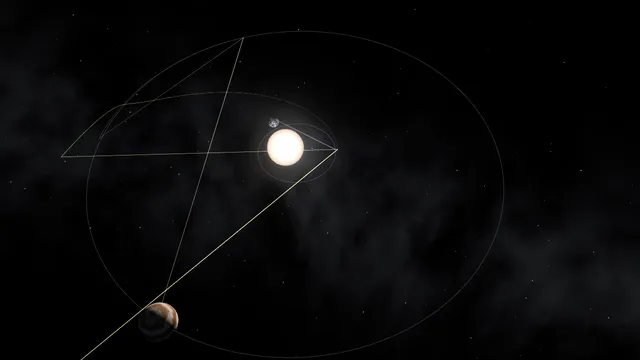
- Drag on empty space to fling a new world. The dotted line shows where it will go; a quick tap drops one into a circular orbit.
- Tap a planet for a fact. Right-drag (or choose Look around) to turn the view.
- Try the three Challenges, or open Lab to speed up time, pick the mass of your new worlds, or line every planet up.
Challenges
- Drag Earth out to Mars’s orbit and watch its year grow longer
- Fling a world onto a long, thin ellipse that crosses Earth’s orbit
- Aim a world so that it crashes into Jupiter (follow the dotted line)
Try this
- Press “Line them up” and speed time up. Mercury pulls ahead at once while Neptune barely moves: that spread is Kepler’s third law at work.
- Fling a “ten Jupiters” planet through the asteroid belt and watch the faint orbit guides: the real planets drift off their old paths.
- Turn Jupiter into a small star with the Lab button and see what happens to the asteroids between Mars and Jupiter.
Fun facts
- The Sun holds about 99.86% of all the mass in the Solar System.
- Jupiter is more than twice as massive as all the other planets put together.
- Neptune takes about 165 Earth years to go round the Sun. In 2011 it completed its first full orbit since it was discovered in 1846.
- Sunlight takes about 8 minutes 20 seconds to reach Earth.
One rule, eight orbits
Every planet here obeys a single rule, Newton’s law of gravity: each body pulls every other body with a force proportional to their masses and falling off with the square of the distance between them. Nothing in the simulation tells Mercury to go round in 88 days or Neptune in 165 years. Those periods come out of the maths on their own.
The simulation adds up the pull of the Sun and of every planet on every other planet, then nudges each one forward by a tiny step of time, over and over. It uses a method called leapfrog (also known as velocity Verlet), which half-updates the speeds, moves the positions, then finishes the speeds. It is a favourite of astronomers because it keeps the total energy of an orbit from drifting, so planets stay on their tracks for thousands of years instead of slowly spiralling away.
Where the planets start
Each planet begins at the position NASA’s Jet Propulsion Laboratory formulas give for the day you open the page, using their published orbital elements. We checked these against known dates when Mars, Jupiter and Saturn lined up opposite the Sun as seen from Earth, and they agree to within about a degree. From then on, gravity takes over.
Why the outer planets are so slow
Distant planets feel a weaker pull, so they move more slowly, and they also have a longer way to go. Johannes Kepler found the exact relationship in 1619: the square of a planet’s year is proportional to the cube of its distance from the Sun. Jupiter is about 5.2 times farther out than Earth, and 5.2 cubed is about 140, whose square root is about 11.9. Jupiter’s year is indeed almost 12 Earth years.
A squeezed map
Space is mostly empty. If Neptune were drawn at the edge of your screen, Mercury would sit almost on top of the Sun and every planet would be smaller than a pixel. So this view squeezes distances: the drawing uses a logarithmic scale, so the inner planets get more room and the outer ones are pulled in. The planets are also drawn far larger than they really are. The physics underneath always uses the true distances, masses and speeds.
For the curious
Units are astronomical units (the Earth–Sun distance), years and solar masses, which makes the gravitational constant exactly 4π². The acceleration of each planet is the sum of G·m/r² towards every other body, and a tiny softening length keeps close encounters smooth. Kepler’s third law follows: P² = a³/(M + m) with P in years and a in AU. The faint rings are each planet’s starting orbit. The Kirkwood gaps in the asteroid belt mark distances where an asteroid’s year would be a simple fraction of Jupiter’s, so Jupiter’s regular tugs clear them out over millions of years.
Questions people ask
Is this solar system simulation to scale?
The physics is: real masses, real distances and real speeds. The picture is not. Distances are squeezed so all eight planets fit on screen, and the planets are drawn much larger than true size.
Are the planets in their real positions?
Yes, roughly. They start where NASA JPL’s orbital elements place them for today’s date, accurate to about a degree, and then move under gravity.
Why does Mercury go round so fast?
It is closest to the Sun, where gravity is strongest, so it must move fastest to stay in orbit, and its path is the shortest. Its year lasts only 88 Earth days.