Black Hole Accretion Disk
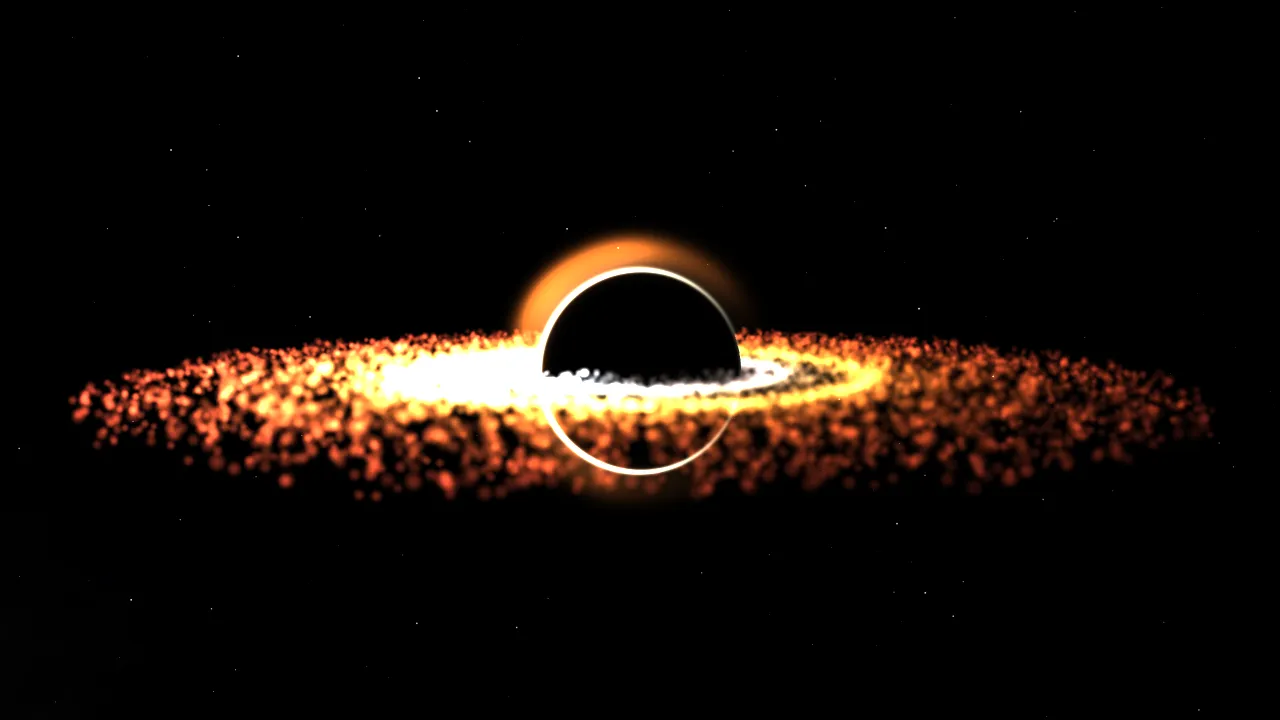
Feed a black hole and watch its glowing disc swirl into the dark.
How to play
- Hold a finger still on the disc to pour in gas. It moves slower than the orbit there, so it falls inwards and the hole swallows it.
- Drag to throw a cloud of gas along the dotted line and watch it stretch into a stream; a quick tap drops a cloud into a circular orbit.
- The side of the disc coming towards you shines brighter. Turn the view almost edge-on and the glowing ring bends over the top of the shadow.
- Try the three Challenges, or open Lab to pick a black hole, switch Doppler beaming or the lensing ring, and show the key radii.
Challenges
- Throw a gas cloud and let it stretch into a stream halfway round the hole
- Pour in gas until the black hole has swallowed 150 puffs of yours
- Throw a cloud that falls straight in before it can finish one orbit
Try this
- Throw a gas cloud and watch its inner edge race ahead of its outer edge. Closer gas orbits faster, so any blob is sheared into a spiral.
- Switch Doppler beaming off and on while looking edge-on. The brightness difference between the two sides comes from the gas’s speed.
- Choose Sagittarius A* in the Lab and read how long one orbit at 3 Rs takes: about half an hour, compared with milliseconds for a stellar black hole.
Fun facts
- The Event Horizon Telescope released the first image of a black hole’s shadow, in the galaxy M87, in April 2019.
- In 2022 the same team released an image of Sagittarius A*, the black hole at the centre of our Milky Way.
- For a black hole that does not spin, no stable circular orbit exists closer than three times the event-horizon radius.
- At 1.5 times the event-horizon radius, light itself can circle the black hole, but that orbit is unstable.
What is real here, and what is painted
A black hole is a region where gravity is so strong that nothing, not even light, can climb out. Its edge is the event horizon, at the Schwarzschild radius Rs = 2GM/c², about 3 kilometres for every solar mass. Gas that falls towards a black hole rarely drops straight in. It has sideways motion, so it settles into a flat, spinning accretion disc, rubs against itself, heats up and glows.
Real physics in this simulation
Every gas parcel follows Newton’s gravity, in units where Rs = 1 and the speed of light c = 1. Inner gas moves faster than outer gas (v = √(GM/r)), so the disc shears, and any cloud you throw in is stretched into a long arc. A striking fact makes Newton useful here: for circular orbits around a non-spinning black hole, the period seen by a distant observer follows Kepler’s formula exactly, which is what the “one orbit at 3 Rs” readout uses. The brightness uses real relativity too: gas moving towards you is boosted by the Doppler factor D = 1/(γ(1 − β·cosθ)), here raised to the third power (a common approximation), so the approaching side outshines the receding side.
Three key distances
The event horizon is at 1 Rs. At 1.5 Rs lies the photon sphere, where light can orbit in an unstable circle. At 3 Rs is the innermost stable circular orbit: in Einstein’s theory, gas closer than that cannot circle at all and plunges in. Turn on “Show key radii” to see them.
What is stylised
Real discs spiral inwards because of turbulent friction (viscosity); here a small, steady drag stands in for it. Inside 3 Rs, gas here is pulled in by a simple extra force rather than by true general relativity. The bright ring and arc around the black shadow are painted with a shader, not calculated by tracing light rays. Their size is real, though: from far away, a non-spinning black hole’s shadow appears about 2.6 times larger than its event horizon, because gravity bends light around it. Colours stand in for temperature, which rises towards the centre.
For the curious
Units: G = 1, M = ½, c = 1, so Rs = 1 and Kepler’s law gives an orbit at radius r a period of 2π√(2r³). At 3 Rs that is about 46 Rs/c, or 92.3·GM/c³: 4.5 milliseconds for a 10-sun black hole, about half an hour for Sagittarius A* and about a month for M87*. The disc temperature roughly follows T ∝ r^(−3/4).
Questions people ask
Why is one side of a black hole’s disc brighter?
Doppler beaming. The gas moves at a large fraction of the speed of light, and light from the side coming towards you is concentrated and boosted, while the receding side looks dimmer and redder.
What is the innermost stable circular orbit?
The closest distance at which something can orbit a black hole in a stable circle. For a non-spinning black hole it is three times the event-horizon radius; inside it, gas spirals in quickly.
Is the glowing ring around the black hole real?
Black holes really bend light into a ring around a dark shadow, as the Event Horizon Telescope images show. In this toy the ring is painted to look like that rather than calculated ray by ray.