Moon Crater Maker
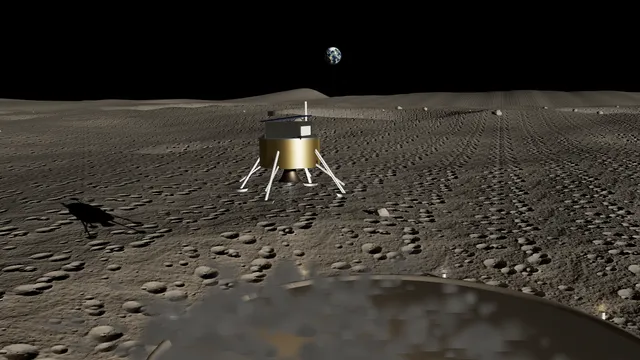
Throw asteroids at the Moon and see what size of crater each one digs.
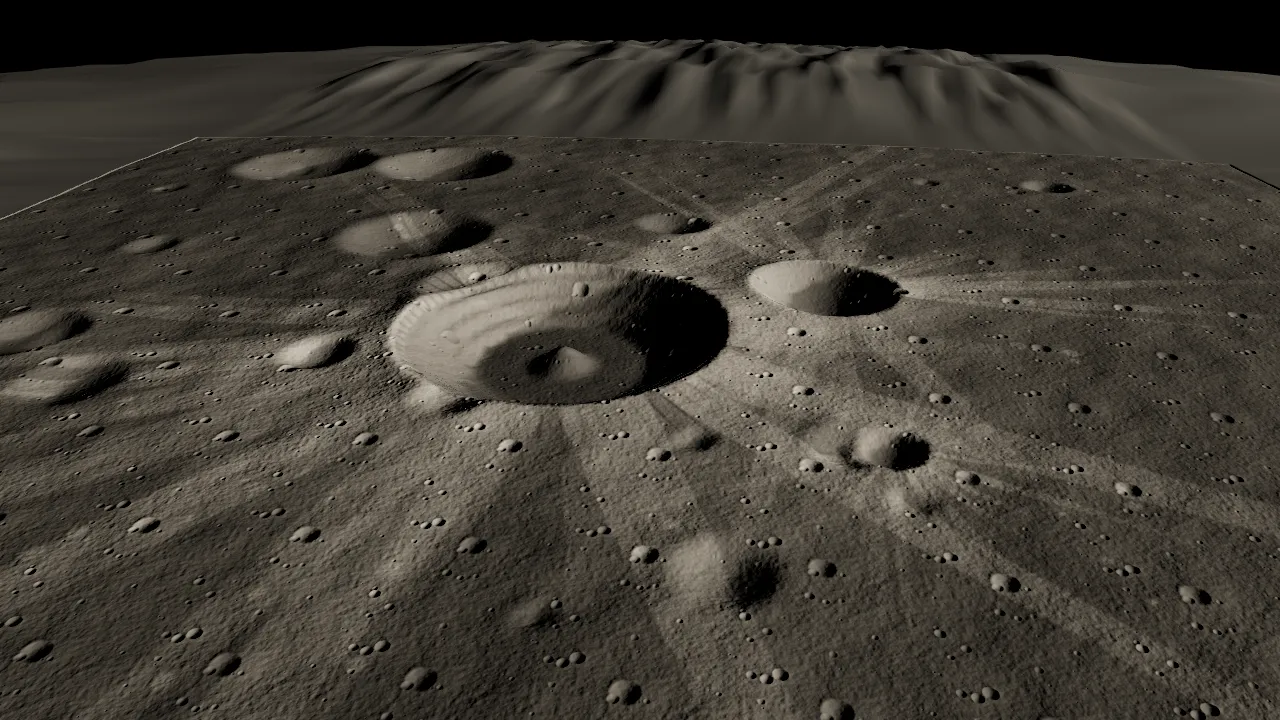
How to play
- Tap one of the three rocks on the right to pick a size: 100 metres, 400 metres or 1.5 kilometres across.
- Press on the ground where it should strike and drag back to aim. The dotted line shows its path: the longer you pull, the lower it comes in.
- Let go to throw. A quick tap throws at 45°, the most likely angle for a real impact.
- Drag the black sky to look around. In the Lab, set any size or speed, age the surface by a billion years or start a fresh plain.
Challenges
- Make a crater wide enough to grow a central peak (over 18 km)
- Throw a grazing shot, lower than 15°, to splash butterfly-shaped rays
- Overlap two craters so the younger one cuts through the older rim
Try this
- Throw the same rock steeply and then at a low angle. The steep one digs a bigger crater; the low one throws its debris to the sides.
- Drop a small rock on the rim of a big crater. The new crater breaks the old rim, which is how geologists tell which came first.
- Make a fresh ray crater, then press “Age the surface a billion years” in the Lab and watch its bright rays fade into the plain.
Fun facts
- The most likely angle for an impact is 45°, yet craters stay nearly round unless the angle is very low, below about 10–15°.
- On the Moon, craters wider than about 15–20 km usually have flat floors, terraced walls and central peaks; smaller ones are simple bowls.
- Tycho, a young crater about 85 km across, has bright rays that stretch across much of the Moon’s near side.
- The Moon has no air to slow or burn up incoming rocks, so even small ones strike at full speed.
How a crater is made
An asteroid fragment strikes the Moon at many kilometres per second, far faster than sound travels through rock. In a split second its energy turns into a shock wave that races outwards, crushing, melting and flinging the ground aside. The hole that opens, the transient crater, is many times wider than the rock that made it, and it is round because the shock spreads in every direction, whatever the angle the rock came in at.
How big?
Crater size here comes from a scaling law fitted to experiments and explosions and used by impact calculators. Diameter grows with the rock’s size, a little more slowly than in proportion (L0.78), and more gently with speed (v0.44). Weaker gravity lets a crater grow larger, which is one reason craters on the Moon are big for the rocks that dig them. A rock 1.5 km across at 18 km/s leaves a crater about 25 km wide, roughly sixteen times its own size. These are estimates: real results depend on the rock, the ground and the angle.
Bowls and peaks
Small craters keep their bowl shape, about a fifth as deep as they are wide, with a raised rim of overturned rock. Beyond about 18 km on the Moon the bowl is too big to hold: its walls slump inwards into terraces, the floor flattens and the centre rebounds upwards into a central peak, like the splash in the middle of a drop falling into milk, frozen in rock.
Angles, rays and butterflies
The angle matters most for the debris. Below about 45° more of it is thrown downrange; below about 25° a wedge uprange stays empty; below about 15° the ejecta pours out mainly to the two sides, a butterfly pattern. Fresh debris is brighter than the weathered surface, so young craters wear bright rays. Over hundreds of millions of years, solar wind and tiny impacts darken them again.
Which came first?
A crater that breaks the rim of another, or whose rays lie across it, must be younger. Geologists map the Moon’s history this way, an idea called superposition. The worn, soft-rimmed craters already on this plain are older than any you make.
For the curious
Transient crater (Collins, Melosh and Marcus, 2005): Dtc = 1.161 (ρi/ρt)1/3 L0.78 v0.44 g−0.22 sin1/3θ in SI units, with g = 1.62 m/s². Final crater: D = 1.25 Dtc, or for complex craters D = 1.17 Dtc1.13/D*0.13 with D* ≈ 18 km. Energy: E = ½mv² with m = ρπL³/6. The ejecta layer thins roughly as (r/R)−3.
Questions people ask
Why are craters round if asteroids come in at an angle?
A crater is dug by the shock wave that spreads out from the point of impact in every direction, so the hole ends up round. Only very low, grazing impacts leave stretched craters.
How much bigger is a crater than the asteroid that made it?
On the Moon, typically 10 to 20 times wider, depending on the speed, the angle and the materials. Faster, steeper and denser impactors dig bigger craters.
Why do young craters have bright rays?
Rock thrown out of a fresh crater is lighter in colour than the old surface. Over hundreds of millions of years the solar wind and tiny impacts darken it, a process called space weathering, and the rays fade.