Perseid Meteor Shower
Catch Perseid meteors as they streak and trace them back to Perseus.
How to play
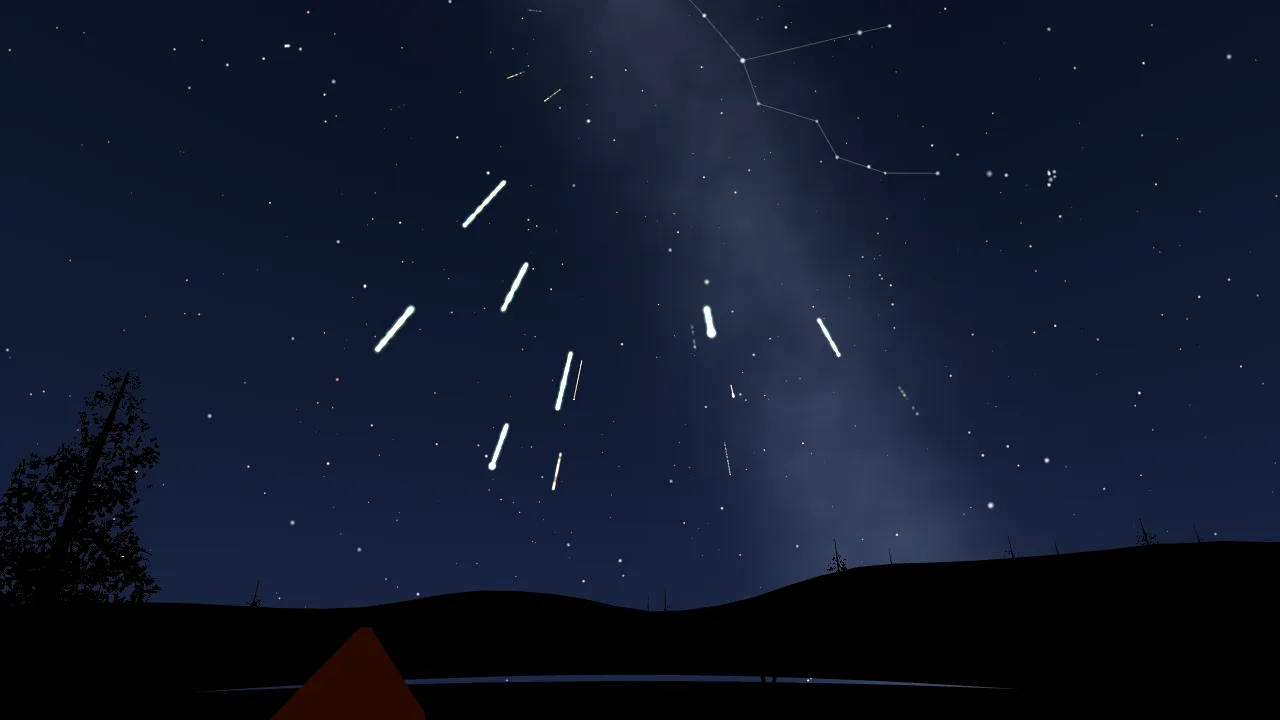
- Lie back and look up. Drag to look around; the radiant is high in the north-east.
- Tap a meteor while it is still glowing: its path is traced back to the point all the meteors seem to come from.
- Tap the glowing tent to switch off its lantern. Your eyes slowly adapt to the dark and fainter stars appear.
- Try the three Challenges, or open Lab for the date, the time of night, sky darkness and a faster time-lapse.
Challenges
- Tap a meteor while it’s still glowing to trace it home
- Trace three meteors back to their radiant in Perseus
- Switch off the lantern and let your eyes adapt to the dark
Try this
- Set the time to 22:00 and then to 04:00. The radiant climbs higher before dawn, and the rate readout rises with it.
- Switch the sky from dark countryside to city centre. Faint stars and most meteors vanish, which is why dark skies matter.
- Move the date away from 12 August by a week. The shower thins out, because Earth is moving out of the densest part of the comet’s dust.
Fun facts
- The Perseids are made by dust from comet 109P/Swift–Tuttle, which takes about 133 years to go once around the Sun.
- Perseid meteoroids hit the upper atmosphere at about 59 kilometres per second.
- Most meteors are made by grains of dust no bigger than a grain of sand.
- From mid-northern latitudes the Perseid radiant never sets, but it climbs highest before dawn, which is when the most meteors are usually seen.
Comet dust at 59 kilometres per second
Every year, from about mid-July to late August, Earth passes through a stream of dust left behind by comet Swift–Tuttle. The grains hit the atmosphere and burn up as meteors, often called shooting stars. The shower usually peaks around 12 to 13 August, when a dark, clear sky can show dozens of meteors an hour. This meadow sky is calculated for the date, hour and latitude you choose, so the stars and the shower behave as they really would.
Why a grain of dust glows
Perseid meteoroids meet the atmosphere at about 59 km/s, more than 150 times faster than sound in air at ground level. At that speed the air in front of each grain is compressed and heated violently, and the grain’s surface boils away, a process called ablation. Vaporised atoms from the grain and from the air glow as they lose their energy, making a brief streak of light somewhere between about 120 and 80 kilometres up. Most Perseids last well under a second; the brightest can leave a glowing trail, or train, that lingers for a few seconds.
The radiant: a trick of perspective
All the grains in the stream travel in parallel. Seen from the ground, parallel paths seem to spread out from a single point, just as parallel railway lines seem to meet at the horizon. That point is the radiant, and for this shower it lies in the constellation Perseus, which gives the Perseids their name. Meteors can appear anywhere in the sky, but trace any streak backwards and it points to the radiant. Tap a meteor as it streaks to see this for yourself.
How many will you see?
Astronomers describe a shower by its zenithal hourly rate, the number one observer would see in an hour under a perfectly dark sky with the radiant overhead; for the Perseids it is around 100 at the peak. Real counts are lower. When the radiant is low, the stream hits the atmosphere at a slant and fewer meteors reach your patch of sky. Light pollution hides faint meteors, and because faint meteors far outnumber bright ones, a bright city sky can hide most of the shower.
Watching the real thing
You don’t need a telescope or binoculars. Find a dark place, lie back, give your eyes 20 minutes or more to adapt, and look about halfway up the sky, a little away from the radiant.
For the curious
The rate you can expect is roughly HR ≈ ZHR · sin(h) · r(m−6.5), where h is the radiant’s altitude, m the faintest star you can see and r the population index (about 2.2 for the Perseids). The scene computes the radiant’s altitude from sidereal time and your latitude.
Questions people ask
When is the best time to see the Perseids?
Around the peak on 12 to 13 August, in the hours before dawn, when the radiant in Perseus is highest. A dark site away from city lights makes a huge difference.
What causes the Perseid meteor shower?
Dust shed by comet 109P/Swift–Tuttle. Each August Earth crosses the comet’s dusty orbit, and the grains burn up as they hit the atmosphere at about 59 kilometres per second.
Do I need a telescope to see a meteor shower?
No. Meteors move fast across large parts of the sky, so your eyes are the best tool. Lie back somewhere dark and let your eyes adapt for at least 20 minutes.