The Roche Limit
Carry a rubble-pile moon too close and watch tides tear it into a ring.
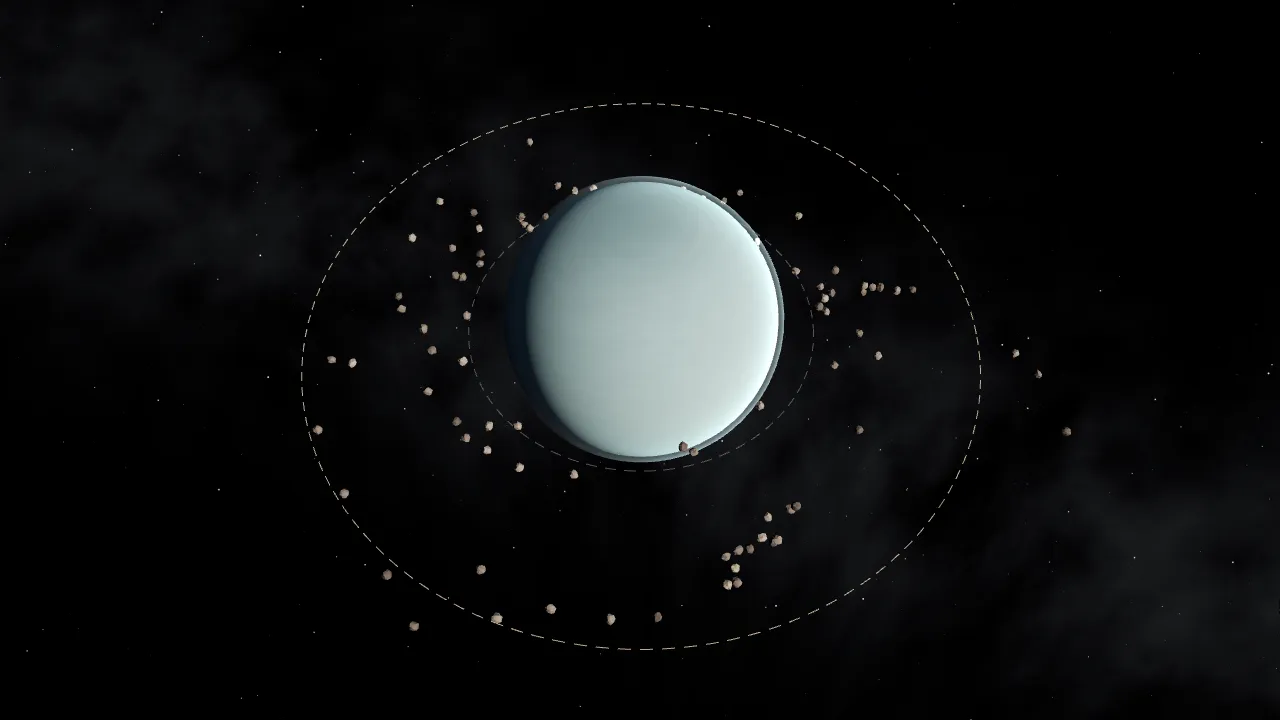
How to play
- Grab the pebble moon and carry it to a new distance. Time pauses while you hold it; let go and it orbits there. The warm dashed circle is the classic Roche limit.
- Drag on empty space to throw a fresh moon along the dotted path, or tap to drop one into a circular orbit.
- Watch the “Largest piece” readout as the moon stretches. Inside the limit the tides win and the pebbles spread into a ring.
- Try the three Challenges, or open Lab for the moon’s density, a slow spiral inwards, or a comet plunge like Shoemaker–Levy 9’s.
Challenges
- Carry the moon inside the dashed Roche limit until tides tear it apart
- Keep a moon whole for three orbits just outside the Roche limit
- Tear a moon apart and let its pebbles spread into a ring all the way round
Try this
- Release the moon at 3.2 planet radii and then at 1.6. Far out it stays a ball; close in it stretches, sheds pebbles and spreads into a ring.
- Make the moon three times denser than the planet. The dashed limit shrinks, and the moon survives much closer in.
- Run the slow spiral and watch the “Largest piece” readout. The moon survives a little inside the dashed line before it finally comes apart.
Fun facts
- Édouard Roche worked out this limit in 1848.
- Comet Shoemaker–Levy 9 was torn into more than 20 pieces after passing close to Jupiter in 1992; the pieces hit Jupiter in July 1994.
- Satellites and the International Space Station orbit well inside Earth’s Roche limit; they are held together by their own strength, not their gravity.
- Mars’s moon Phobos is slowly spiralling inwards and is expected to break up or crash into Mars in tens of millions of years.
When tides beat a moon’s own gravity
A planet pulls harder on the near side of a moon than on its far side. That difference, the tidal force, tries to stretch the moon along the line to the planet. Meanwhile the moon’s own gravity holds it together. The tidal stretch grows quickly as the moon comes closer, like one over the distance cubed, so there is a distance inside which the stretch wins. That is the Roche limit, worked out by Édouard Roche in 1848.
For a moon with no strength at all, held together only by gravity like a liquid, the limit is about d = 2.44·R·(ρ_planet/ρ_moon)^⅓, where R is the planet’s radius and ρ the densities. A moon as dense as its planet is torn apart closer than 2.44 planet radii. A denser moon can go closer; a fluffier one breaks up farther out. Change the density in the Lab and the dashed circle moves.
A moon made of rubble
The moon here is a rubble pile: a few hundred pebbles that attract each other by gravity and push apart only when they touch, with no glue. Many small moons and asteroids are thought to be like this. Each pebble feels the planet, every other pebble, and the jostling of its neighbours, and the whole pile spins once per orbit, as tidally locked moons do. Nothing is scripted: the break-up happens when the forces say so.
One honest surprise: a rubble pile is not quite a liquid. Its pebbles jam together, which gives it a little strength, so in our tests an equal-density moon survives at 1.95 planet radii and breaks up at 1.8, about three-quarters of the classic fluid distance. The break-up distance still scales with the density ratio exactly as Roche’s formula says. The faint purple circle marks the much smaller limit for a perfectly rigid moon.
Rings and broken comets
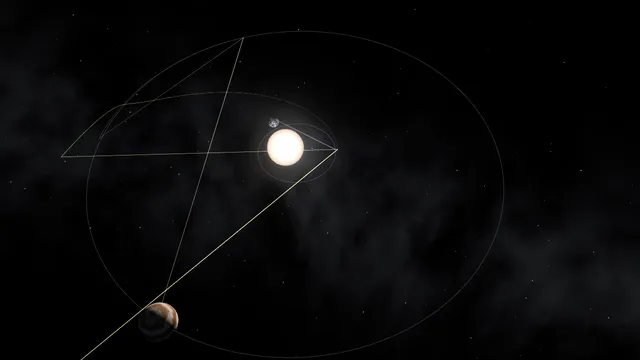
Material that ends up inside a planet’s Roche limit cannot gather into a single large moon, which helps explain why Saturn’s great rings lie so close to the planet. In 1992 comet Shoemaker–Levy 9, a loose, low-density body, swung close to Jupiter, was pulled into a string of fragments, and two years later the pieces crashed into Jupiter one after another. The “Comet plunge” preset recreates a swoop like that.
For the curious
Units: planet radius 1, planet mass 1, G = 1. Pebbles attract with softened Newtonian gravity and repel on contact with a spring and damper, and everything moves with leapfrog on fixed steps of 0.004. A pebble that strikes the planet is absorbed, handing over its momentum.
Questions people ask
What is the Roche limit?
The distance from a planet inside which its tides pull apart a moon held together only by its own gravity. For a fluid moon of the same density as the planet it is about 2.44 planet radii.
Why doesn’t the International Space Station get torn apart?
The Roche limit applies to bodies held together by gravity. The space station, satellites and people are held together by the strength of their materials, which is far stronger than the tidal stretch.
Did the Roche limit make Saturn’s rings?
It helps explain them. Inside Saturn’s Roche limit, ring material cannot clump into a large moon, so it stays spread out as rings. How the rings first formed is still debated.