Kepler’s Laws: A Comet’s Orbit
Drag a comet onto new orbits and see Kepler’s three laws at work.
How to play
- Press on the comet and drag out an arrow: that is its new speed and direction. The dotted line shows the new orbit; let go to make it real. An arrow about as long as the comet’s distance from the Sun on screen makes a near-circle.
- Drag on empty space to throw a new comet from there; its orbit is worked out from your throw.
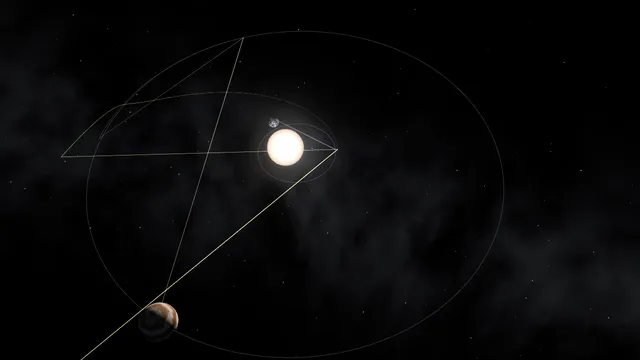
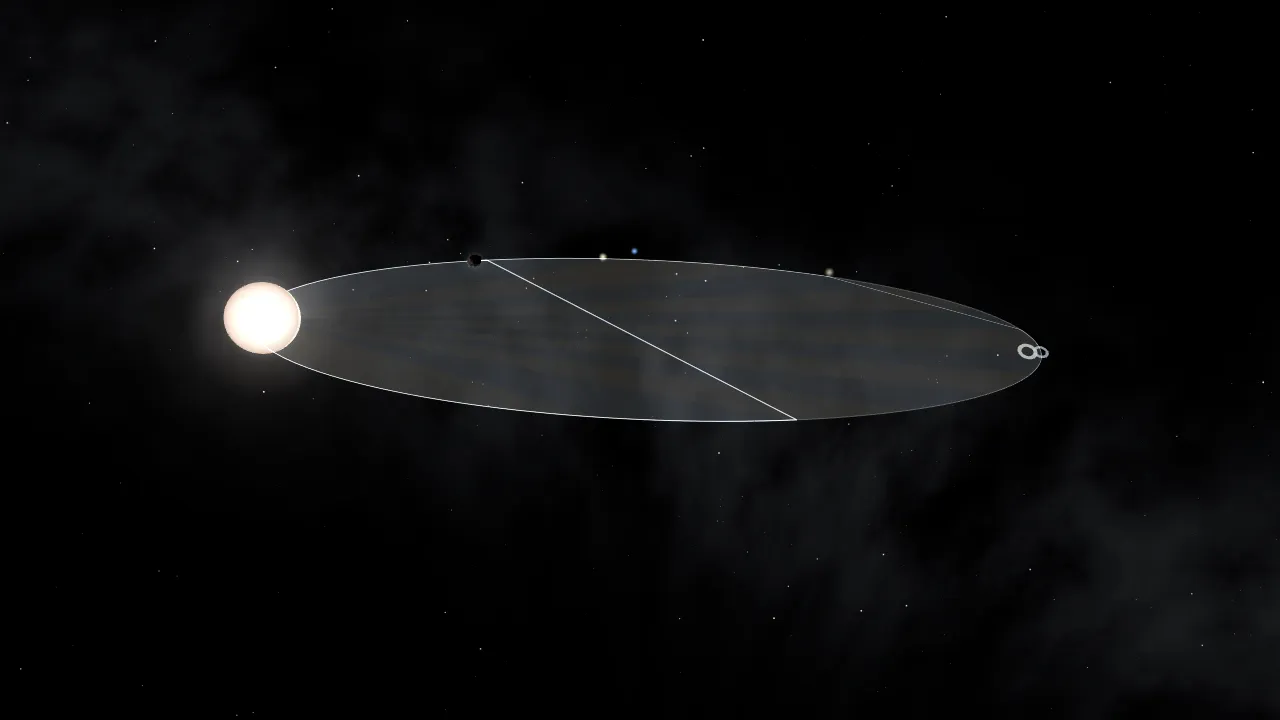
- Each pale wedge is swept out in the same time. Compare their shapes and the “Wedge areas” readout.
- Try the three Challenges, or open Lab to set the orbit’s size (a) and stretch (e), pick Halley, Encke, Earth or Mars, or change the seconds per orbit.
Challenges
- Reshape the comet’s orbit into a near-circle (e below 0.1)
- Make the comet dive closer to the Sun than Mercury (under 0.39 AU)
- Make an orbit that takes 8 years per lap (P² = a³, so a = 4 AU)
Try this
- Pick Halley’s Comet and watch the wedges: long and thin far from the Sun, short and fat close in, yet the “Wedge areas” readout shows they are all the same size.
- Keep the eccentricity fixed and double the semi-major axis. The period readout grows by a factor of about 2.8, the square root of 2 cubed.
- Set the eccentricity to zero for a circle. Now the speed stays the same all the way round.
Fun facts
- Johannes Kepler published his first two laws in 1609 and his third in 1619.
- Halley’s Comet returns about every 76 years; it last passed the Sun in 1986 and is expected back in 2061.
- Comet Encke has the shortest orbital period of any known bright comet, about 3.3 years.
- Earth moves fastest in early January, when it is closest to the Sun (about 30.3 km/s), and slowest in early July (about 29.3 km/s).
Three laws from one force
In the early 1600s Johannes Kepler spent years fitting Tycho Brahe’s careful measurements of Mars. He found three rules that every planet obeys, and Isaac Newton later showed they all follow from a single idea: gravity pulls towards the Sun with a strength falling as one over distance squared. This simulation does nothing but apply Newton’s gravity, and Kepler’s laws appear by themselves.
Law 1: orbits are ellipses
A bound orbit is an ellipse with the Sun at one focus, not at the centre. The white ring marks the other, empty focus. The eccentricity e measures the stretch: 0 is a circle, Earth’s is 0.017, and Halley’s Comet’s is about 0.97, a long thin loop that reaches beyond Neptune.
Law 2: equal areas in equal times
The line from the Sun to the comet sweeps out equal areas in equal times. Each coloured wedge here is swept in exactly one twelfth of an orbit, and the “Wedge areas” readout adds them up as you watch: they match to a fraction of a percent. The reason is that gravity pulls straight towards the Sun, so it can never change the comet’s spin around the Sun, its angular momentum. Close to the Sun the comet must move fast to sweep the same area; far away it crawls.
Law 3: bigger orbits take much longer
The square of the period is proportional to the cube of the semi-major axis, the average of the nearest and farthest distances. In years and astronomical units, P² = a³. Halley’s Comet has a ≈ 17.8 AU, and 17.8 to the power 1.5 is about 75: its period in years.
The tail
Near the Sun, sunlight warms the icy nucleus and gas streams off it. The solar wind pushes the gas away from the Sun, so a comet’s tail points away from the Sun, not behind the comet. The tail here grows as the comet approaches perihelion and fades far out.
For the curious
The speed anywhere on the orbit follows the vis-viva equation, v² = GM(2/r − 1/a). Units are AU, years and solar masses (G = 4π²), and integration is leapfrog with steps that shrink near the Sun. To keep every orbit on screen, the drawing is rescaled so the long axis always fits; the readouts convert back to real distances and speeds, and time is always real years.
Questions people ask
What are Kepler’s three laws?
Planets move on ellipses with the Sun at one focus; the line from the Sun to a planet sweeps equal areas in equal times; and the square of the orbital period is proportional to the cube of the orbit’s semi-major axis.
Why do comets speed up near the Sun?
Gravity cannot change a comet’s angular momentum around the Sun, so when its distance shrinks its speed must grow, the same way a spinning skater speeds up by pulling in their arms.
When will Halley’s Comet return?
It is expected to pass closest to the Sun again in 2061, about 76 years after its 1986 visit.