Lagrange Points
Place asteroids at the five spots where they ride along with a planet.
How to play
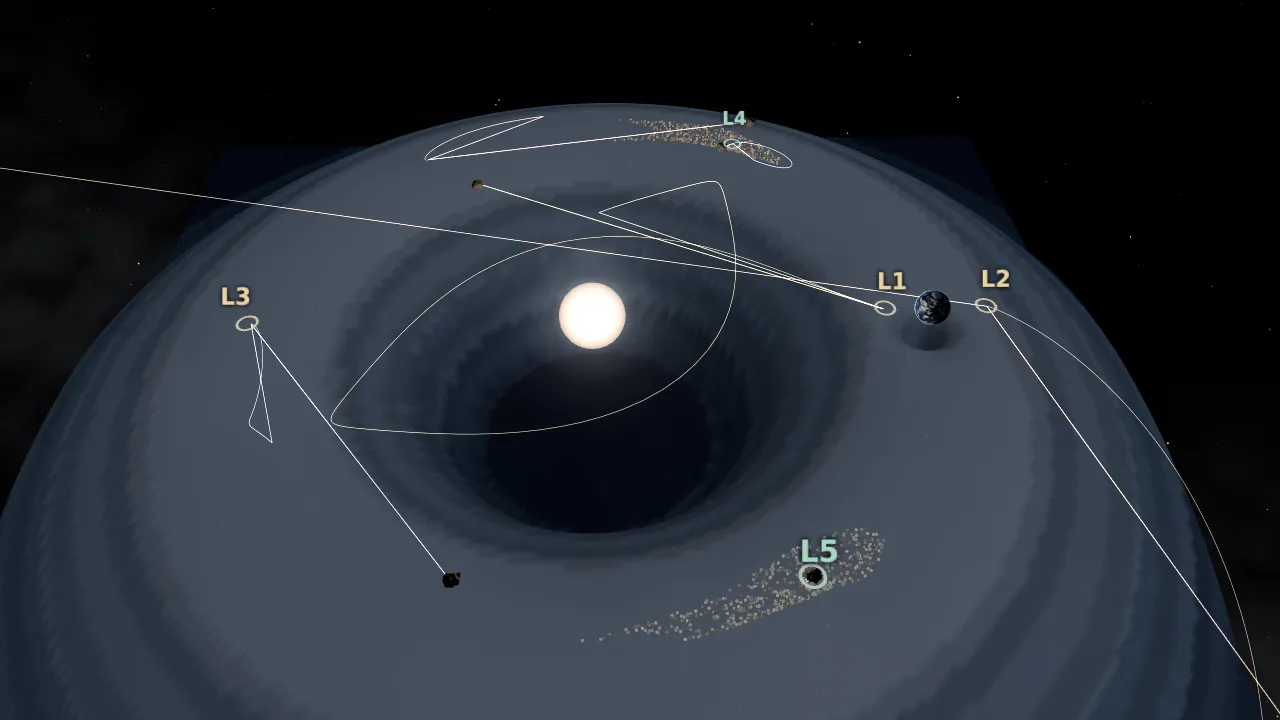
- Tap anywhere to place an asteroid at rest in this view, which turns with the planet so the planet stands still. Drag instead of tapping to give it a push.
- Drag any asteroid to a new spot; it is let go at rest there. Compare a spot on L1 with one on L4.
- The dark relief below shows the effective gravity: L1, L2 and L3 sit on saddles, L4 and L5 on hilltops that the Coriolis effect makes stable.
- Try the three Challenges, or open Lab to change the planet’s share of the mass, μ.
Challenges
- Park an asteroid at L4 and keep it there for a whole orbit
- Place an asteroid right on L1 and watch it slide away
- Find a horseshoe orbit: an asteroid that loops from L4’s side round to L5’s
Try this
- Set μ to the Sun and Jupiter value. The Trojans trace tadpole-shaped loops round L4 and L5 and stay put.
- Set μ = 0.06, above the stability limit, and watch the swarms melt away.
- Tap to place an asteroid exactly on L1 and another on L4, then compare where each one is after a few orbits.
Fun facts
- The James Webb Space Telescope orbits near the Sun–Earth L2 point, about 1.5 million km from Earth.
- The SOHO observatory has watched the Sun from near the Sun–Earth L1 point since 1996.
- Thousands of Trojan asteroids share Jupiter’s orbit, clustered around its L4 and L5 points.
- Joseph-Louis Lagrange found the triangular points in 1772; Leonhard Euler had found the three points on the line a few years earlier.
Five places to park in space
Take a star and a planet circling each other. Is there anywhere a small object, such as a spacecraft or an asteroid, could sit and keep pace with them, staying in the same place relative to both? There are exactly five such places, the Lagrange points, L1 to L5.
In the frame that turns with the planet, the small body feels the pull of both big bodies plus a centrifugal push outwards. Where all three balance, it can stay put. L1 lies between star and planet, L2 just beyond the planet, and L3 on the far side of the star. L4 and L5 sit 60° ahead of and behind the planet, each forming an equilateral triangle with the star and planet.
The landscape
The coloured surface is the effective potential, the energy landscape of the turning frame. The star and planet sit in deep wells. L1, L2 and L3 are saddle points, like mountain passes: balanced, but the slightest nudge sends you sliding off, which is why the visitors placed there drift away. Spacecraft at L1 and L2 must fire their thrusters every few weeks to stay near them.
Why L4 and L5 are special
L4 and L5 are hilltops, so you might expect anything there to roll off. It does start to, but in the turning frame a moving object is deflected sideways by the Coriolis effect, which steers it round the hilltop instead of off it. The result is a loop shaped like a tadpole. This only works if the planet is light enough: Edward Routh showed it needs the planet to have less than about 3.85% of the total mass. Sun and Jupiter (about 0.1%) and Earth and Moon (about 1.2%) both qualify, which is why Jupiter has thousands of Trojan asteroids. Try μ = 0.06 in the Lab to see the swarms escape.
How it is simulated
Nothing here is solved by formula. The star and planet move on Newton’s gravity, and every asteroid is pulled by both of them, integrated step by step with leapfrog in an ordinary, non-turning frame. Only the drawing turns, so that the planet stays still on screen. The tadpoles and the drift away from L1 to L3 emerge from the simulation itself.
For the curious
Units: G = 1, distance between star and planet 1, total mass 1, so one orbit takes 2π. With mass ratio μ, the effective potential is Φ = −(1 − μ)/r₁ − μ/r₂ − ½(x² + y²). L4 and L5 lie at (½ − μ, ±√3/2). L1 to L3 are found by solving for the zeros of the force along the line through both bodies. Routh’s stability limit is μ < (1 − √(23/27))/2 ≈ 0.0385.
Questions people ask
What are Lagrange points?
Five positions near two orbiting bodies, such as the Sun and Earth, where the combined gravity and the orbital motion let a small object keep the same position relative to both.
Why is the James Webb Space Telescope at L2?
Near L2 the Sun, Earth and Moon all lie in roughly the same direction, so one sunshield can block them all and keep the telescope extremely cold while it keeps pace with Earth.
Are Lagrange points stable?
L1, L2 and L3 are unstable, so spacecraft there need small course corrections. L4 and L5 are stable when the smaller body has less than about 3.85% of the total mass, as for Sun and Jupiter.