Songkran Water Splash
Send arcs of water across a Thai riverside, or pour it gently.
How to play
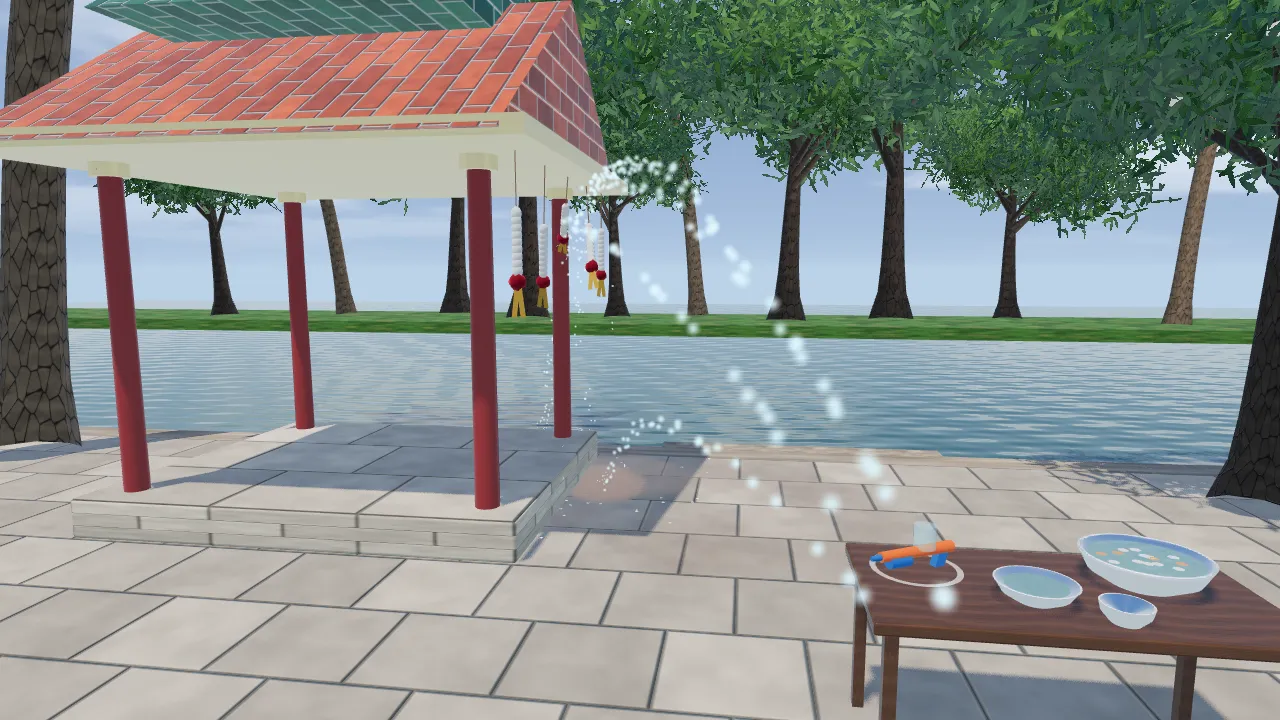
- Press and drag to spray water at the spot you point to. The arc is worked out for you from the launch speed.
- Hit the jasmine garlands under the pavilion eaves to set them swinging, and watch the wet stone dry in the sun.
- Tap a tool on the table: the water gun, the khan bowl for a big splash, or the small silver bowl. With the silver bowl, press and hold to pour gently into the bowl of scented water.
- Change the launch speed, drop size and air temperature in Lab.
Challenges
- Splash a jasmine garland hard enough to set it swinging
- Pick up the small silver bowl and pour gently into the scented water
- Set all five garlands swinging at the same time
Try this
- Aim at something far away with a low launch speed: the water has to go up at a steep angle. With more speed the same target needs a flatter arc.
- Make the drops tiny (0.5 mm). Air drag slows small drops much more, so they fall well short of the no-drag range in the readout.
- In gentle-pour mode, compare the width of the stream at the spout and at the bowl. The water speeds up as it falls, so the stream gets thinner.
Fun facts
- Songkran is the traditional Thai New Year, celebrated from 13 to 15 April.
- In the gentle custom of rod nam dam hua, younger people pour scented water over the hands of elders and parents and ask for their blessing.
- The name comes from the Sanskrit word saṅkrānti, the passage of the sun from one sign of the zodiac to the next.
- In 2023 UNESCO inscribed Songkran in Thailand on its list of the Intangible Cultural Heritage of Humanity.
Arcs, streams and drying stone
Songkran marks the traditional New Year in Thailand. It falls in mid-April, one of the hottest times of the year, and water is at its heart as a symbol of cleansing and a fresh start. Many people visit temples, make merit and gently pour water over Buddha images. Families honour their elders in rod nam dam hua, pouring fragrant water over their hands and receiving blessings in return. And in streets and along rivers, friends and strangers splash each other with bowls and water guns. Neighbouring countries celebrate related new year festivals, such as Thingyan in Myanmar, and customs vary from place to place.
Every drop is a projectile
Once a drop leaves the water gun, the only forces on it are gravity and air drag. Ignoring drag, its sideways speed stays constant while gravity steadily changes its upward speed, so it follows a parabola. On level ground the range is R = v²·sin 2θ / g, greatest at a launch angle of 45°. To hit a given spot there are usually two angles that work, a low, fast arc and a high, lobbed one. This scene picks the lower arc, using the angle from the projectile formula.
Real drops also feel air drag, and it matters most for small ones. Drag depends on a drop’s area while its momentum depends on its volume, so the deceleration grows as the drop gets smaller. Spray fine mist and it falls short. Big drops fly almost as the formula says.
Why a pouring stream gets thinner
In gentle-pour mode the water leaves the vessel slowly and speeds up as it falls: v² = v₀² + 2gh. Water hardly compresses, so the same volume must pass every level each second. The flow rate Q = A·v is constant, and as v grows the cross-section A must shrink. That is why a falling stream narrows, the same effect you see under a kitchen tap. Further down, surface tension eventually breaks a thin stream into drops.
Drying in the sun
Wet stone dries by evaporation, and evaporation is faster in hot air. The amount of water vapour air can hold rises steeply with temperature, nearly doubling with every 10 °C. Evaporation also carries heat away, about 2.4 million joules per kilogram of water, which is why a splash feels so refreshing on a hot April afternoon.
For the curious
The launch angle solves tan θ = (v² − √(v⁴ − g(gd² + 2hv²)))/(gd). Drops feel a deceleration of 3ρairCdv²/(8ρwaterr) with Cd ≈ 0.47, and wet patches fade at a rate proportional to the saturation vapour pressure, eₛ(T) = 6.112·exp(17.62T/(243.12 + T)) hPa.
Questions people ask
What is Songkran?
Songkran is the traditional Thai New Year, celebrated from 13 to 15 April. It is a time for family, visiting temples and honouring elders, and it is famous for joyful water splashing in the streets.
Why do people splash water at Songkran?
Water stands for cleansing and renewal at the start of the new year. Pouring water respectfully over elders’ hands or Buddha images is a long-standing custom, and splashing friends in the street grew from the same idea. It also helps everyone cool off in the April heat.
What is the formula for the range of a projectile?
Without air resistance, an object launched at speed v and angle θ over level ground travels R = v²·sin 2θ / g, where g is about 9.81 m/s². The range is greatest at 45°, and air drag makes real ranges shorter, especially for small drops.