Soap Film Surfaces
Dip wire frames in soap and stretch films into minimal surfaces.
How to play
- Drag the wire frame down into the dish until it is completely under the soap, then lift it out. A film forms as the last wire leaves the surface and settles in a moment.
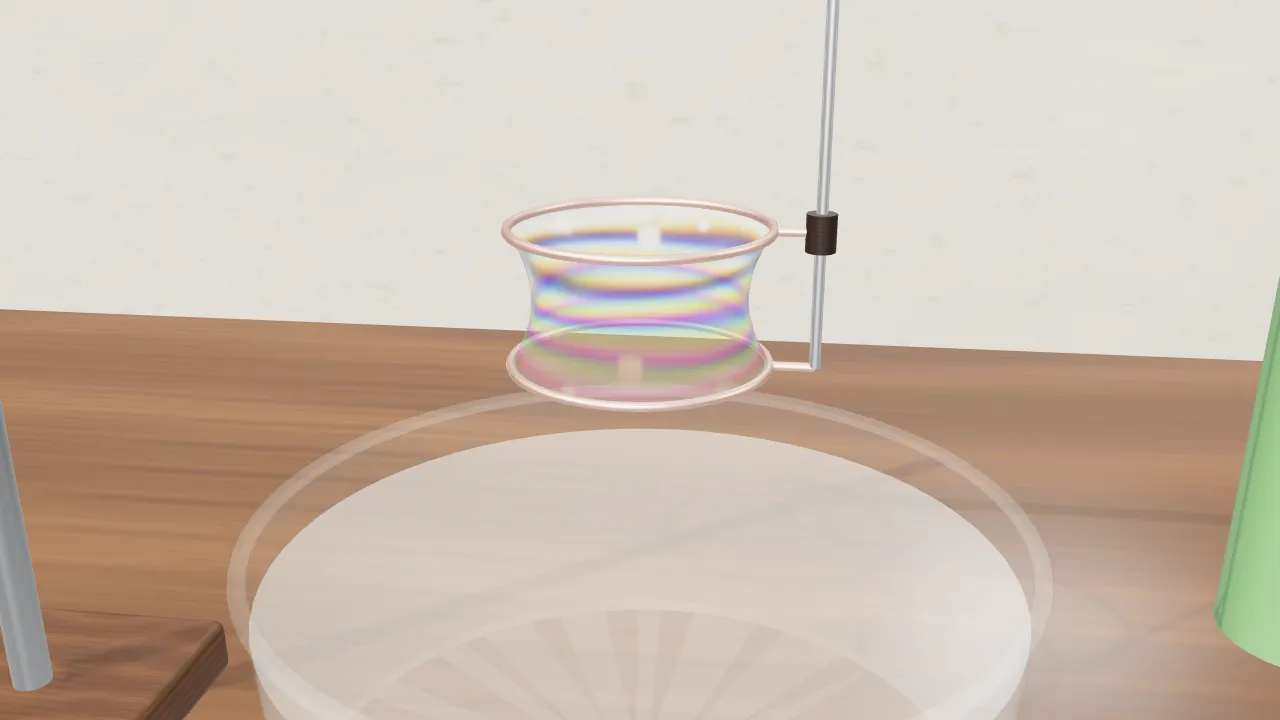
- With the two rings, drag the upper ring upwards. The film between them narrows into a waisted catenoid, and pops into two flat discs when the rings get too far apart.
- Tap the cube or the tetrahedron lying on the table to hang it on the stand, then dip it. Watch the films slide into place and meet along curved edges.
- Open Lab to choose a frame or make a film without dipping. The readouts show the ring spacing and the measured angles between films.
Challenges
- Dip the two rings and lift out a catenoid
- Pull the rings apart until the catenoid pops at the critical ratio
- Dip the cube frame and find Plateau’s 120° junctions
Try this
- Pull the rings apart very slowly and watch the neck. It thins gently at first, then suddenly collapses once the spacing passes about 1.33 times the ring radius.
- Dip the tetrahedron. Six flat triangles meet at a single point in the middle, where four edges come together at about 109.5°, the angle between bonds in methane.
- Look closely at the cube’s film: a small square floats in the middle, connected to every wire by twelve curved sheets.
Fun facts
- A soap film always shrinks to the smallest area its wire frame allows, because surface tension pulls it tight like a stretched skin.
- The Belgian physicist Joseph Plateau described the rules soap films obey in the 19th century: films meet only in threes at 120°, and those edges meet only in fours.
- Leonhard Euler showed in 1744 that the catenoid, the shape between two rings, is the surface of revolution with the least area.
- The colours in a soap film come from light reflected from its front and back surfaces interfering; a film a few tens of nanometres thick looks black.
Why soap films are the laziest surfaces in nature
Surface tension makes a liquid surface behave like a stretched elastic skin. A soap film is a thin sheet of water with two such skins, one on each side, so it pulls itself as tight as it can. Whatever wire frame it hangs on, the film slides and settles until its area is as small as possible. Mathematicians call these shapes minimal surfaces, and soap films let you find them by experiment.
Zero mean curvature
At every point of a minimal surface, the curving one way is exactly balanced by curving the other way: the mean curvature is zero. That is why the waisted film between two rings looks like a saddle everywhere. It curves inwards around the waist and outwards from top to bottom, by the same amount, so the pull of the film is balanced and it stays still.
The catenoid and its sudden pop
Between two equal rings the film takes the shape of a catenoid, made by spinning a hanging-chain curve around the axis. Pull the rings apart and the waist narrows. Beyond about 1.06 times the ring radius, two flat discs would actually have less area, but the catenoid holds on because it is still a stable shape. Only when the spacing passes about 1.3255 times the radius does no catenoid exist at all. The waist then collapses and the film pops, leaving a flat film across each ring.
Plateau’s laws
Frames like the cube and the tetrahedron produce films with several sheets. Joseph Plateau noticed that however complicated the frame, the films obey simple rules: sheets meet only in threes, along curved edges called Plateau borders, at angles of exactly 120°; and those borders meet only in fours, at about 109.5°. The rules were finally proved mathematically by Jean Taylor in 1976.
For the curious
This simulation knows nothing about angles. Each film is a mesh that repeatedly moves every free point a little in the direction that reduces its area most, a process called mean-curvature flow, until it stops moving. The tetrahedron’s film comes out with its sheets at 120.0°; the coarser cube film lands within a few degrees. Between rings of radius R at spacing h, the catenoid is
r(y) = c · cosh(y / c), with the waist radius c fixed by R = c · cosh(h / 2c).
That equation has a solution only while h/R is below about 1.3255. The colours are thin-film interference: light reflected from the front and back of a film of thickness d and refractive index n ≈ 1.33 is brightest at wavelengths where 2nd is an odd number of half wavelengths, so the colour changes as the film drains and thins from the top.
Questions people ask
Why does a soap film form a minimal surface?
Surface tension pulls the film tight, so it keeps shrinking until any further change would increase its area. The shape it settles into has the least area possible for its wire frame, and zero mean curvature at every point.
What is a catenoid?
It is the waisted surface a soap film forms between two rings, made by spinning a catenary (the curve of a hanging chain) around an axis. Euler showed it is the surface of revolution with the least area.
What are Plateau’s laws?
They describe how soap films join: sheets meet only in threes at 120°, along edges called Plateau borders, and those borders meet only in fours at about 109.5°. Joseph Plateau found them by experiment in the 19th century, and Jean Taylor proved them in 1976.