Möbius Strip
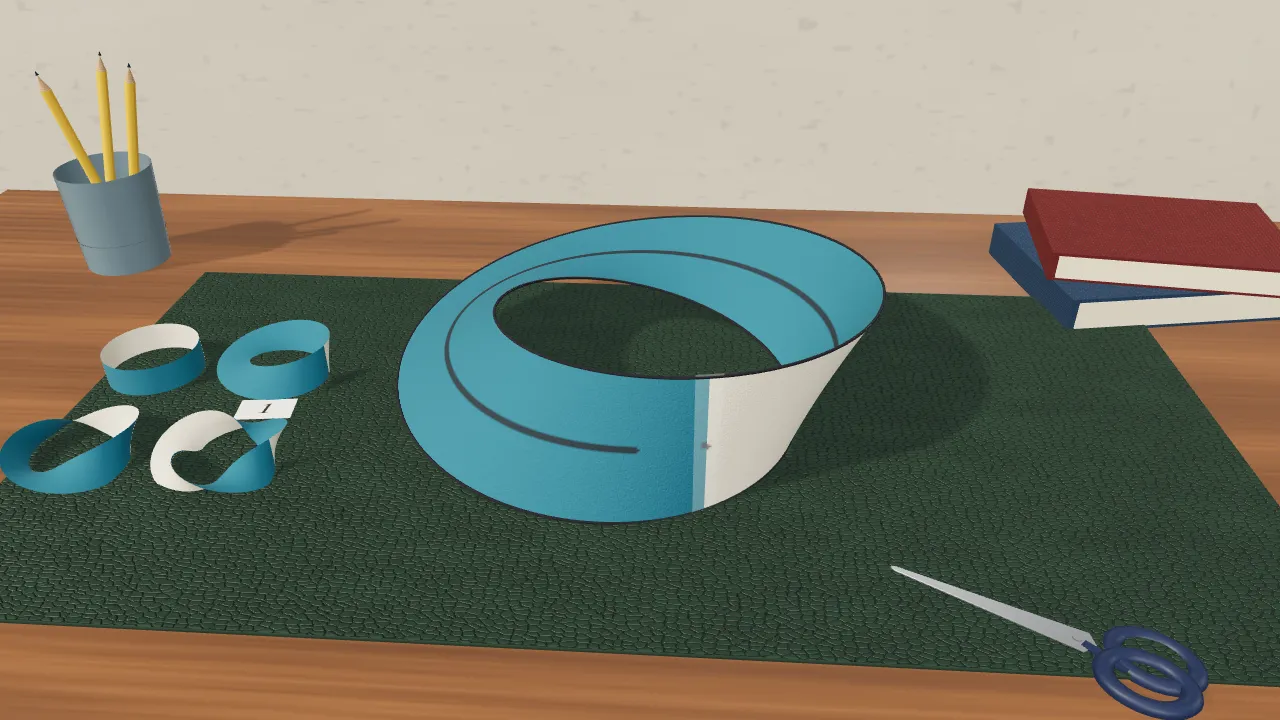
Set an ant on a paper Möbius strip, then cut the loop down the middle.
How to play
- Tap the paper strip to set the ant down there, or drag the ant to a new spot. It draws a pencil line as it walks.
- The paper is coloured on one face and white on the other. See where the colours meet at the taped join.
- Tap the scissors to cut the strip down the middle, and watch the pieces fall open.
- Tap one of the small loops on the desk for a fresh strip with 0, 1, 2 or 3 half-twists.
Challenges
- Set the ant down and follow it back to its start on the other face
- Snip the Möbius strip down the middle and see how many pieces you get
- Cut the loop with two half-twists down the middle to make two linked loops
Try this
- Pick the loop with 2 half-twists. Now the ant only ever draws on one face: this band has two sides and two edges.
- Let the ant walk two laps. Its pencil line runs over the coloured face and the white face without ever crossing an edge.
- Follow the felt-tip edge with your eye. On the Möbius strip it is a single loop that goes round twice.
Fun facts
- The strip is named after August Ferdinand Möbius, who described it in 1858. Johann Benedict Listing found it independently in the same year.
- Cutting a Möbius strip along its centre line gives one longer loop with two full twists, not two separate strips.
- The international recycling symbol, designed by Gary Anderson in 1970, is often drawn as a Möbius strip.
- A Möbius strip has only one edge: trace it and you come back to your starting point after going round twice.
One side, one edge, half a twist
Take a strip of paper, give one end half a twist and tape the ends together. You have made a Möbius strip, one of the simplest surprising shapes in mathematics. It looks like an ordinary loop, but it has only one side and only one edge.
The ant’s walk
The ant in this simulation draws a pencil line on the face it is standing on. The strip is cut from origami paper, coloured on one face and white on the other, so you can tell the faces apart. Watch it set off along the middle of the strip. After one full lap it is back where it started, but upside down, standing on the other face, and it never crossed an edge to get there. After a second lap it is back on its original face, and its trail now runs along both faces. On an ordinary loop that could never happen: an ant on the outside stays on the outside. That is what mathematicians mean by one-sided, or non-orientable: there is no consistent way to say which side is “up”. Notice the taped join, where the coloured face meets the white one. On an ordinary loop the colours would match all the way round; here the half-twist brings the white face round to meet the coloured one.
Twists and edges
The number of half-twists decides everything. With an odd number (1, 3, …) the band is one-sided and its edge is a single loop. With an even number (0, 2, …) it has two sides and two separate edges, however twisted it looks. Pick another loop from the desk and watch the felt-tip edge split into two loops, or join back into one.
Cutting it in half
Cut a paper Möbius strip along its centre line and you do not get two strips. You get one longer loop with two full twists, which is two-sided. Cut it a third of the way in from the edge instead, and you get two linked loops: one Möbius strip and one longer two-sided band. The scissors work on the other loops too: a plain ring falls into two separate rings, two half-twists give two linked loops, and three half-twists give one long loop tied in a knot.
For the curious
This strip is the surface S(u, v) = ((R − v sin(ku/2)) cos u, v cos(ku/2), (R − v sin(ku/2)) sin u) for 0 ≤ u ≤ 2π and −w ≤ v ≤ w, where k is the number of half-twists. For odd k the end u = 2π joins the start with v flipped to −v, and the normal vector flips with it. The ant walks in u at constant speed, and each time it crosses that join it switches to painting the other face’s texture. The strip’s Euler characteristic is 0, the same as a plain ring; what tells them apart is orientability and the number of edges.
Questions people ask
Why does a Möbius strip have only one side?
The half-twist joins the top surface at one end to the bottom surface at the other. If you travel once around the strip you arrive on what looked like the other face, without ever crossing an edge, so there is really only one side.
What happens if you cut a Möbius strip in half?
Cutting along the centre line gives one longer loop with two full twists, not two pieces. Cutting a third of the way from the edge gives two linked loops: a smaller Möbius strip and a longer two-sided band.
Where are Möbius strips used?
The recycling symbol is often drawn as one, and belts shaped like Möbius strips have been used in machines so that both faces of the belt wear evenly. Mathematicians also use the strip as the classic example of a non-orientable surface.