Snowflake Growth
Steer a growing snowflake through a cloud and shape its crystal.
How to play
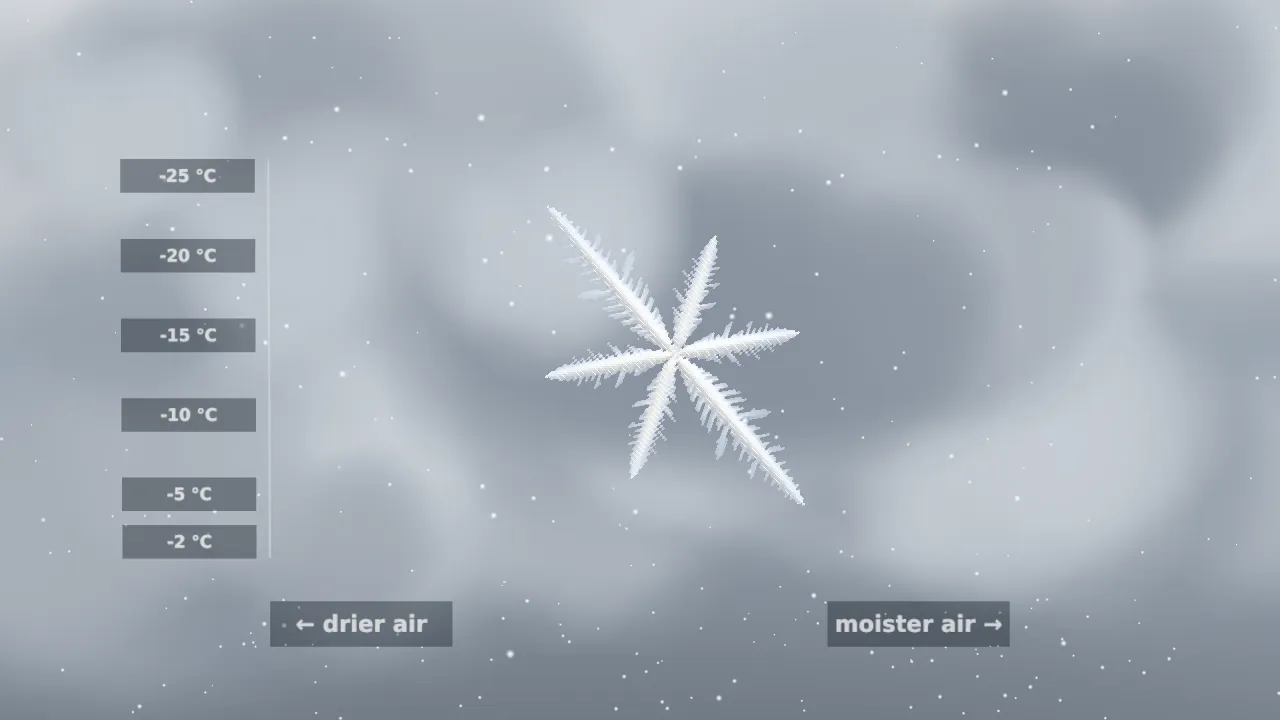
- Drag the crystal up into colder air or down into warmer air. The scale on the left gives the temperature at each height in the cloud.
- Drag it right into moist air full of cloud droplets, or left into drier air. The readout names the shape that grows best there.
- Tap anywhere in the cloud to start a new crystal at that spot. A crystal keeps a record of every layer it has grown in.
- Try the three Challenges, or open Lab to set the temperature and humidity exactly.
Challenges
- Hold a crystal in moist air near −15 °C until it grows six fernlike arms
- Grow a plain hexagonal plate in drier air, near −2 °C or −20 °C
- Grow a column first, then carry it into plate weather to cap both ends
Try this
- Park the crystal at −15 °C on the moist side for a fernlike star covered in side branches.
- Start a crystal at −5 °C: it grows as a long needle or a hollow column instead of a flat plate. Carry it to −15 °C and plates grow on both ends.
- Grow a star at −15 °C, then drag it into drier air. The new growth fills in between the arms, the way real crystals change as they fall.
Fun facts
- Snow crystals have six-fold symmetry because water molecules lock together in a hexagonal pattern when they freeze into ordinary ice.
- In the 1930s the Japanese physicist Ukichiro Nakaya grew snow crystals in his laboratory and mapped how their shapes depend on temperature and humidity.
- Wilson Bentley of Jericho, Vermont, began photographing snow crystals in the 1880s and went on to record thousands of them.
- The most elaborate, fernlike crystals grow at around −15 °C in very humid air.
How temperature chooses a snowflake’s shape
A snowflake is not frozen rain. It grows straight from water vapour, as water molecules in cold, humid cloud air stick to a tiny seed of ice and build up layer by layer. The molecules lock into a hexagonal lattice, which is why every snow crystal has six-fold symmetry.
Facets and branches
Two effects compete as a crystal grows. Flat faces of ice gather new molecules slowly, so a crystal growing gently keeps neat facets and becomes a hexagonal plate or prism. But vapour has to diffuse through the air to reach the crystal, and the corners stick out into the humid air further than the middle of the faces do. In very humid air the corners therefore grow fastest, sprout arms, and the arms sprout side branches. That is how a simple hexagon turns into a fernlike star.
The Nakaya diagram
Temperature decides which surfaces of the crystal grow fastest, and the shape changes surprisingly sharply. Near −2 °C crystals grow as thin plates. Around −5 °C they grow as columns and needles instead. Between about −10 and −22 °C they are plates again, and close to −15 °C, in very humid air, the large branching stellar dendrites appear. Colder still, plates and columns mix. Ukichiro Nakaya mapped this pattern in the 1930s, and it has been refined by later researchers. A crystal’s six arms usually look alike because they grew together, through the same changes of temperature and humidity, as the crystal drifted through the cloud.
About this model
The crystal here is grown by a cellular model published by the mathematician Clifford Reiter in 2005. The plane is divided into hexagonal cells, each holding an amount of water. Cells that are frozen, or touch a frozen cell, collect a little extra vapour each step; the others share their water with their neighbours, which imitates diffusion. A cell freezes when its water reaches a threshold. Just two numbers, the background vapour level and the amount added, decide whether the result is a plate, a sectored plate or a fernlike dendrite. Where you hold the crystal chooses those numbers, following the pattern of the Nakaya diagram, and they change as you move it, so one crystal can grow in several layers of air; they stand in for the real physics rather than calculating it. Columns and needles grow along the third dimension, so they are drawn as hexagonal prisms.
For the curious
In Reiter’s model, receptive cells gain a constant γ each step, while the water u in the other cells diffuses as u ← u + (α/2)(ū − u), where ū is the average of the six neighbours. The edge of the grid is held at the background level β. Each cell here is about 25 micrometres across, so a full crystal is about three millimetres wide.
Questions people ask
Is it true that no two snowflakes are alike?
Small, simple crystals can look almost identical. But large, branched crystals follow such complicated paths through the cloud that finding two exactly identical ones is extraordinarily unlikely.
Why are snowflakes six-sided?
When water freezes into ordinary ice, its molecules join in a hexagonal pattern. A crystal growing from that lattice inherits its six-fold symmetry, so its corners and arms come in sixes.
At what temperature do the biggest snowflakes form?
The largest single crystals, the fernlike stars, grow near −15 °C in humid air. The big, fluffy flakes you see falling on mild days are usually many crystals stuck together, which happens most near 0 °C.