Seasons and the Tilted Earth
Drag the Earth round the Sun and tilt its axis to make the seasons.
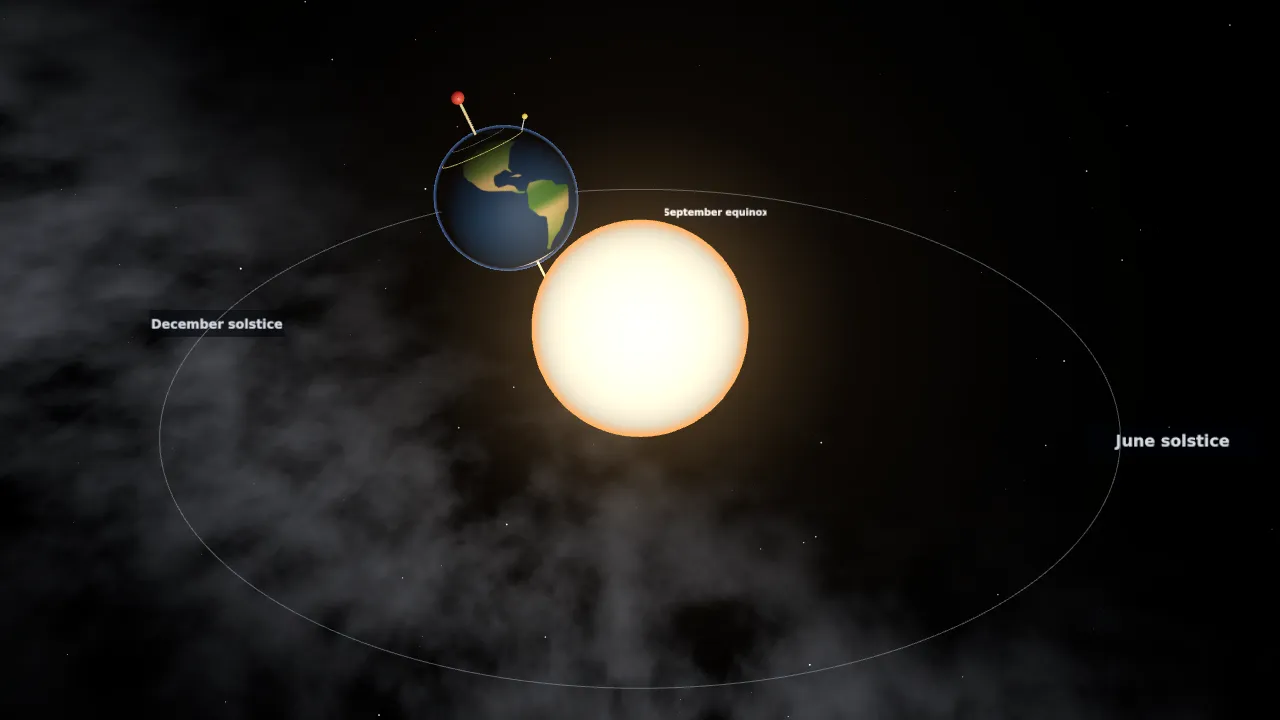
How to play
- Drag the Earth along its orbit to change the date. The labels mark the solstices and equinoxes.
- Tap the globe to stand there. The readouts give the noon Sun height and the hours of daylight where you stand.
- Drag the red knob on top of the axis to tilt the Earth more or less, from upright to lying on its side.
- Try the three Challenges, or open Lab to set the tilt or your latitude exactly.
Challenges
- Drag the Earth to an equinox, when day and night are equal everywhere
- Give the Arctic Circle the midnight sun: 24 hours of daylight
- Stand in Sydney and bring it midsummer, with the noon Sun above 75°
Try this
- Stand near the equator and drag the Earth all the way round. The daylight hardly changes, but the noon Sun swings from north to south of overhead.
- Set the tilt to zero. Every place now has twelve hours of daylight all year round, and there are no seasons at all.
- Tilt the axis right over, like Uranus. Nearly the whole planet gets months of midnight sun and then months of polar night.
Fun facts
- The Earth’s axis is tilted by about 23.4 degrees from upright compared with its orbit, and it keeps pointing the same way in space, towards Polaris, all year.
- The Earth is closest to the Sun in early January, during the northern winter, so distance is not what causes the seasons.
- At the equinoxes, in March and September, the Sun is overhead at the equator and day and night are about equally long everywhere.
- North of the Arctic Circle, at about 66.6 degrees north, there is at least one day each summer when the Sun does not set.
Why tilt, not distance, makes the seasons
It is tempting to think summer comes when the Earth is closest to the Sun. In fact the Earth is nearest the Sun in early January, in the middle of the northern winter, and the difference in distance is only a few percent. The seasons come from the tilt of the Earth’s axis, and from the fact that the axis keeps pointing the same way in space while the Earth goes round.
Sunlight that arrives steeply or at a slant
Around late June the northern half of the Earth leans towards the Sun. The Sun stands high at noon there, so its light strikes the ground steeply and each square metre gets a concentrated beam. Six months later, on the far side of the orbit, the same hemisphere leans away. The noon Sun is low, the same beam is spread over a larger area, and it also has to pass through more air. Meanwhile the southern hemisphere has its summer, which is why Christmas is a summer holiday in Sydney.
Long days and short days
Tilt also changes how long the Sun is up. On the hemisphere leaning towards the Sun, more than half of each circle of latitude lies in daylight, so days are long. Close to the pole the whole circle stays in sunlight and the Sun never sets: the midnight sun. In winter the opposite happens, up to the polar night, when the Sun never rises. At the equinoxes the Sun is overhead at the equator and every place on Earth has about twelve hours of day and twelve of night.
Other tilts, other worlds
A planet with no tilt has no seasons. Mars is tilted about as much as the Earth and has seasons too, though each lasts about twice as long. Uranus is tipped right over on its side, so each pole spends decades in sunlight and then decades in darkness.
For the curious
The Sun is overhead at latitude δ, its declination, with sin δ = sin ε · sin λ, where ε is the tilt and λ the Sun’s position along its yearly path (0° at the March equinox). At latitude φ the Sun stands 90° − |φ − δ| above the horizon at noon. The Sun is up for 2ω₀ / 15° hours, where cos ω₀ = (sin h₀ − sin φ sin δ) / (cos φ cos δ) and h₀ = −0.83° allows for the bending of light in the air and the size of the Sun’s disc. When the right-hand side is less than −1 the Sun never sets; when it is more than 1 it never rises.
Questions people ask
What causes the seasons?
The Earth’s axis is tilted by about 23.4 degrees and keeps pointing the same way in space. As the Earth goes round the Sun, first one hemisphere and then the other leans towards the Sun, getting a higher noon Sun and longer days. That is its summer.
Is summer when the Earth is closest to the Sun?
No. The Earth is closest to the Sun in early January, which is winter in the northern hemisphere. The change in distance through the year is only a few percent, much smaller than the effect of the tilt.
What is the midnight sun?
Near the poles in summer, the whole circle of latitude stays in sunlight as the Earth turns, so the Sun circles the sky without setting. North of the Arctic Circle this happens for at least one day each year, and for months at the pole itself.